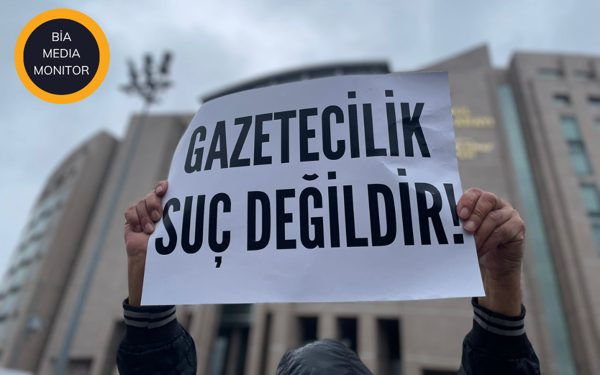



Turkey is currently experiencing a period in which media freedom is not only targeted by political operations aimed at well-known faces in journalism, but also, as in the case of Fatih Altaylı, journalists are being sentenced to heavy prison terms under prolonged arbitrary detention, thereby intimidating the public through the harassment of journalism.
The BİA Media Monitoring Report covering the period from October to December 2025 reveals that government authorities continued their interference with the judiciary, as seen in the cases of LeMan magazine, Fatih Altaylı, Merdan Yanardağ, and Enver Aysever. This pattern persisted with the arbitrary detention of respected figures such as Ruşen Çakır and Barış Terkoğlu. The report also shows that, despite a change in leadership, the Radio and Television Supreme Council (RTÜK) has continued imposing monetary fines aimed at weakening critical broadcasters.
Altaylı and Karabay released, now Yanardağ and Aysever in prison
TELE1 editor-in-chief Merdan Yanardağ, whose channel was placed under a trustee, has been awaiting an indictment since his arrest on Oct 26, 2025, on charges of “espionage.” Enver Aysever was also arrested on the grounds of “inciting hatred and hostility,” based on his criticism of right-wing politics. Journalist Can Taşkın, who reported on alleged extortion in Nevşehir, has been in pretrial detention since Sep 1.
During this period, when what is officially called “preventive and exceptional” detention has clearly become prolonged for journalists, Fatih Altaylı was released one month after being sentenced to 4 years and 2 months in prison on charges of “threatening the president.” Similarly, Furkan Karabay was released after 201 days in custody, coinciding with his sentencing to 4 years and 3 months in prison for “insulting the president,” “targeting someone involved in counterterrorism,” and “insulting a public official.”
While the European Union has been taking steps to positively regulate media pluralism, public broadcasting, social media platforms, and copyright through frameworks like the European Media Freedom Act (EMFA) and the Digital Services Act, Turkish authorities have shown no initiative to regulate the journalism sector—particularly in relation to artificial intelligence and social media platforms. Following political and legal pressure, Turkey is now also grappling with the media’s severe economic vulnerability. It ranks 159th among 180 countries in Reporters Without Borders’ (RSF) 2025 World Press Freedom Index.
Four journalists sentenced to a total of 9 years and 3 months in prison
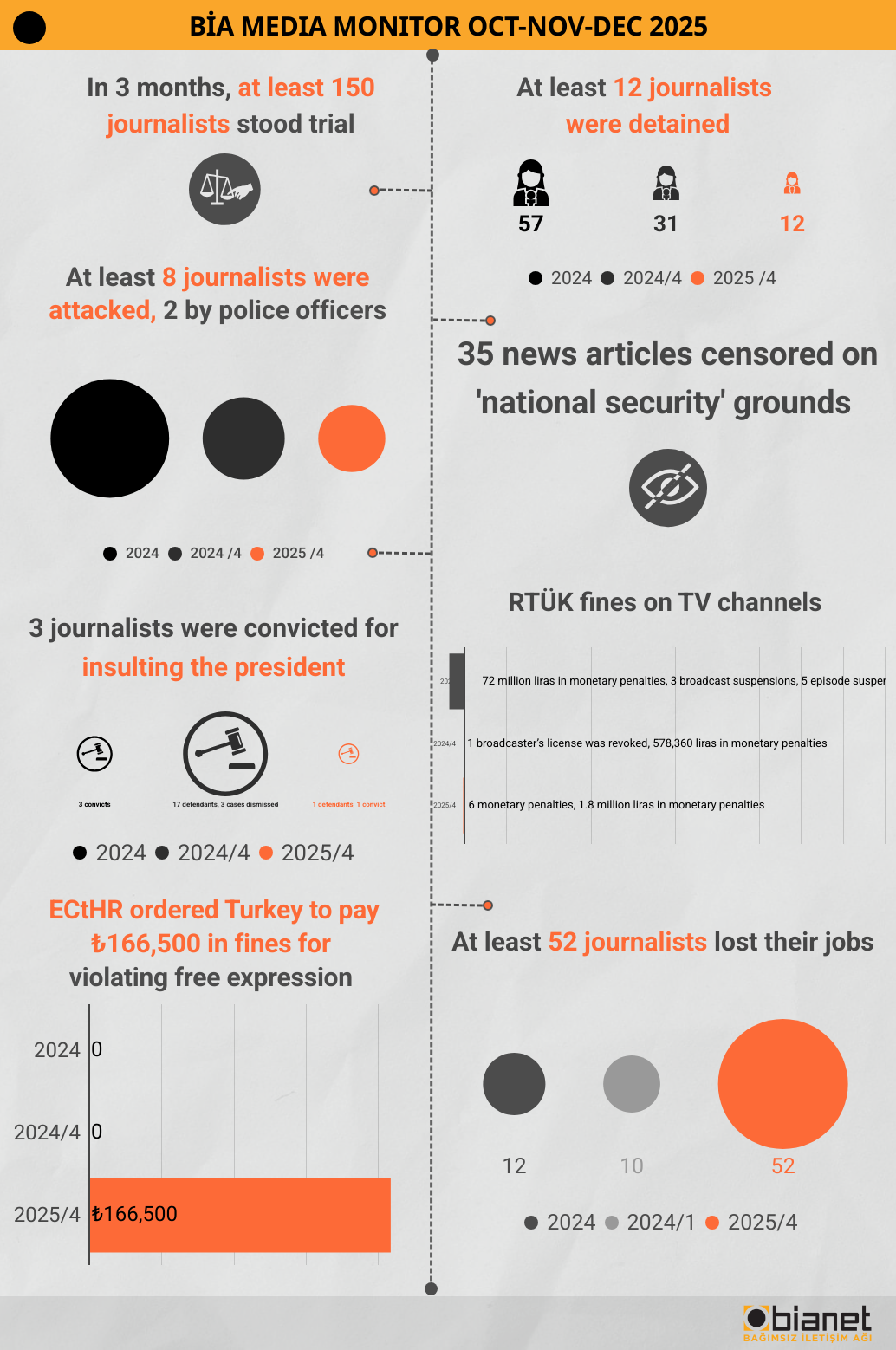
In the past three months, nine journalists were acquitted in cases where they were charged with “aiding a terrorist organization,” “publicly spreading misleading information,” “insulting a public official,” or “violating the Law on Demonstrations and Marches.” Meanwhile, four reporters—Fatih Altaylı, Furkan Karabay, Asuman Aranca, and Melisa Gülbaş—were sentenced to a total of 9 years and 3 months in prison (10 months of which are suspended) and judicial fines amounting to 49,580 liras. The charges included “threatening the president,” “insulting the president,” “targeting counterterrorism personnel,” “insulting a public official,” and “violating confidentiality.” In addition, convictions for “membership in a terrorist organization” were upheld for seven journalists.
'Insulting the president': 18 defendants, one new conviction
Arbitrary lawsuits against journalists for “insulting the president” continued over the last three months, with at least 18 journalists and cartoonists—including Deniz Yücel, Sedef Kabaş, Baransel Ağca, Erk Acarer, Julien Serignac, Gérard Biard, Laurent Sourisseau, “Alice,” Mehmet Tezkan, İbrahim Kahveci, Suat Toktaş, Ramazan Yurttapan, Haydar Ergül, Furkan Karabay, Zafer Arapkirli, Hakkı Boltan, Doğan Pehlevan, and Rüstem Batum—facing trials. Karabay was sentenced by a heavy penal court to 1 year and 9 months in prison for “insulting the president,” in addition to two other charges, based on a video he produced on YouTube and related social media posts.
Ultimately, Article 299 of the Turkish Penal Code has served as grounds for the prosecution of more than 250 journalists and the conviction—often with suspended sentences or fines—of at least 80 journalists during President Erdoğan’s tenure of over 11 years. Neither the 2016 recommendations of the Venice Commission nor the European Court of Human Rights’ (ECtHR) Oct 2021 ruling against Turkey in the “Vedat Şorli” case have prevented the ongoing judicial harassment of journalists.
Twelve journalists detained or forced to testify
In the last three months, at least 12 journalists were either detained or forcibly taken to give statements by police under accusations such as “insulting the president,” “publicly spreading misleading information,” “violating the confidentiality of communication,” “aiding a criminal organization,” or “praising a crime or criminal.”
As part of efforts to publicly discredit journalists, Soner Yalçın, Şaban Sevinç, Ruşen Çakır, and Yavuz Oğhan—who also serves as the communication coordinator for the Republican People's Party (CHP)—were subjected to “forced testimony” in connection with an investigation into jailed İstanbul Metropolitan Municipality (İBB) Mayor Ekrem İmamoğlu. Journalist Barış Terkoğlu was detained in an effort to force disclosure of a news source related to a police operation he had reported on.
Eight journalists assaulted, four threatened
Between October and December 2025, at least eight journalists were physically assaulted and four others faced threats. In Aydın, four journalists were attacked after arriving at the scene of a traffic accident. In Adıyaman, two reporters from the state-run Anadolu Agency were assaulted by a group of police officers while trying to report on a police officer’s suicide.
Several journalism professional organizations have called for a thorough investigation into the killing of environmental documentary filmmaker Hakan Tosun, who was beaten to death in a street attack in İstanbul in October. They demanded clarity on whether his profession was a motive behind the assault.
Constitutional Court ruling on 'solidarity'
The Constitutional Court ruled that the banning and seizure of books written by T24 columnists Hasan Cemal and Tuğçe Tatari constituted a violation of press and expression freedom. It also ordered the state to pay 166,500 liras in non-pecuniary damages to TELE1 editor-in-chief Merdan Yanardağ, who was detained for 100 days two years ago over his remarks about PKK leader Abdullah Öcalan. However, this ruling did not prevent his re-arrest on Oct 26, 2025, this time on charges of “espionage.” Meanwhile, the Constitutional Court unanimously rejected journalist Ragıp Duran’s application concerning his symbolic show of solidarity with the newspaper Özgür Gündem, for which he had been sentenced to prison.
In the past three months, the European Court of Human Rights (ECtHR) did not issue any rulings related to journalists’ rights.
Sanctions continue at RTÜK under Daniş
Since Mehmet Daniş was elected as the new president of the Radio and Television Supreme Council (RTÜK) at the end of October, he has not made statements that would cast doubt on the institution’s impartiality—unlike his predecessor Ebubekir Şahin. However, the dominance of “ruling party influence” within the council’s membership continues to preserve the penalty mechanisms targeting critical broadcasters.
At its first meeting under Daniş’s presidency, RTÜK fined Sözcü TV for airing comments by Republican People's Party (CHP) Deputy Chair Suat Özçağdaş, who said the political leadership had “lost legitimacy, is seeking legitimacy in America, and is selling off the country’s mines.” In the last three months, RTÜK maintained its opaque interventions into online broadcasts—such as giving BirGün TV’s YouTube channel 72 hours to obtain a license—and imposed a total of 1,848,907 liras in fines on television networks.
'AKP defended by journalists, not its MPs'
One of the most discussed issues in journalism over the past three months was the rejection—by votes from the Justice and Development Party (AKP) and Nationalist Movement Party (MHP)—of a legislative proposal that would have allowed the court cases of imprisoned İstanbul Metropolitan Municipality (İBB) Mayor and CHP presidential candidate Ekrem İmamoğlu to be broadcast live on state-run TRT. The debate sparked criticism that “AKP is defended not by its MPs but by journalists close to the party.”
Censorship of 35 news articles under ‘national security’
In the last three months, criminal judgeships imposed access bans on at least 35 online news articles concerning detained İBB Mayor Ekrem İmamoğlu, Cengiz Holding, and Can Holding. These bans were justified under Article 8/A of the Internet Law, citing “national security” and “public order,” or under the Civil Code. During this period, articles about fake invoice allegations at the Yunus Emre Foundation and about people summoned to testify in the İBB-Can Holding operation were also blocked from access.
33 years of impunity in Mumcu murder case, 19 in Dink’s murder
In the trial of Oğuz Demir, who is accused of planting the bomb that killed journalist Uğur Mumcu on Jan 24, 1993, and is reportedly wanted through Interpol, former Interior Minister Mehmet Ağar testified as a witness after 32 years. On Sep 22, 2025, Ağar stated, “Uğur and I had a certain rapport,” to which Mumcu’s daughter Özge Mumcu responded, “No, that’s not true.” Now, the General Directorate of Security, Gendarmerie General Command, National Intelligence Organization (MİT), and Foreign Ministry are expected to coordinate efforts to locate the suspect and his family, who are believed to be in Australia. The trial was postponed to Feb 9, 2026.
Since the 2007 assassination of journalist and peace advocate Hrant Dink, only the Pelitli Group from Trabzon and certain security officers accused of negligence or of creating a permissive environment “on behalf of FETÖ” have been prosecuted. However, officials from the General Staff who threatened Dink with a public notice on Feb 22, 2004, MİT officers who threatened him during a Feb 24, 2004 meeting at the İstanbul Governor’s Office, and political and administrative authorities of the time who failed to protect him or downplayed the murder, have not faced legal action. Applications regarding these protected, untried, or acquitted public officials are still pending before the ECtHR and Constitutional Court.
In the trial over the armed attack against the İzmir office of the newspaper Evrensel on the night of Aug 13, 2025, the detention of defendant İsa Can Biler was lifted after 106 days, even though the full circumstances of the attack remain unclear. Another release occurred in the case involving three defendants who assaulted Sözcü reporter Evren Demirdaş in Elazığ in October.
52 media workers unemployed, trustee appointed to TELE1
In the past three months, transformations and conflicts within media outlets, including interventions via trustee appointments, led to the dismissal of at least 52 journalists, presenters, hosts, and editorial staff. Following the arrest of editor-in-chief Merdan Yanardağ on “espionage” charges and the appointment of a trustee to TELE1, many journalists and media employees were forced to resign.
BIA Media Monitoring Reports
(EÖ/HA)