
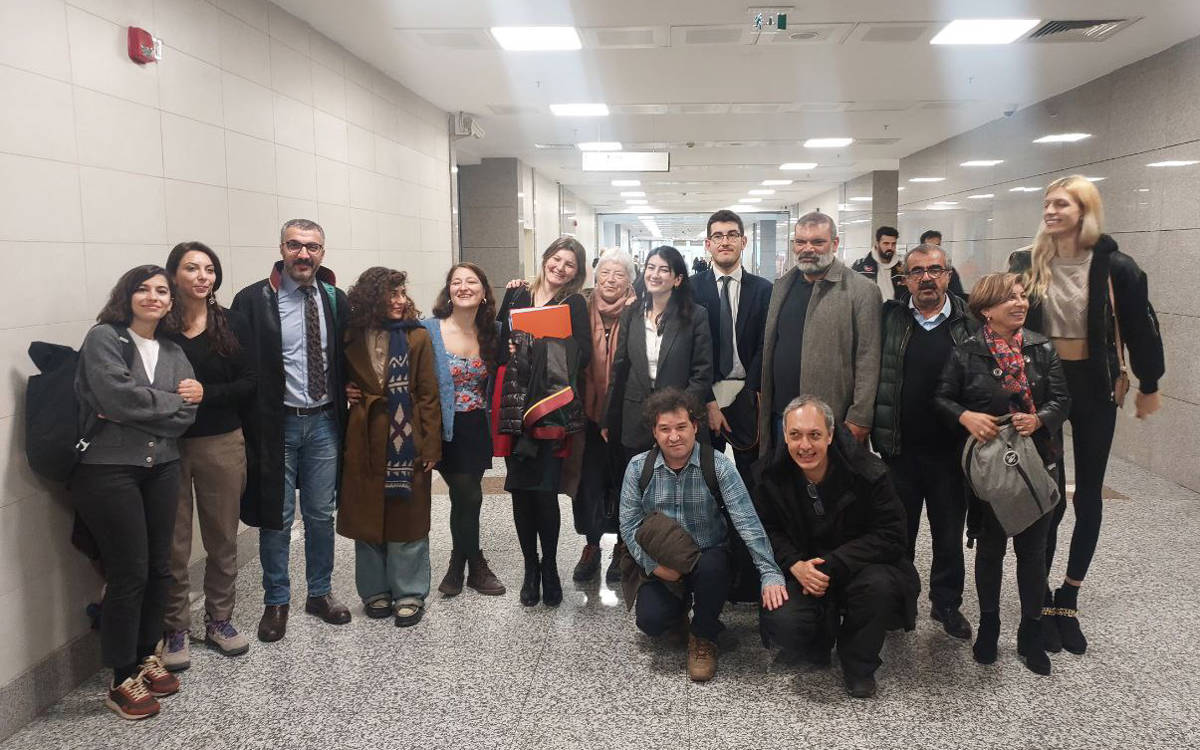



Seven people stood before a judge today in a "terrorism" trial over copyrighted work they published in the pro-Kurdish newspaper Yeni Özgür Politika and the magazine PolitikArt over the last decade.
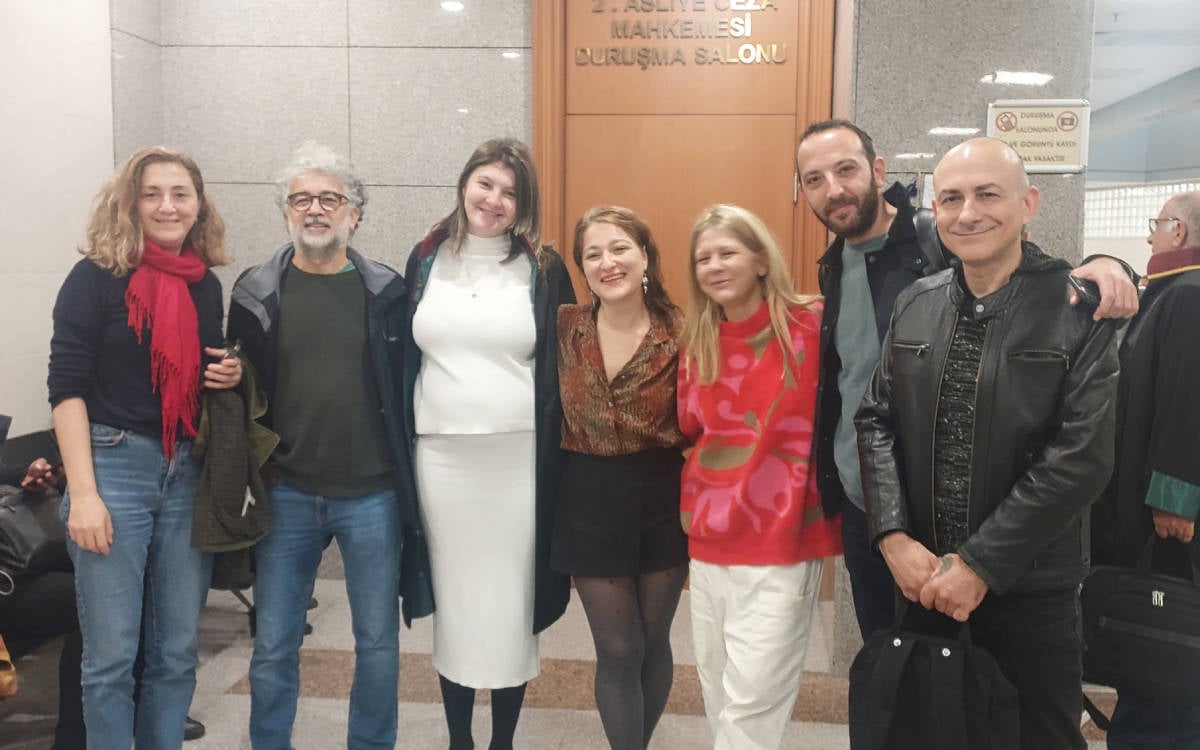
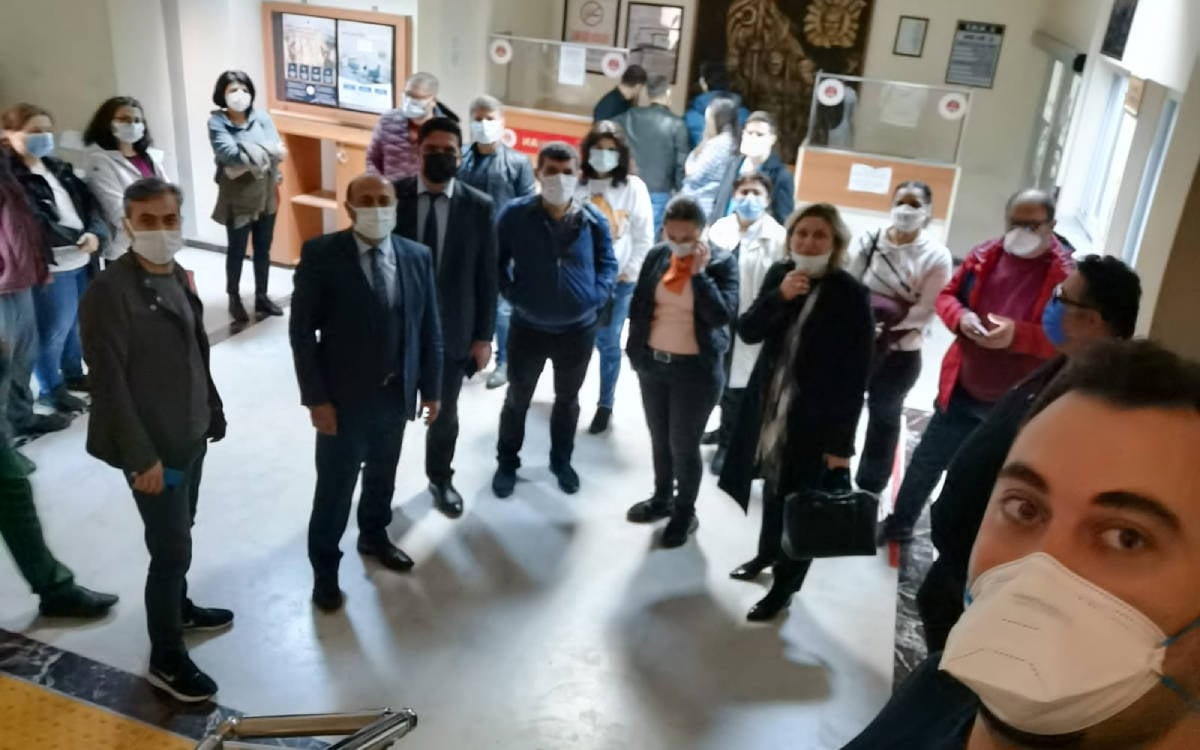
bianet editor Tuğçe Yılmaz, journalists Erdoğan Alayumat, Suzan Demir, Taylan Abatan, and Gülcan Dereli, translator Serap Güneş, and sociologist Berfin Atlı attended the hearing at the İstanbul 13th Heavy Penal Court with their lawyers. A large crowd of observers also followed the session.
The hearing began with the identification of the defendants. During this process, the panel of judges left the courtroom, returning after the court clerk completed the identification procedure.
Berfin Atlı was the first to speak against the indictment, which accused the defendants of "making propaganda for a terrorist organization" and "financially aiding a terrorist organization." Stating, “I am here because I wrote articles and received royalties,” Atlı said she also writes for other outlets. “These are newspapers that do not have access restrictions and are announced with an open call. I am a sociologist. The work I do does not have a strict definition. It includes writing. The source of the accusation is a royalty payment for two articles. The amount was not even enough to cover one person’s rent.”
bianet reporter Tuğçe Yılmaz questioned over interview with philosopher Michael Hardt in ‘terror’ probe
‘I am being criminalized for doing journalism’
Erdoğan Alayumat then presented his defense against the indictment. He stated, “I am here today not as the perpetrator of a crime, but as a person who is being criminalized for doing journalism for years.”
Alayumat stated that the indictment is primarily based on the prosecution's interpretation of money sent by a Germany-based media company in the name of the two outlets as “activities within the scope of a terrorist organization.” He added, “Presenting the income I earned from journalism as a criminal activity is not only an approach detached from reality but also reveals a dangerous understanding that turns a journalist’s labor into a crime. All my communication is via email, all payments are within the banking system, and I sent my news with my open identity, as I have for years.”
Alayumat asserted that the indictment contradicts itself, saying, “The indictment states that there is ‘insufficient evidence to establish an organic link with the armed terrorist organization.’ If there is no organic link, there is no criminal intent. If there is no criminal intent, the material element of the crime does not exist at all. Despite this, journalistic activity is being shown as a crime through mind-reading.”
Alayumat denied the charges against him and requested his acquittal.
Journalist Erdoğan Alayumat strip-searched in police custody
'I am a journalist and I receive royalties'
Gülcan Dereli took the floor after Alayumat, stating, “I am a journalist, and I receive royalty fees for the articles I write. I do not think this is a crime. After all, journalism is a professional practice, not volunteering. You need to send in your news so you can receive a salary or royalty in return and continue your life.”
Dereli explained that she has sent articles to many news organizations, not just Yeni Özgür Politika and PolitikArt.
Regarding the social media posts included in the indictment and cited as grounds for the accusation, Dereli said, “These are tweets about the news I produced. What is criminal about sharing the news I made?”
Prosecutor says freelance payments cannot be grounds for 'terrorism' charges
Taylan Abatan similarly stated that he was being prosecuted for doing journalism. He said, “I wrote news articles. I am being prosecuted because of the royalty fees I received in exchange. I must receive these fees to sustain my life. I do not accept the accusations. I demand my acquittal.”
Serap Güneş began her statement by saying she has been working as a translator for 20 years. Güneş said, “I earn my living by translating,” adding, “I started translating articles instead of books while doing my doctorate. For royalties, of course. I do not accept the charges brought against me.”
Suzan Demir mentioned that she has been working as a journalist since 2008. She said she has written news and articles on various topics for different organizations. “I sent two articles containing film reviews to Yeni Özgür Politika. It is a publicly accessible publication. I do not think this is a crime.”
'I never had money to help an organization in my life'
Finally, bianet editor Tuğçe Yılmaz took the floor. Yılmaz began her statement by addressing the judge, saying, “You were not here during the identity check, but the journalists here are people trying to get by on 35-40 thousand liras. It is obvious that we cannot make a living with these fees.”
She reminded the court that Berfin Atlı was subjected to a strip search while in custody and was denied her medication during her detention. She then said the following:
“I am here today as a journalist accused of ‘aiding an organization’ solely because of the royalty fees I received for the culture and arts articles I wrote. I have been working as a journalist for four years at the bianet news website, known for its tradition of peace journalism. I have been in the profession for over 10 years.”
“I was detained for four days just for doing journalism. I was taken to Eskişehir in handcuffs for eight hours, and due to a confidentiality order on the file, I could not learn why I was detained for days. It may be insignificant to you, but for me, being separated from my dog, whom I love more than my life, without my consent for days was a punishment in itself.”
“For over a year, I have had to go to the police station every week to sign in. Because of this, let alone traveling abroad, I cannot even go out of the city whenever I want, and I cannot exercise my right to follow news on the field, which is the most fundamental requirement of my profession. Throughout this process, my rights were clearly violated, and I was subjected to intense psychological violence. The Human Rights Foundation of Turkey is the closest witness to this.”
BIA Media Monitoring Reports
“I am a member of no organization other than the Journalists’ Union of Turkey, and I have not ‘aided’ any organization. Logically, for me to help an organization, I would have to give money to the organization. But in my 34 years of life, I have never had the money to help someone else or an organization. On the contrary, I am still trying to sustain my life with high-interest loans and support from my mother at the end of the month.”
“In a period when peace discussions are back on the agenda in the country, and the state, including the President and Devlet Bahçeli, is talking about the possibility of a different language, I am being accused of ‘aiding’ and ‘being a member’ of an organization that dissolved itself and laid down arms. Isn't this a clear irony?”
“Moreover, this entire accusation is leveled only on the basis of the film and book reviews I wrote—in other words, entirely culture and arts journalism. I just did my job. And as a young journalist living in İstanbul, I naturally received royalty fees in return for my labor. The indictment contains almost nothing about me, apart from the MASAK (Financial Crimes Investigation Board) report, which is clearly biased.”
“Our colleagues detained on the same charges were granted a decision of non-prosecution in different cities. For this reason, I must ask: Is our crime living in İstanbul? Is the law not the same across the entire country?”
“What occupies you and us here today is the very profession of journalism. This case tells us this: The view of the outlet where you report or write is your view, and accordingly, you can only work at the Anadolu Agency. This case also tells me: ‘Stay away from Kurdish journalists.’”
“However, silencing journalists at a time when society's will to live together and a language that respects mutual dignity is strengthening contributes neither to democracy nor to peace,” Yılmaz concluded.
“I absolutely reject all the charges leveled against me. I request the lifting of my judicial control measures and my acquittal.”
Following the defendants’ statements, witness Büşra Özer was heard. The presiding judge asked Özer about Gülcan Dereli. Dereli replied, “She was a friend of my ex-boyfriend’s friends.” She limited her statement to saying, “I only know that she wrote for Yeni Özgür Politika. I don’t know the content.”
'Does a terrorist organization pay through Ziraat Bank?'
Subsequently, the defense lawyers made their statements. Arguing that the trial was not lawful, the lawyers presented examples from the judgments of the European Court of Human Rights (ECtHR) and the Constitutional Court (AYM).
They stated that Germany recognizes the PKK as a terrorist organization and that it is illegal in Germany. However, they explained that Yeni Özgür Politika is not considered the publishing organ of the PKK and has the status of a legal foundation with a tax registration in Germany.
Attorney Batıkan Erkoç asked, “If it is claimed that propaganda for an organization was made by reporting for the journalists here, these news items are not shown in the indictment. Where is the crime, then?” Erkoç said, “One of the most fundamental characteristics of a terrorist organization is secrecy. Does a terrorist organization pay through Ziraat Bank? Then Ziraat Bank also took commission from these payments; let's include the bank in this case, too.”
Travel ban not lifted
After the statements, the court panel announced its interim decision, ruling to lift the judicial control measures, which included the signing requirement. However, the journalists’ travel bans abroad will remain in effect.
The court also ruled to send the file to the prosecutor's office for the preparation of the opinion on the merits. The next hearing is scheduled for Feb 17.
Background
As part of an investigation initiated by the Eskişehir Chief Public Prosecutor's Office, police raided the homes of writers, poets, cartoonists, and mostly journalists in İstanbul, Diyarbakır, Ankara, and Batman on Nov 26, initially detaining eight people.
Those detained included bianet reporter Tuğçe Yılmaz, Roza Metina, Erdoğan Alayumat, Hamza Kaan (Bilge Aksu), Ahmet Sümbül, Bilal Seçkin, Mehmet Ücar, Havin Derya, and Suzan Demir.
Other names among the detainees were director Ardin Diren, poet Hicri İzgören, writer/translator Ömer Barasi, cartoonist Doğan Güzel, photography artist Emrah Kelekçier, publishing house coordinator Baver Yoldaş, dismissed academic Abdurrahman Aydın, LGBTI+ activist Berfin Atlı, and Serap Güneş.
Mehmet Uçar and Hamza Kaan (Bilge Aksu), who were among the detainees, were arrested. The others were released with judicial control measures after four days in custody.
The indictment prepared for the two arrested individuals was accepted by the Eskişehir 2nd Heavy Penal Court but later issued a decision of lack of jurisdiction. The journalists’ files were separated and sent to the courts in the cities where they were detained. In the indictment, the news produced by the journalists, their social media posts, and the "royalty" fees they received from the institutions they worked for were made the subject of the accusation. The two individuals were released at the first hearings held on Jul 3 and Jul 8.
Furthermore, the Ankara Chief Public Prosecutor's Office also decided to "not prosecute" journalist Bilal Seçkin.
(HA/VK)