









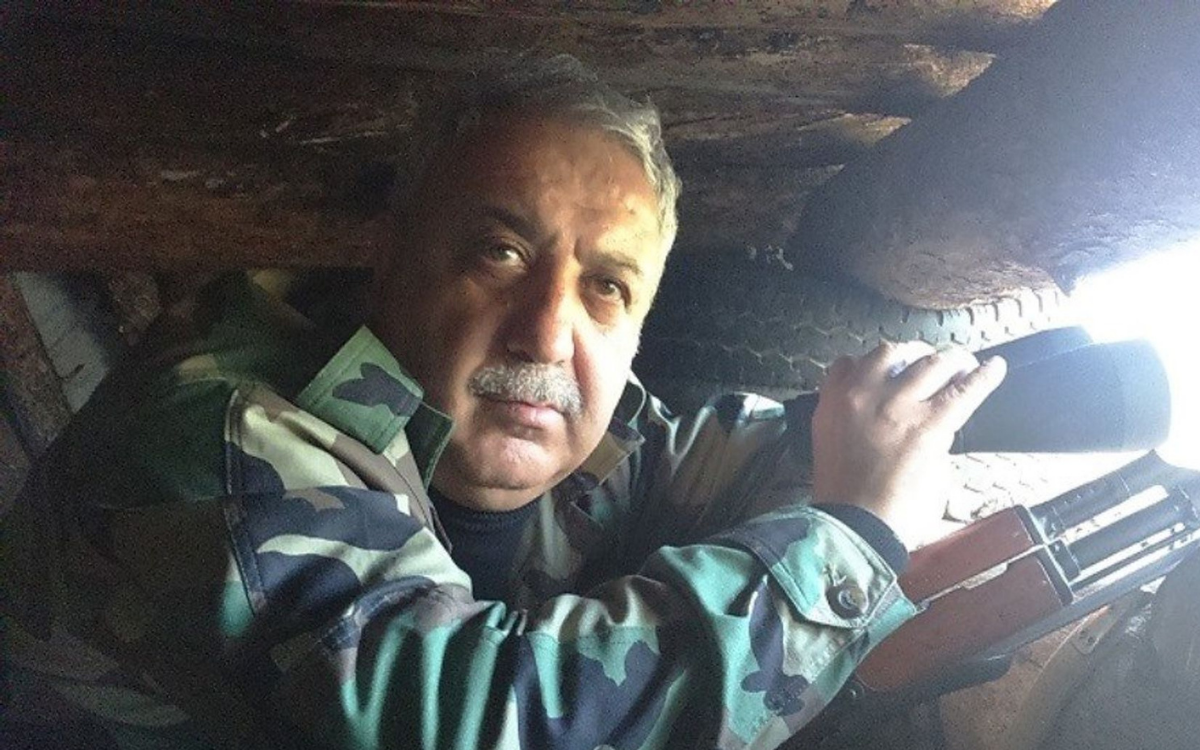



Syria's General Intelligence Service has captured Mihraç Ural, a longtime pro-Assad militia leader known in Syria as Ali Kiyali, as he allegedly attempted to flee across the border, the country's official news agency SANA reported.
The agency said the operation was carried out in collaboration with Turkey's National Intelligence Agency (MİT). Turkish authorities have not yet commented on this statement.
Lebanese media outlets reported a different account of Ural's capture, raising questions about where and how he was taken into custody.
Lebanon-based MTV television claimed that unidentified individuals abducted Ural from his home in Mansourieh, in the Matn district northeast of Beirut, before transporting him to Syria.
According to MTV, the assailants tied up Ural's wife and son during the raid. The network also reported that the Intelligence Branch of Lebanon's Internal Security Forces had launched an investigation.
The London-based Syrian Observatory for Human Rights (SOHR), citing its sources, reported that Ural was seized during a raid on his Mansourieh home after returning from Al-Rassoul Al-Aazam Hospital in Beirut.
The observatory said the individuals who carried out the operation spoke Arabic with Lebanese accents, but their identities had not been established.
Turkish ambassador's response
Turkey's ambassador to Damascus, Nuh Yılmaz, reacted to reports of Ural's capture with joy, posting a religiously charged message:
"Alhamduillah! May our anguish and wrath fall upon the enemy! I seek refuge in God, I seek refuge in God. O God, endless thanks!"
Who is Mihraç Ural?
Born in Antakya in 1956, Mihraç Ural was among the leaders of THKP-C/Acilciler, a Marxist militant organization active in Turkey during the 1970s.
According to an indictment cited in the Ankara 9th Heavy Penal Court's Jun 5, reasoned judgment in the Reyhanlı bombing case, Ural assumed leadership of the organization after members of its senior leadership were killed in a clash with police in Malatya in 1976.
The judgment states that Ural escaped from prison with Engin Erkiner in 1979 and subsequently moved the organization's operations to Syria.
Ural lived in Syria for decades, where his activities, particularly in and around Latakia, and his alleged links to Syrian intelligence became the subject of investigations and court proceedings in Turkey.
The reasoned judgment in the Reyhanlı case states that THKP-C/Acilciler established an armed group called Mukaveme Suriyye (Syrian Resistance) with the support of the Syrian government.
The group reportedly fought alongside forces loyal to Bashar al-Assad during the Syrian conflict.
Alleged responsibility for Banyas massacre
Syrian authorities have identified Mihraç Ural as one of those responsible for the 2013 massacres in Banyas.
Numerous civilians were killed in attacks carried out by forces loyal to the Assad government on May 2-3, 2013, in the village of al-Bayda and the Ras al-Nabe neighborhood of Banyas, both in Syria's Tartus province.
According to a report published by Human Rights Watch (HRW) in September 2013, government forces and allied armed groups executed at least 248 people in the two locations.
The United Nations Independent International Commission of Inquiry on Syria also presented findings in its 2013 report indicating that government forces and allied armed groups were responsible for the massacres.
Neither the HRW report nor the UN commission's findings established Ural's individual responsibility for the attacks. However, the Syrian Network for Human Rights (SNHR) named Ural among those responsible for the Banyas massacre in a report published in May 2013. Ural has denied allegations that he participated in the massacre.
In its report on Ural's capture, the Syrian Observatory for Human Rights (SOHR) called for him to face a public and fair trial before an independent, competent court over the allegations. The observatory also urged that the trial be held in Banyas, where the massacres took place, if legally feasible.
Allegations against Ural in the Reyhanlı bombing
Ural is among the defendants wanted in connection with the May 11, 2013, bombings in Reyhanlı, a district of Turkey's southern Hatay province.
Two car bombs exploded in Reyhanlı, killing 52 people, including five children, and injuring 155 others.
The indictment alleges that Ural played a role in planning and organizing the attack through individuals linked to Syrian intelligence.
On Jun 5, the Ankara 9th Heavy Penal Court sentenced Memet Gezer, Temir Dükancı and Cengiz Sertel to 53 aggravated life sentences each for their roles in the bombing.
The court also imposed additional prison terms totaling 3,921 years on each defendant.
The proceedings against Ural and another defendant, Omar Alkhatıp, were separated from the main case because the outstanding arrest warrants against them had not been executed.
The court ordered that their cases continue separately and that the arrest warrants remain in force. (VC/VK)

