







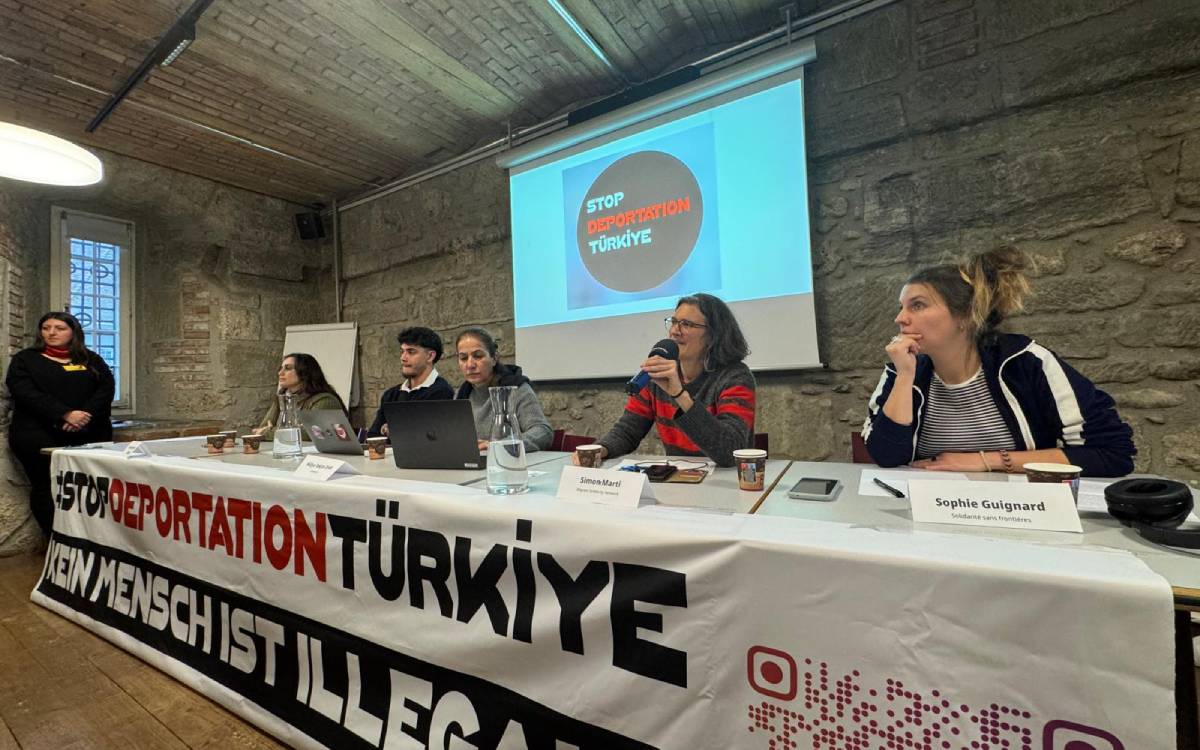



Democratic organizations, associations, and collectives gathered in Bern, Switzerland, to announce the formation of Stop Deportation Türkiye, a platform opposing the forced return of political refugees from Turkey.
The platform’s founding declaration was read at the meeting, which was attended by journalists, representatives of various organizations, and solidarity groups. Representatives also took the floor to share their assessments of deportation policies.
The founding declaration stated that Switzerland’s immigration and asylum policies were becoming increasingly restrictive, the right to asylum was being undermined, and forced returns had become systematic. It noted that legal assessments of asylum applications, particularly those submitted by political refugees from Turkey, were increasingly intertwined with political considerations. The declaration criticized the criminalization of refugees, the emphasis on security concerns, and the failure to adequately consider the risks refugees could face upon returning to Turkey.
The declaration said deporting people who face the risk of politically motivated persecution, detention, imprisonment, and ill-treatment in Turkey raised serious concerns regarding the right to asylum and the principle of non-refoulement.
'Deportations are measures with political consequences'
Stressing that decisions by Swiss authorities could not be regarded as merely administrative measures, the declaration noted that they directly affected people’s lives, freedom, safety, and family unity.
The declaration also highlighted a report published on Oct 14, 2026, by the Swiss Refugee Council (OSAR), Democratic Lawyers of Switzerland (JDS), and the Swiss Observatory for Asylum and Foreign Nationals Law (ODAE-Suisse). The report documented the experiences of nine people deported to Turkey, including cases in which individuals were detained, imprisoned, or subjected to criminal proceedings upon their return. The declaration called for Swiss asylum decisions to take greater account of prosecution practices in Turkey and the risks individuals could face upon returning.
The cases of Bahar Yalçınkaya and the Gürçay and Özgün families
The declaration also addressed recent deportation cases. It noted that Bahar Yalçınkaya had been deported from Switzerland to Turkey with her two children. Despite Swiss authorities having been informed in advance of the risk of imprisonment in Turkey, Yalçınkaya was detained upon arrival and subsequently placed in pretrial detention. She was sent to prison with her 15-month-old baby.
Recounting the Gürçay family’s experience, the declaration said numerous police officers entered the family’s home in the early hours of the morning, waking the terrified children and separating them from their parents. It also highlighted the family’s account of police using excessive force at the airport.
The declaration noted that the Özgün family, who have five children, also faced deportation to Turkey. The children have attended school in Switzerland for years, developed social ties, and built their lives there. It stressed that decisions concerning the family’s future should be guided by the best interests of the children and the protection of family life.
Guignard: The right to asylum is not just a refugee issue
Speaking at the meeting, Sophie Guignard of Solidarity Without Borders (Solidarité Sans Frontières) said Switzerland’s failure to protect political dissidents from Turkey went beyond violations of individual rights and had serious implications for democracy.
Emphasizing the importance of collective action against attacks on the right to asylum, Guignard said the Swiss state was making two fundamental mistakes by refusing to protect people fleeing torture. The first was violating the legal principles established to protect people fleeing persecution, while the second pointed to a much broader democratic problem.
“Refusing to protect people fleeing Turkey is not simply another sign that the right to asylum is being undermined. It is also a clear sign of a broader collapse of democracy that will inevitably follow if we continue to regard the right to asylum as an issue that concerns only refugees,” she said.
Guignard noted that even a simple social media post could trigger a criminal investigation in Turkey. Being Kurdish, expressing support for LGBTI+ people, or being queer could put individuals at risk. She pointed out that even participating in lawful demonstrations in Switzerland could put people in danger upon their return to Turkey.
“By refusing to acknowledge these realities, Swiss authorities are, in a sense, legitimizing a brutal regime. They are failing to oppose the establishment of a police state with the necessary resolve,” she said.
Guignard said European countries were turning a blind eye to the practices of authoritarian governments with which they had signed migration agreements, citing the European Union’s relations with Libya and plans to deport people to Rwanda. She described such agreements as the product of opportunistic and irresponsible political calculations.
Recalling the adoption of the Convention Relating to the Status of Refugees after World War II, Guignard noted that it was intended not only to protect those who would face persecution in the future but also to declare, “Never again.”
Marti: Solidarity and resistance can stop deportations
Also speaking at the meeting, Simone Marti of the Migration Solidarity Network described the establishment of the platform as an important step toward collective action.
Marti said the struggle against forced returns should extend beyond deportations to Turkey and encompass the broader fight against racism and discrimination.
Recalling an earlier protest outside the State Secretariat for Migration (SEM), Marti said authorities had also attempted to deport the Özgün family a week after Bahar Yalçınkaya’s deportation. She described police entering refugee accommodation centers and children screaming in fear. The Özgün family had avoided deportation thanks to the solidarity of other refugees staying at the center at the time, she said.
Pointing to the incident as an example of the importance of solidarity, she said, “Solidarity and resistance can make a difference and delay deportations, even if only temporarily.”
Marti said those at risk of deportation were not limited to people with prominent political profiles. People who had attended demonstrations, shared posts on social media, or participated in political activities in Switzerland could also face imprisonment upon returning to Turkey.
She noted that even if these individuals were not immediately arrested upon returning to Turkey, they lived in constant fear of being detained at any moment.
“This means living in a state of constant fear and insecurity. Both they and their family members face this uncertainty,” she said.
Marti also criticized the SEM for disregarding arbitrary practices within Turkey’s criminal justice system and the experiences of Kurdish communities and communities from Turkey. “Disregard for human dignity has become a guiding principle of the Swiss asylum system, and this approach is now embedded in the system itself,” she said.
She noted that deportations were being normalized by presenting them as routine, mandatory administrative procedures.
She said they would work together to oppose forced returns to Turkey and all other forced deportations.
'We must move beyond our individual problems'
Berna B., who also spoke at the meeting and faces deportation from Switzerland, called for a focus on collective action rather than individual stories.
Noting that sharing personal experiences alone was not enough to bring about solutions for refugees, Berna B. said, “I think it would benefit us to move beyond our individual problems, come together, and act collectively. If we combine our individual efforts, we can be stronger in this just struggle.”
Five areas of action
Stop Deportation Türkiye will focus on five areas: establishing a rapid response and solidarity network, monitoring legal proceedings and submitting cases to the United Nations, providing direct support to refugees facing deportation, strengthening international solidarity with organizations in Turkey and Switzerland, and raising public awareness. Its activities will range from legal initiatives and press statements to protests and petition campaigns.
The founding members of Stop Deportation Türkiye include the ATİK Switzerland Committee, ADKM, BİR-KAR, FEDA, İDHF, İGİF, İHDD, İTİF, KUTÜSCH, Migration Solidarity Network, CDK-S Bern, NCDK-C, NCDK-L, PangeaKolektif, PDD, Leyla Kasım Initiative – Kanton Wallis, SYKP Switzerland, and YJK-S.
Organizations supporting the platform include Asylnetz (Luzerner Asylnetz), Bewegungsfreiheit für alle (Bfa!), Droit de Rester Fribourg, Droit de Rester Lausanne, Droit de Rester Neuchâtel, elisa-asile, Freiplatzaktion Zürich, Migrant Solidarity Network, SolAB, Solidarité sans frontières, and Vernetzung gegen Ausschaffungen (Zürich) CH/TR.
(MMY/HA/VK)


