
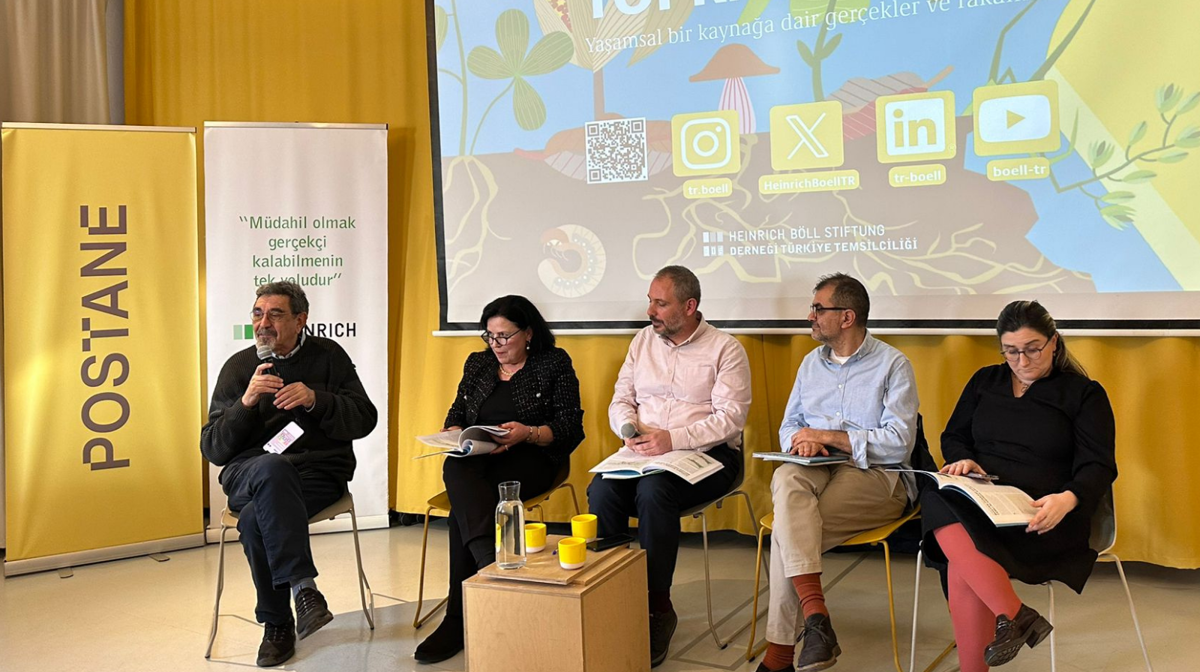



The Heinrich Böll Stiftung (HBS) Turkey Representation unveiled the 2025 edition of its Soil Atlas, titled “Facts and Figures About a Vital Resource,” at an event held on Jan 6 in İstanbul’s Postane venue. First published in 2015, the atlas has been updated a decade later with data specific to Turkey.
Moderated by Cem Bico, coordinator of HBS’s Ecology and Climate Change Program, the launch event featured a panel discussion addressing the physical, social, and economic dimensions of land degradation. Soil scientist Prof. Dr. Ayten Namlı and economist Dr. Ulaş Karakoç served as keynote speakers.
‘Once the top 15 centimeters are lost, productivity ends’
Prof. Dr. Ayten Namlı emphasized that soil degradation is a global crisis, pointing to the critical role of topsoil in maintaining productivity. “The loss of the topsoil layer, meaning the first 15 centimeters, results in a significant decline in the biological productivity of the soil,” she said.
Namlı argued that carbon should be central to soil management strategies, noting that carbon management plays a key role in preserving biodiversity and combating the climate crisis.
She identified water and wind erosion as the primary drivers of soil loss in Turkey. Salinization has reached critical levels in plains such as Iğdır and Harran, she added, yet Turkey still lacks an up-to-date salinity map. In contrast to Europe, where heavy metal maps are publicly available, Namlı noted that a similar Turkish project completed three years ago has yet to release its findings.
‘Farmers are already disconnected from the land’
Dr. Ulaş Karakoç explored the social aspects of agriculture, focusing on demographic shifts and the aging rural population. “The question isn’t whether farmers are becoming disconnected from the land—the reality is, most already are,” Karakoç said. “The real issue is whether they are becoming disconnected from life itself.”
He cautioned that the slowdown in rural-to-urban migration since 2010 should not be interpreted as a revival of agriculture. For many farmers, agricultural income has become a secondary concern. Highlighting the gendered impact, Karakoç noted that while rural women are counted in the labor force, once they move to urban areas, they often remain in the domestic sphere and are registered as unemployed.
İstanbul under concrete: 180 square kilometers lost
One of the most alarming data points shared during the panel concerned the increase in impervious surfaces across İstanbul. According to the Soil Atlas:
In the past 15 years, 180 square kilometers of land in İstanbul—roughly the size of 36,000 football fields—have been covered by asphalt, concrete, or metal, becoming impermeable.
The share of impervious surfaces rose by 38% during this period.
The largest increases occurred in the Northern Forests region, along the route of the third bridge, and near the new airport.
Tracking the spread of concrete
Prof. Dr. Murat Güvenç illustrated the change in impervious surfaces between 2006 and 2021, stating: “That’s equivalent to 36,000 football fields. It includes bridges, highways, and shopping malls. Although malls may seem like single structures, the parking lots they require can be ten times their footprint.”
He added that deforested areas around the third airport have created urban heat islands. “In some spots, temperatures have reached 50.5°C, while on the same day, nearby areas recorded just 19°C.”
‘Don’t let vegetable garden names exist only on street signs’
Burçak Gürsoy addressed the mounting pressure on İstanbul’s remaining farmland. “Despite all the pressures—from profiteering to construction—urban agriculture is somehow holding on. A form of agriculture continues in the shadow of concrete,” she said.
The atlas highlights how crops like Beykoz beans and eggplants, Çengelköy cucumbers, and Yedikule lettuce were integral to İstanbul’s identity 150 years ago. By the late 19th century, as modern urban governance emerged and the population expanded, the idea of relocating urban gardens to the outskirts began to gain traction.
It also suggests that local food systems—such as producer and organic markets, food and farming cooperatives, e-commerce platforms, and solidarity networks—could help address urban challenges related to food and land access.
‘Who will produce food in 20 years?’
In the panel’s closing segment, the discussion turned to resilience and alternative solutions in the face of overlapping crises. Framing the debate, Cem Bico asked, “Who will produce food over the next 20 years?”
Panelists considered how to pass on agroecology and regenerative agriculture practices to small-scale producers, and emphasized the need for science-based and rights-centered approaches to environmental issues.
Key figures from the Soil Atlas
The ideal organic matter content in soil should be around 3%, but in Turkey, it is below 1%.
One-third of the world’s soils are degraded.
The global economic cost of soil degradation is at least 230 billion US dollars annually.
Turkey loses approximately 642 million tons of soil each year, with 59% of its land at risk of erosion.
About 150 million tons of this lost soil end up in dams annually.
An estimated 25.5% of Turkey’s land faces high desertification risk.
Turkey ranks first in Europe for soil loss due to construction.
Soil compaction affects around 7.1 million hectares of Turkish land.
About 32.5% of irrigated agricultural land in Turkey suffers from salinity, and roughly 900,000 hectares of farmland are acidic.
Each year, Turkey uses around 2.3 million tons of fertilizer and 55,000 tons of pesticides, with many pesticides exceeding the maximum residue limits set in EU countries.
Soils store more carbon than forests, yet cultivated soils have lost between 50% and 70% of their carbon stocks. Agriculture in Turkey emits around 26 million tons of carbon annually.
Over 70% of global farmland is controlled by just 1% of farms.
Between 2012 and 2023, at least 2,100 people were killed due to land disputes.
Click to see all graphics and texts from the Soil Atlas are available [Turkish].