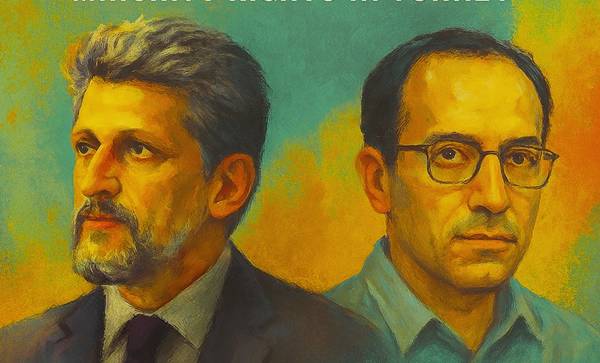




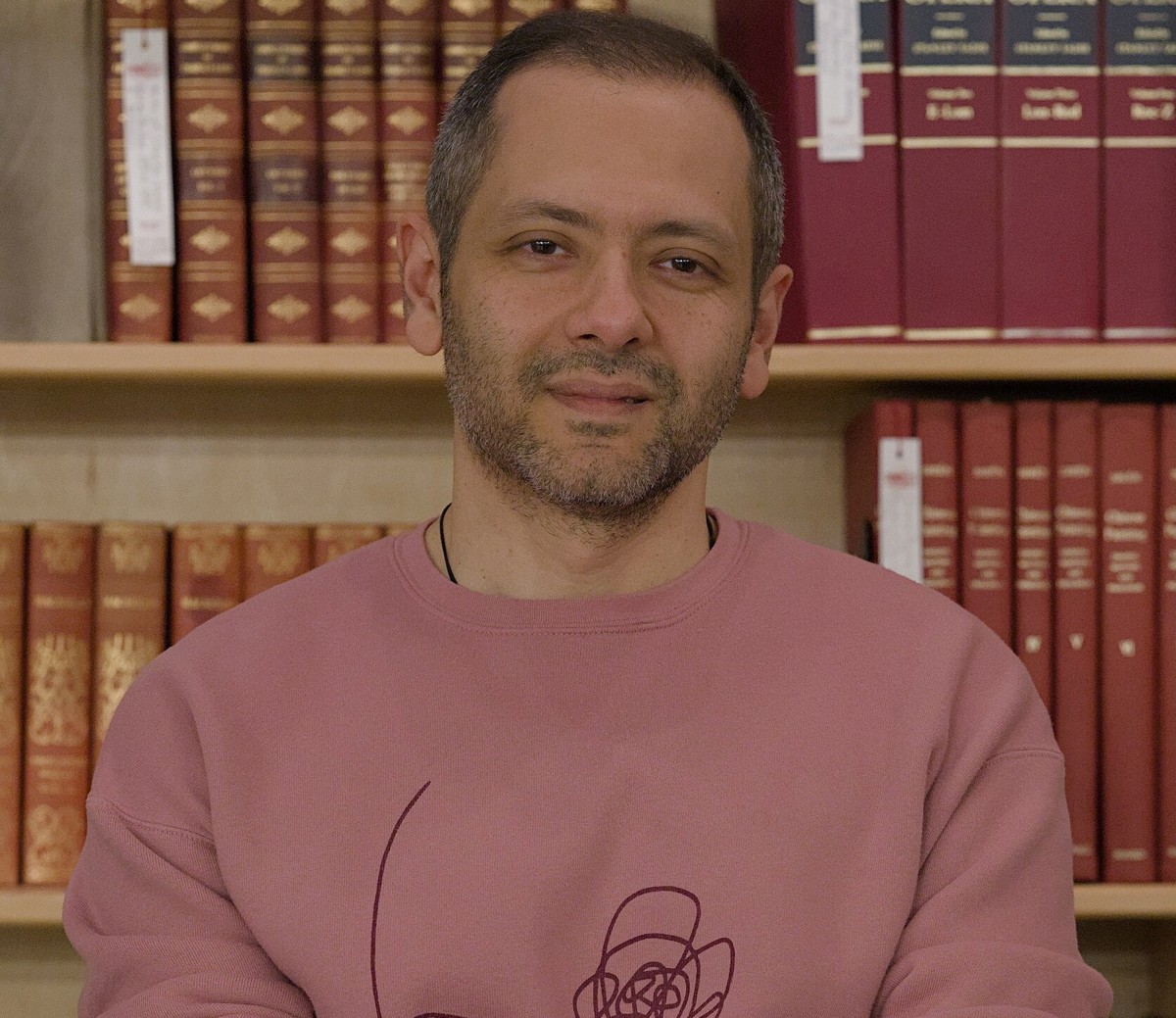
I met Omar El Akkad a few years ago at a friend’s house and I was deeply impressed by his humble demeanor and generous spirit. He and I spoke about his most recent non-fiction book, One Day, Everyone Will Have Always Been Against This that grew out of a tweet he posted on October 25, 2023, after several weeks of the Israel’s assault on the Palestinian territory, Gaza:
“One day, when it’s safe, when there’s no personal downside to calling a thing what it is, when it’s too late to hold anyone accountable, everyone will have always been against this.”
El Akkad worked as a journalist for The Globe and Mail in Canada for nearly a decade, reporting on NATO’s war in Afghanistan, Guantanamo Bay, the Arab Spring, and Black Lives Matter. His novels American War (2017) and What Strange Paradise (2021) won several Canadian literary awards including the Giller Prize for fiction.
Before I saw the title of your book, I remember saying the same to myself; that one day people will mourn the Gaza tragedy as we now study the Holocaust, Bosnia, and Rwanda. As a teacher, I feel frustrated with history repeating itself. The young people learn and have a critical eye, but they grow up, get into power and can turn an eye. How can educators teach history and current events, such as war, displacement, and genocide, in ways that help students think critically, connect emotionally, and distinguish just from unjust, while grounding their understanding in facts and avoiding emotional overwhelm.
It's a really good question. I will say as a caveat that, you know, I have a PhD in absolutely nothing. So please take everything I tell you with a grain of salt. I'm certainly not a full-time educator and I'm in awe of people who are. It's incredibly difficult work even at the best of times. I think one of the reasons this is a difficult question to answer is because I must separate in my head between the individual and the institutional. I spend a lot of time talking students, high school students, college students, and overwhelmingly they don't find a single thing in this book I've written to be remotely revolutionary or profound. They were so much further ahead of me as they should be. And whenever I talk to them, I try to make the distinction that the only reason I'm the one dispensing advice or I'm the only one standing at the lectern is not because I'm more intelligent than they are, I'm certainly not. It's not because I have some kind of profound moral worldview that they don't have, that's certainly not the case. It's purely experiential. I've been on the earth twice as long as they have. And so the reason I bring that up is because I think young folks from a very young age have a sense of moral correctness that that is as well established as any grown-up in fact more well established because they haven't been subjected to the rewards of punishment and rewards and punishments of the systems in the same way we have. So, I'm never worried about overwhelming them. In fact, I'm worried about the opposite. I'm worried about oversimplifying or trying to dumb things down for a group for an audience, pound for pound, that is far more engaged and far more astute than most of the grown-up audiences that I talked to.
The way I try to frame it is twofold. First, I try to describe the power of narrative. The narrative tools of colonialism are always the same and have always been the same. It's always the same stories over and over again, including ironically the story that this time it's different. This time there's some special thing that makes it different from all the other times. Every instance of colonialism has used that same argument. This incredible coincidence that every single population in history from which a colonizer has wanted something just happened to be barbaric and savage, right? That incredible coincidence, that narrative is always the same. So, I try to explain that the narratives they're going to see are always going to be the same and that they should treat them the same way. And the second thing I try to talk about is the reward/punishment equilibrium. Every generation up until mine, if you kept your head down, if you didn't make trouble, if you did what was expected of you, not only would you avoid punishment, but you would be rewarded. You'd be rewarded with the house in the suburbs and the two-car garage and all that good stuff. For the generations that have come after me, not only is the punishment side of the equilibrium just as stringent, but the reward side is also falling apart. You will never be able to afford a house. Also, the planet you live on might become uninhabitable. I try to frame it that way because I know, and I try to tell them, that as they get older, the same systems responsible for these injustices will try to reward them for looking away from the injustices. And they should know not only is the reward fraudulent, but it’s also disappearing. And so, you may as well speak your conscience. That's sort of the way I've been thinking about it.
As someone who works with children every day, I loved what you said once, “There's no such thing as someone else's children”. Indeed, they are all our children. I don't believe there's one nation, country, or people that are inherently more evil than another. I think that hatred often grows out of misinformation, fear, and some kind of conditioning. Watching the hostility between Israelis and Palestinians is very painful for me to watch, especially within a school setting when I think of an Israeli and Arab child in my classroom, who are both recent immigrants to Canada. They learn and play together. And, you know, they have a lot more in common than they do with other children. I wonder if this innocence and friendship will harden and if they will be divided. In your view, how can people especially educators help counter this conditioning that turn ordinary people against each other?
Again, for me, it comes down to this distinction between the individual and the institutional. I know that if I was a teacher at a public school in the country I live in and I tried to express most of these thoughts to the children, there's a good chance I would be out of a job by the end of that week because the institution cannot possibly abide that. Yes, of course, I don't think there's any one population or any one group of people that is inherently evil. But by the same token, I think any group of human beings on this earth once asked to pledge allegiance to a system of endless taking, which is what colonialism is, which is what late capitalism is, that can become deeply evil in pursuit of a system without ceiling. There's no such thing as enough under colonialism. There is no such moment where the taking stops because the person or the system doing the taking is satisfied. System is never satisfied. And so as much as possible, I try to talk to younger folks about recognizing the immense distinction between how we, as human beings, relate to one another and the natural human tendency to want to care for one another, which is present from the youngest age. And what the systems of power are going to ask them to do, which is the exact opposite, which is to step all over one another in pursuit of that reward that is constantly shrinking. I can't do anything that will, with 100% accuracy or certainty, make sure that those two students don't grow up to eventually hate each other. I can't do that. But the least I can do is make them aware of what systems are bigger than they are going to try to make them do and try to make them feel about each other so that at least they are well prepared for that. Beyond that I'm not sure. I'm not sure at all.
I have been following many Jewish anti-Zionist organizations and people, and journalists, and writers. While I understand the Palestinian perspective very well, I find that these Jewish voices are especially powerful when they are pro-Palestinian. They don't only offer moral clarity, but they challenge the misinformation and media bias within Israel itself about what's happening in Gaza. I don't see Palestinians as passive victims, and they haven't been’ but I believe the voices of anti-Zionist Israelis and Jewish people are especially important. They have this unique power to maybe speak from the structures that perpetuate injustice. Here in Vancouver, I go to talks by Gabor Mate and Naomi Klein. they have both openly stated that the collective Jewish trauma and the attacks of October 7 have been exploited to justify actions in Gaza. I'm curious to know what you think this and do you follow any Israeli Jewish, anti-Zionist Jewish journalists and writers whose work that you find particularly honest, insightful and illuminating?
Yeah, good question. I think it's worth breaking down the various facets of it because I think not just in this situation, but in every situation of great injustice and great asymmetry of power, the voices I want to hear from first are the ones subjected to that injustice, and that will never change. I think one of the really fascinating things, (fascinating not in a particularly positive sense,) about the present situation is that for two years, the only source of first-hand information about what was happening in Gaza was journalists in Gaza, who were quite often being murdered, being executed for doing their jobs. Yet in the part of the world I live in, those voices were always, almost always subjected to a kind of inherent assumption of bias, inherent minimization. I'm not sure I ever turned on the TV and watched any major news network in this part of the world that would center those voices. And that, to me, is just fascinating because I think it speaks to an issue that relates to the other part of what you said. There are lots of anti-Zionist Jewish voices that I quite admire, including both Gabor Mate and his son, Aaron. I admire Nathan Thrall, who wrote A Day in the Life of Abed Salama: Anatomy of a Jerusalem Tragedy. There are people in Portland, Sarah Jeff, who's organizing a campaign to pressure the arts organization here to cut ties with a bank that is invested in Israeli weapons makers and weapons makers in general. In B.C. when I went up there to do my event, there was a group that was trying to get the Vancouver Public Library to stop their ridiculous ban on keffiyehs and watermelon pins. That was led by an anti-Zionist Jewish person. There is no shortage of those voices, and I admire them greatly. I think it is worth of thinking deeply about why, especially in the West, there is a kind of implicit respect given to those voices, which they deserve, and whether that is inherently due to what they're saying or whether it is due to the relative unimportance that is placed on Palestinian voices, on the voices of the people who are subjected most directly to this injustice. This will happen in the future as well. Once, foreign journalists are allowed into Gaza, the first white Western correspondent who files a dispatch from there will be taken with a degree of seriousness that has rarely if ever been afforded to the Palestinian journalists who have been giving the same information for years. There's a part of me that agrees with you fully, that these voices are incredibly important. There's another part of me that thinks, what about the relative unimportance of the voices closest to what is happening? That's why it gives me pause a little bit to think of it in those terms. Yeah, I guess the Israeli and the anti-Zionist Jewish people may influence the Israeli public much more unfortunately. And that's crucial in a way. I genuinely don't know. I think you might be right.
I think the same thing about the Kurdish rights in Türkiye, the Kurds, you know, if we, the Turks, the journalists and writers fight for their rights, it makes them (the Kurds) a bit stronger somehow.
Yeah, I think solidarity is a vital component. If we want anything to change, we can't exist in our little silos. You know, I've had activists in BC actually come and ask me for advice on this and one of my central pieces of advice is build bridges. I mean, the system is dependent on all of us living in our little silos and not having that connection with one another. I have no argument with that at all. I do think it's worth pausing and considering why this is so asymmetric in these kinds of situations. If there was a great injustice happening in France, I'm not sure that French voices would be as minimized. And I don't think as many people would be saying, well, we need outside voices to go to France.
One of my top movies of all times is a recent film called The Zone of Interest by Jonathan Glazer. In the movie, we see silence and pastel colours, esthetics calmness and the gardens, the domestic bliss while the horror of the holocaust is happening next door. Even though it is happening literally next door, the bystanders keep living as if nothing was happening. How important is “audience discomfort” to you as a writer, especially when contrasting the quiet horror in The Zone of Interest with the graphic scenes in One Day, Everyone Will Have Always Been Against This? People around me now are looking away from what’s happening away as well. How do you see the legacy of current events like the ones in Gaza shaping history’s judgment of bystanders versus the outspoken?
I think when I was putting the book together and when I used that title, I was thinking of a very specific group of human beings. And I think the title has been taken quite literally by a lot of people since the book has come out. There are plenty of people, I would argue, the majority of people on this earth, who are against this right now! And there are some people who are going to be cheerleaders for this genocide for the rest of their lives, not only fully supported, but celebrated as well. I think, by definition, history is an after the fact phenomenon. By the time the history books have their say on this, we're all going to be dead. And there's an immense relative safety that comes with describing the thing as it is after the fact. What we are probably going to witness is the very slow, infuriating march towards that conclusion. And you're already seeing it right now. I mean, I can't count the number of political officials, who have suddenly come to the conclusion that what happened was bad as soon as they retire from their office. As soon as they have the word “former” in front of their job title, suddenly they come to realize that maybe something bad was happening. This is part of the process because I think the central mechanism is self-preservation. While somebody is still in a position of power and while they still have to depend on campaign donations and making the right people happy and all that stuff, they will say a certain thing. Then when they're out of office and they have a little bit more freedom, they will say a different thing. Then towards the end of their lives, they will say a different thing. We all know this. We've seen it in the wake of every historical atrocity. So, there's no doubt in my mind that we're headed towards that. But that's not a good thing. That's not something I'm celebrating. It's just the inevitable sort of manifestation of group cowardice, I think.
That brings me to the leaders of Canada. Canada has been known as this compassionate and humanitarian nation, and you have deep connections with Canada, you're Canadian. How do you reconcile with the country's response to the crisis in Gaza?
I think the Canadian government failed miserably and quite deliberately.
Despite the recent recognition of Palestine as a country?
Oh, I think this performative recognition of Palestine is part of the failure.
How is that?
Because it produces the condition whereby after the slaughter of hundreds of thousands of human beings, a country that was in a position to exert pressure to prevent that slaughter now deigns to acquiesce to what the vast majority of the world already accepted. Under conditions that, again, would never be considered acceptable for any group of human beings that were seen to be sufficiently human. There are not too many places on this earth where I could come along and say, I'm going to grant you the acceptance of your sovereignty, but only if you're demilitarized and only under the following conditions and only so long as you accept continued humiliation at the hands of an occupation, and that would be accepted. I certainly couldn't do that for Norway. I couldn't do that for the vast majority of places on this earth. But one of the repeated patterns, especially in the case of Palestine, is that this specific group of human beings needs to accept whatever crumbs are thrown their way. And this, to me, seems part and parcel of that. And when you couple it with two years of deliberately not doing nearly enough to stop weapons sales deals, to exert pressure of any kind, it becomes part of a larger failure and a very deliberate failure, I think.
I have the same question, but this time for Turkey, or the new name, Türkiye, where I was born and raised. Turkey occupies a very complex position, a bridge of some sort. And some people say it's a regional power in the Middle East. In your view, how does Turkey's stance in moments like Gaza reflect or challenge tensions in the region?
One of the reasons I'm uncomfortable sort of giving an answer to that question is because I'm not nearly well-versed enough on Turkish politics. I can give you my wider regional answer, but I don't know how helpful that is to you. I think that with a lot of Palestine's close and distant neighbors, there's a real balancing act and quite a malicious balancing act made by the leaders of a lot of these countries. I'm thinking here overwhelmingly of its Arab neighbors, which are countries that are largely run by authoritarians, they're largely run by would-be dictators, where it's very important to present, again, a performance of support because you know that your own population is outraged at what is happening, but at the same time you don't want to upset the most powerful nation on earth and you don't want to give your own population any ideas about the value of resistance. I suspect that those factors are at play, but I don't want to any further in that because my own ignorance knows no bounds particularly with respect to a country that I don't know.
In your book you examine how silences sustain injustice. And you've said, “When it matter, who sided with justice and who sided with power?” And you have also said that when it mattered, did we look away? Did we tell ourselves there was nothing to be done?” you also said, “neutrality in the face of injustice is not balance, it's taking the side of the powerful. So for ordinary people like me and my friends and my family, I know my friends are struggling with how to think, what to think. They're watching these atrocities, they unfold, and we're watching it from the safety of our homes. For many people, it's really hard to know what to do. We can vote, speak out, go to protests and engage in dialogue, but it always feels inadequate. We have a moral responsibility as citizens of this world, but we are left unsure about how to truly act. I wonder if you can offer some guidance.
I think a vital component of any system of injustice is to make people feel like there is absolutely no alternative, to make people feel exhausted, to make people feel dejected. so my first impulse is always to say that “I have no right to give up on somebody else's behalf. “And so no matter how dejected I feel when I get out of bed in the morning, I have to know that I have the privilege of living within the heart of the empire. That comes with an obligation to speak out. The mantra that I've been going by is that nothing is enough and everything matters. Every little thing, even if it feels trivial, calling your elected representatives, even if they ignore the call, there's usually somebody in that office who has to keep a tally of how many calls are coming in and you're adding to the tally. Writing to representatives and just flooding them, annoying them.
And even if we risk losing our jobs?
So, this is what it comes down to, right? Everybody has to make the determination of how troublesome they want to be about this issue. And for some reason, the answer, for some people, the answer is not troublesome at all. I refuse to do anything precisely for the reasons you've listed, right? I could lose my job, my friends will stop talking to me, I'll lose out on career opportunities, I'll be labeled a terrorism supporter or an anti-Semite or whatever the accusation happens to be. I live in the literary world, and I have friends who will never be able to publish again. I have friends whose book deals were canceled. My film deal was canceled. I had speaking engagements canceled, but at the same time, my house is still standing. My bloodline hasn't been wiped off the face of the earth. I have to keep these things in perspective. I think everybody has to make that determination for themselves. There are lots of people who have been doing the work for a really long time and one of the easiest ways to engage with this issue is to find them and give them some support. At the highest levels, we have things like PCRF, you know, the Palestinian Children's Relief Funds or medical aid for Palestinians. Dr. Ghassan Abusitta, who goes personally and does surgery on children who've had limbs blown off as part of this genocide. He has a foundation simply donating to those, supporting the folks who are putting together the rallies. All of that is a way of helping. But mostly it comes down to somebody just sitting down and thinking, how much of a nuisance do I want to be about this issue? And once decide that you go down whatever avenue is available to you.
Thank you so much Omar. (NS/VK)