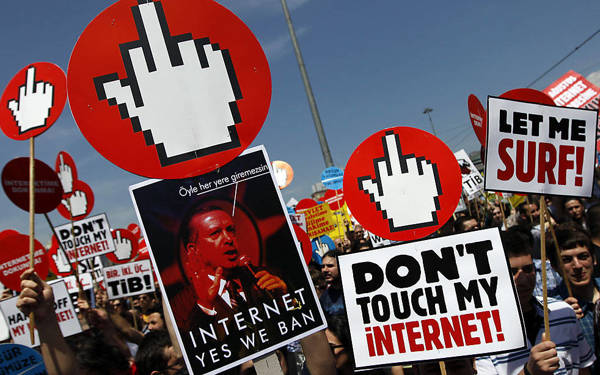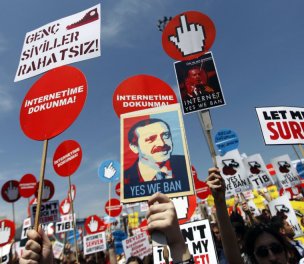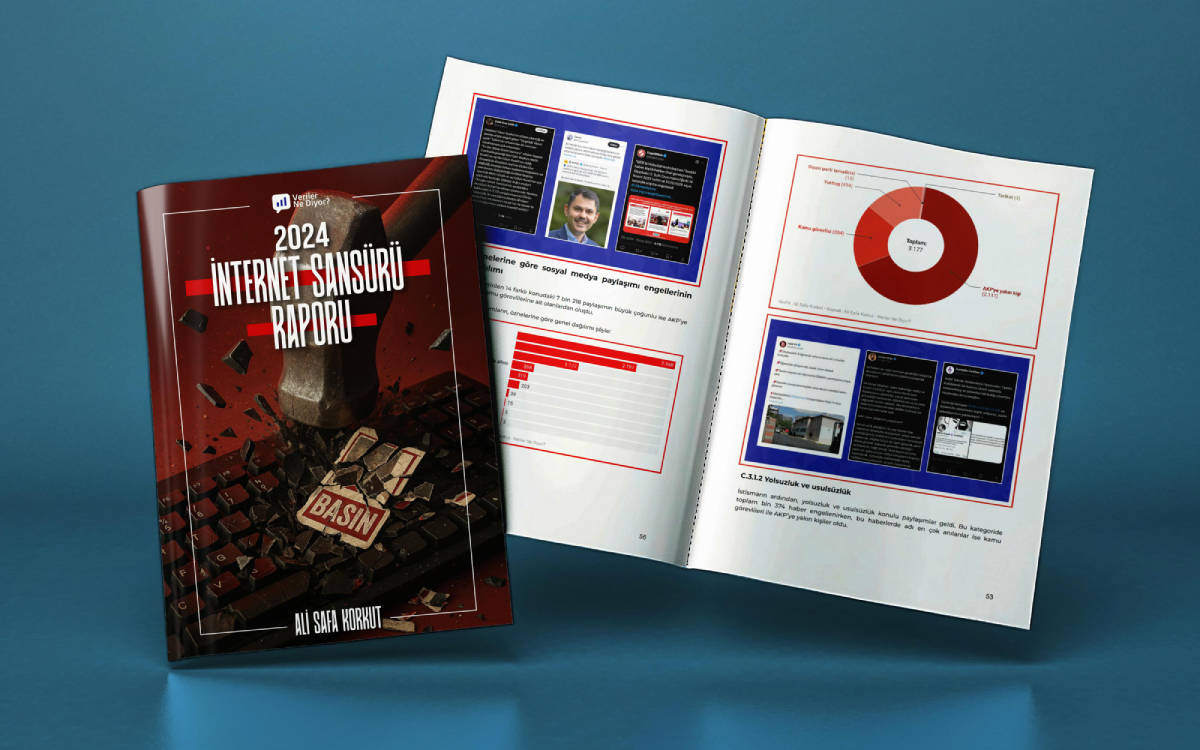



A new report titled What Do the Numbers Say? 2024 Internet Censorship Report has revealed the scale of online censorship in Turkey throughout 2024, highlighting a broad crackdown on digital content ranging from news articles to social media posts.
According to the report prepared by journalist Ali Safa Korkut, access to a total of 758,716 URLs was blocked over the year. This included 740,624 domain names, 8,762 news articles, 7,218 social media posts, and 1,897 social media accounts.
In addition to these, authorities also blocked 73 Google Maps reviews, 71 advertisements, 36 Google search results, 34 mobile applications, and one Google Drive file.
Websites of 12 newspapers among blocked domains
Among the more than 740,000 blocked domain names were the websites of several newspapers. In 2024, 22 different domain names belonging to 12 newspapers were restricted by orders from 16 separate penal courts of peace.
AirportHaber was the most targeted online outlet, with five domain names blocked, followed by Mezopotamya Agency with four. The stated justification for these blocks was “the protection of national security and public order.”
Social media platforms censor journalists’ accounts at Turkey’s request
Most censored content involved corruption allegations
The majority of blocked news stories dealt with allegations of corruption and misconduct. Of the censored articles, 1,834 were related to corruption and irregularities, followed by 1,559 on celebrity news, 1,458 on other forms of misconduct, and 891 covering violence against women.
Among the 1,834 corruption-related articles, the accused individuals were predominantly public officials (804), companies (325), and businesspeople (322). Public officials were also the main subjects of articles about general misconduct.
In nearly half of the 891 articles on violence against women, the alleged perpetrators were individuals reportedly close to the ruling Justice and Development Party (AKP).

Minister: Turkey blocked 108 million attempts to access 'harmful' websites in a decade
Public officials topped list of subjects in blocked news
A broader look at the 8,762 censored news stories shows that public officials were the most frequently reported group in relation to by content removals.
İstanbul courts issued most censorship orders
In 2024, a total of 288 censorship decisions affecting news content were issued by 127 different authorities. Nine of the top ten institutions issuing the most censorship orders were penal courts of peace located in İstanbul.
The only exception in the top ten was the 6th Penal Court of Peace in Adana. Of the top 30 authorities issuing censorship decisions, only 13 were located outside İstanbul.

BIA Media Monitoring Reports
‘Violation of personal rights’ most common reason for blocking
The primary legal basis for blocking content was the “violation of personal rights,” cited in 8,587 of the cases involving news articles.
This justification was enabled by a specific legal article, which was annulled by a Constitutional Court ruling on Oct 10, 2024. Following this change, many applicants began citing “protection of national security and public order” instead. Of the 133 articles blocked for this reason in 2024, 96 were targeted after the Oct 10 ruling.
Nearly half of blocked social media posts focused on abuse
Social media posts were the third most censored content type after domain names and news articles. In 2024, 120 court decisions led to the blocking of 7,218 posts.
These posts covered 14 different topics, with the most prominent being content related to the abuse of women and children. Posts on this issue accounted for 3,177 of the blocked items—nearly half the total.
The report included a breakdown of alleged perpetrators in these abuse-related posts, though specific figures were not detailed.
Censorship of journalists' accounts
A total of 1,897 social media accounts were blocked in 2024, across 14 categories.
The most significant action was taken by the Trade Ministry, which blocked 1,426 accounts for posting property and vehicle listings outside its Electronic Listing Verification System (EİDS).
The second-largest category included accounts accused of committing or promoting organized crime. This was followed by accounts allegedly involved in illegal betting, fraud, obscene content, market manipulation, terrorist propaganda, illegal sports broadcasts, or financing terrorism.
Among the blocked accounts, 51 belonged to journalists, newspapers, or television channels, spread across 45 individuals or institutions. The most common justification cited was “the protection of national security and public order.”
Even censorship reports were censored
Notably, news stories reporting on the very censorship of digital content were themselves also censored in 2024.
One of the most striking cases involved a censorship order requested by President Recep Tayyip Erdoğan’s son, Bilal Erdoğan, on Aug 20, 2024. The order, issued by the 5th Penal Court of Peace in İstanbul, was the sixth in a chain of censorship rulings targeting stories about a public tender won by Erdoğan’s high school friend.
In 2020, businessman Aykut Emrah Polat, a classmate of Erdoğan from Kartal İmam Hatip High School, won a 280 million lira tender for the Ataşehir Modern Project held by the Savings Deposit Insurance Fund (TMSF). Following media coverage of the tender, news articles were successively blocked by court orders, prompting further articles reporting the censorship itself—each of which also faced censorship.
By Jan 1, 2021, the censorship extended to a Gerçek Gündem article titled Access ban on report about access ban on tender won by Bilal Erdoğan’s friend. This marked the sixth successive court decision blocking reports on earlier censorship.
In essence, each round of censorship led to a new round of reporting, which in turn triggered additional bans. The latest decision, from Aug 20, 2024, continued this cycle.
Google Maps reviews blocked at business request
As in the previous year, comments posted on business profiles on Google Maps were also targeted. In 2024, 73 such reviews were blocked, all upon requests filed by the respective businesses.
Each of these reviews reportedly involved allegations of malpractice.
Click to see the full report (Turkish)
(HA/VK)