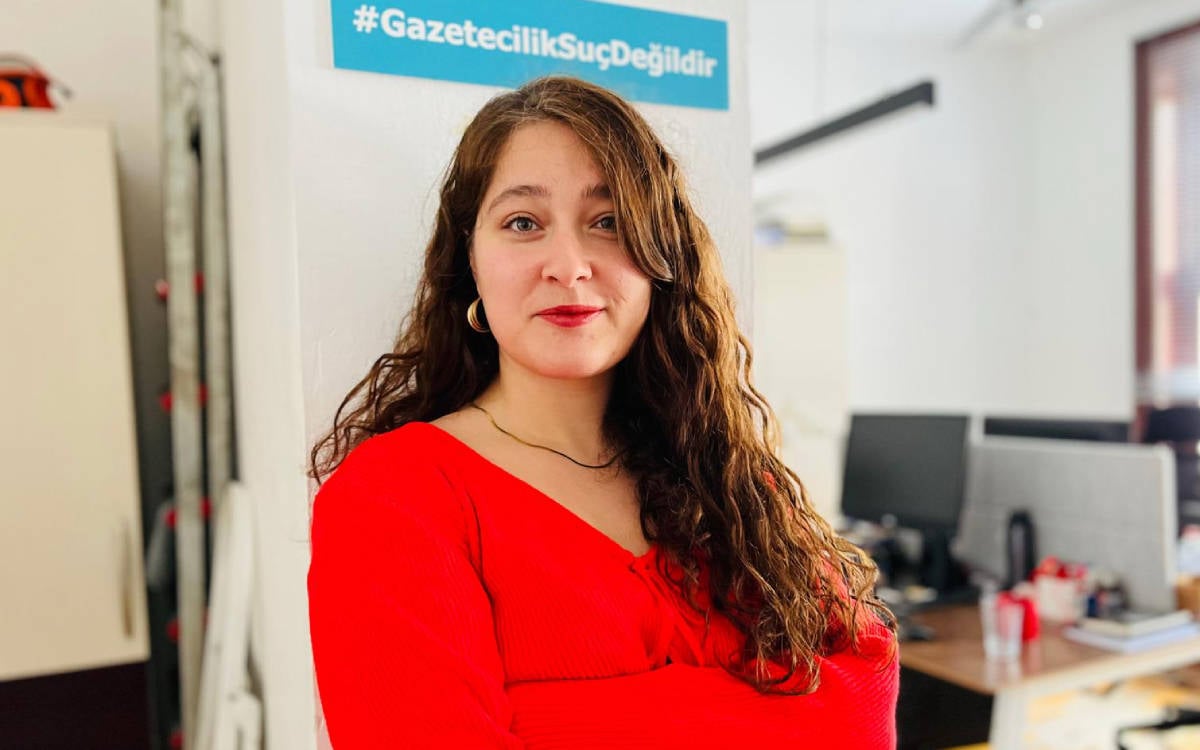



The İstanbul Chief Public Prosecutor’s Office has submitted its final opinion in the case against bianet editor Tuğçe Yılmaz, journalists Erdoğan Alayumat, Suzan Demir, Taylan Abatan, Gülcan Dereli, translator Serap Güneş, and sociologist Berfin Atlı.
Prosecutor Muhammet Yağcı accused the seven defendants of “aiding an armed terrorist organization” based on their contributions to Yeni Özgür Politika and its supplement PolitikArt, which are published in Germany. He alleged that the articles they wrote and the royalties they received amounted to support for the outlawed Kurdistan Workers’ Party (PKK), and demanded prison sentences under Articles 220/7 and 314/2 of the Turkish Penal Code.
'Language used by the publications'
The initial hearing of the case was held on Dec 9, 2025, where the defendants presented their defenses against the charges.
In a written opinion submitted to the İstanbul 13th Heavy Penal Court between hearings, the prosecutor argued that freedom of the press is not without limits. Citing rulings from the European Court of Human Rights (ECtHR) in the cases of Leyla Zana and Kamil Tekin Sürek, he claimed that press freedom can be restricted on the grounds of national security and territorial integrity.
The prosecutor described Yeni Özgür Politika and PolitikArt as media outlets affiliated with the PKK/KCK and claimed they engaged in “propaganda for the organization.” He argued that the publications provided space for the writings of PKK leaders and used language that targeted security forces. Therefore, he concluded, the activities carried out in these publications could not be considered as “normal journalistic activity.”
'Aiding the organization'
According to the prosecutor, the defendants’ submissions to Yeni Özgür Politika and PolitikArt contributed to the continuity of these publications. The opinion alleged that their work served to disseminate the goals and messages of the organization to the public, misused the power of the press for illicit purposes, and fostered public sympathy for the organization’s acts of violence.
The prosecutor further argued that by accepting royalties, the defendants established a “financial relationship” with the organization, which constituted sufficient grounds for the aiding charges.
He emphasized that aiding a terrorist organization is not limited to providing material support. Citing the case law of the Court of Cassation’s General Criminal Assembly, he stated that any action contributing to the organization’s activities falls within the scope of this offense.
Prosecutor demands prison terms
Based on these allegations, the prosecutor requested prison sentences ranging from five to ten years for Tuğçe Yılmaz, Erdoğan Alayumat, Suzan Demir, Taylan Abatan, Gülcan Dereli, Serap Güneş, and Berfin Atlı.
The trial will resume on Feb 17, when the defendants are expected to respond to the final opinion. The court is then expected to deliver its verdict.
Armenian youths speak up: A 109-year-long mourning
Background
The investigation originated with the Eskişehir Chief Public Prosecutor’s Office, which ordered raids on Nov 26 targeting the homes of journalists, writers, poets, and cartoonists in İstanbul, Diyarbakır, Ankara, and Batman. Eight individuals were detained in the initial operation.
Those detained included Bianet reporter Tuğçe Yılmaz, Roza Metina, Erdoğan Alayumat, Hamza Kaan (Bilge Aksu), Ahmet Sümbül, Bilal Seçkin, Mehmet Uçar, Havin Derya, and Suzan Demir.
Other detainees included filmmaker Ardin Diren, poet Hicri İzgören, writer and translator Ömer Barasi, cartoonist Doğan Güzel, photographer Emrah Kelekçier, publishing coordinator Baver Yoldaş, dismissed academic Abdurrahman Aydın, LGBTI+ activist Berfin Atlı, and translator Serap Güneş.
Among those detained, Mehmet Uçar and Hamza Kaan (Bilge Aksu) were arrested. The others were released after four days in custody under judicial supervision.
The indictment for the two detained individuals was accepted by the Eskişehir 2nd Heavy Penal Court, but the case was later referred to other courts due to jurisdictional issues. The journalists’ files were separated and sent to courts in the cities where they were detained. The indictment cited their reporting, social media posts, and royalty payments from their media outlets as evidence for the charges. The two were released at their first hearings on Jul 3 and Jul 8.
Separately, the Ankara Chief Public Prosecutor’s Office decided not to pursue charges against journalist Bilal Seçkin. (HA/VK)