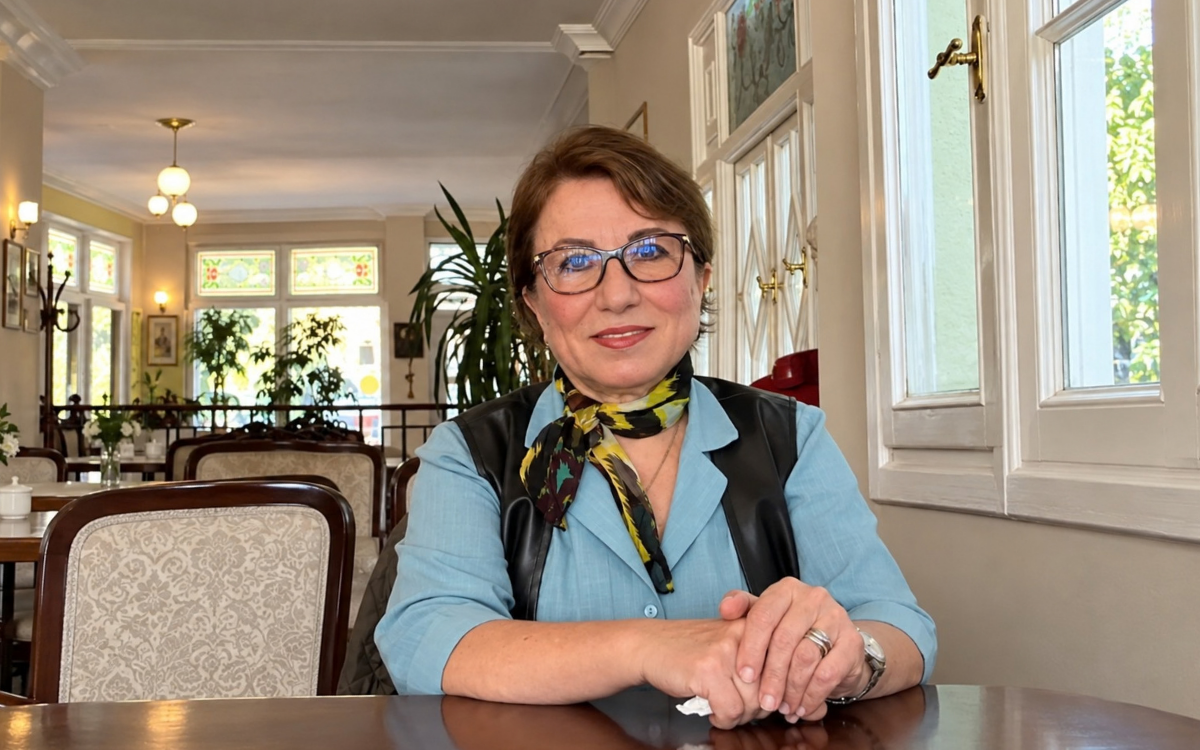

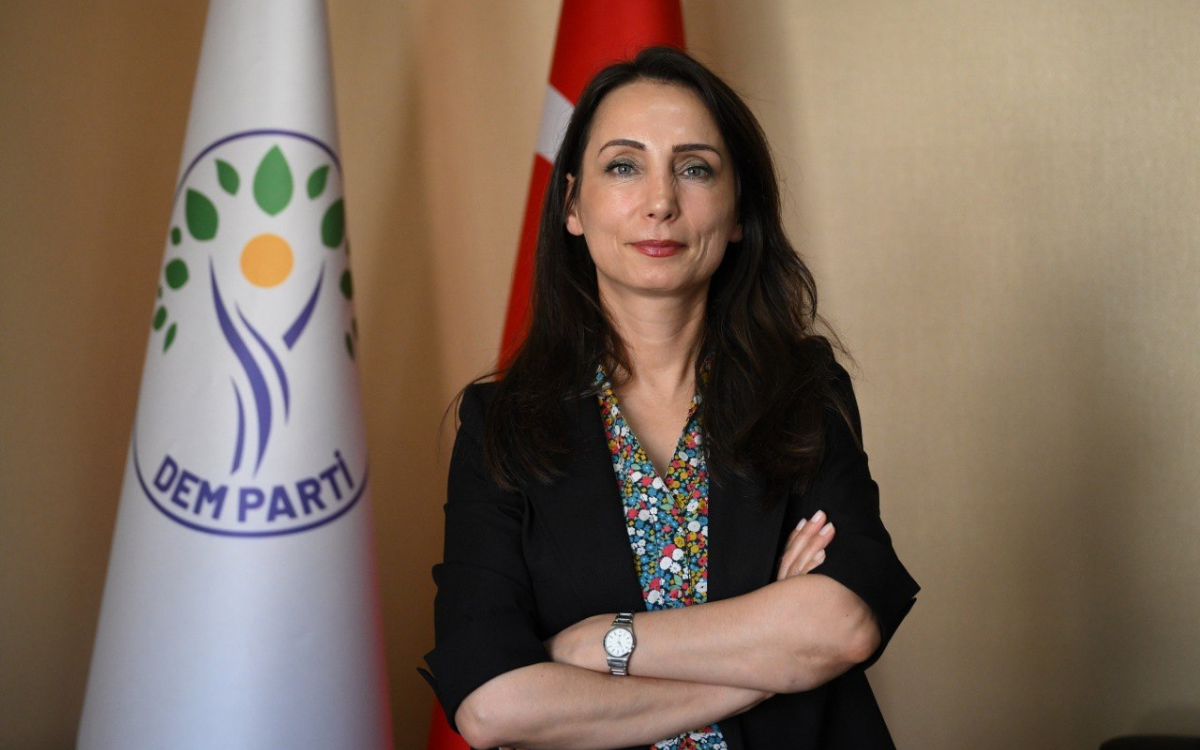



Peoples’ Equality and Democracy (DEM) Party Co-Chair Tülay Hatimoğulları has outlined her expectations for the next phase of the Kurdish peace process following parliament’s passage of a “framework law” on Aug 10, calling for its swift implementation and subsequent legislation aimed at democratization.
Hatimoğulları acknowledged concerns over the extensive authority given to the executive power in implementing the law, arguing that the parliamentary commission and the broader public should play an active role in monitoring the process.
She argued that while the law does not yet address some of Turkey’s fundamental problems, it does not restrict the space for rights and freedoms either: "Once armed conflict disappears, the grounds for criminalizing these struggles will also narrow. That is the space this law opens up, and it is up to all of us to fill it."
Significance of the law
The 'framework law' has been passed. What steps do you expect to be taken first following its adoption?
Let us once again acknowledge the significance of the framework law’s passage with a majority rarely seen in the history of Parliament, as well as the value of our shared desire for the guns to fall silent. It is of historic importance that the body envisaged under the framework law becomes operational and that the National Security Council (MGK) swiftly adopts the necessary decision so the law can take full effect in all its dimensions. We believe the law will have a tremendous impact on Turkey's politics in the medium and long term and will strengthen the foundations of democratic politics.
At this stage, it is important for the law to be implemented in full and as quickly as possible. The political and psychological climate that will emerge if the framework law is implemented smoothly will pave the way for the next steps. In this respect, for the framework law, the first step, to realize its full potential, it must be followed by democratization and civil liberties legislation that expands and strengthens the democratic political sphere.
Nearly 4,000 prisoners could be released under Turkey’s Kurdish peace law
You described the prominent role of the security bureaucracy in the mechanisms that will oversee implementation of the law as “the biggest handicap.” What is your main concern here? How do you think democratic oversight of its implementation should be ensured?
There may be concerns and questions about granting extensive authority to the executive under a law that passed parliament with such a large majority. Those questions and concerns do not necessarily have to lead to a negative interpretation. The executive must avoid mistakes in timing and implementation. On the one hand, we will continue to raise our concerns on this issue. On the other, we will work to strengthen the ground for democratic struggle and make the demand for peace a demand shared by all 86 million people. For this process to succeed, we must enable the parliamentary commission and the peoples of Turkey to become forces capable of monitoring and overseeing it.
Why the previous process failed
In 2015, the negotiating table was overturned by a political decision. What distinguishes today’s process from 2015? Are there safeguards this time that can prevent a reversal?
There are no absolute guarantees. Anyone who says otherwise is not telling the truth.
What we can say is this: The two structural weaknesses of 2015 were the absence of a legal framework and the lack of a timetable. This time, those shortcomings have been partly addressed. Parliament is involved, there is a law and there is a commission. We say “partly” because a timetable and binding oversight mechanisms are still missing. What you call a guarantee can only be established by filling those gaps. The nature and distinctive character of this process mean that it will move forward through an equation of “trust and safeguards.” The way to secure guarantees is not to reject the process, but to make turning back from it impossible.
A stop on the road to peace: The Framework Law
Roadmap for democratization
Although a legal framework has been established, there are criticisms that the legislation does not address structural problems and that the state’s security-oriented structure remains unchanged. How do you assess these criticisms?
It is true that, at this initial stage, the law does not address some of the fundamental structural problems that society also expects to be tackled. But consider it this way: Does the law open up or restrict the space for struggles over the Anti-Terror Law and the Turkish Penal Code, freedom of expression, freedom of association and local democracy?
Once the context of armed conflict disappears, the grounds for criminalizing these struggles will also narrow. That is the space this law opens up, and it is up to all of us to fill it. Of course, it would be difficult for the state’s security-oriented structure to change through this law alone. What this law does is remove the justification for the conflict regime. Let me underline that: its justification. States of emergency, extraordinary powers, the Anti-Terror Law and similar measures all derived their legitimacy from the conflict. It is true that the apparatus will not simply wither away once that justification disappears. Dismantling it will be the political struggle of the second stage, and the program for that struggle must be written together.
The right not to be killed
What should the concrete road map for this second stage you are referring to look like?
Steps are needed at three levels. The first consists of urgent measures. These are more or less clear.
The second involves what we might call medium-term measures. These include revising the Anti-Terror Law and related penal legislation, introducing safeguards for freedom of expression and association, reforming the law on local administrations, developing a concrete program on the mother tongue, establishing mechanisms for truth and reckoning with the past, creating a fair socioeconomic program and ensuring public participation in the bodies overseeing the process.
The third consists of longer-term steps. These include a democratic constitution guaranteeing equal citizenship, mother-tongue rights and strengthened local government, as well as a comprehensive transitional justice framework. The way to reach these stages is to broaden the struggle for democracy across the widest possible spectrum. That is also how we can lay the foundations for lasting peace, democratization and the construction of a democratic republic.
You say, “Peace cannot last unless it takes root in society.” How do you see the public response to the support that has emerged in parliament? In particular, what kind of political communication and language do you envision for reaching voters who remain skeptical of the process and nationalist-conservative segments of society?
From the very beginning, we have emphasized that making peace a social cause is essential both to building legitimacy and to making it lasting. We have tried to shape our work around that principle.
Our answer to the question “Why peace?” has always been that it serves the interests of all 86 million people and the peoples of the Middle East. For that reason, there is an inseparable connection between peace taking root in society and becoming permanent. And that reflects a fundamental truth.
We believe the support that has emerged in parliament also exists in society, and may in fact be even stronger. No one raised on this land, within this culture and tradition, would say no to peace. Whatever our criteria may be, peace is something we all share, and the framework law is an important step toward it. At the same time, we know there are segments of society where support is high but trust is low, or where people still need to be convinced. We are trying to remain in close contact and communication with them.
We are aware that voters who remain skeptical of the process see contradictions, such as the apparent paradox between supporting peace and democratic backsliding. To overcome these contradictions, we insist on pursuing the struggles for peace and democracy together, without separating them from the goal of building a peaceful and democratic Turkey. There are also some groups that oppose peace itself because everything they have accumulated politically has come out of an environment of conflict. These are groups that have benefited from the failure to resolve the Kurdish issue and cannot bring themselves to accept equality.
Of course, we respect freedom of thought and expression, but we will continue our democratic, freedom-based and dignified struggle for peace against hierarchical, sexist and racist approaches
'The way to protect the Republic is not to freeze its problems in place'
You said of some New Party deputies who voted against the bill that “they are perpetuating a 100-year-old mindset,” and later added that “a new era cannot be built on century-old assumptions.” What do you mean by a “100-year-old mindset”? What do you say to those who interpret these remarks as criticism of the founding values of the Republic, Atatürk and the Treaty of Lausanne?
Some circles are deliberately taking my words out of context through a forced interpretation. There is a coordinated assault on several fronts in this process. We have seen many examples of this in the past as well.
The truth is, they are not discussing what was actually said. They are discussing the intentions they themselves attribute to those words. We have been saying these things for years. This is nothing new. The context is clear. What I am criticizing is an approach that, whenever the Kurdish issue comes up, substitutes security for politics, silence for dialogue, and denial and conflict for a democratic solution. In fact, this goes back not just 100 years, but 200 years.
There is a fear that “if we discuss the Kurdish issue, the country will be divided; if we recognize rights, the state will weaken; if we expand the political sphere, national unity will be undermined.” Yet 100 years of experience have shown us the opposite. What strengthens unity is not denial and conflict, but equality and the rule of law. This process will also be a period in which these fears are overcome. That is what our struggle is about. If a new era is to be built, it will have to be built by learning from the past.
That is why we say creating taboos does a disservice to all 86 million people. The way to protect the Republic is not to freeze its problems in place, but to make it more democratic, more equal and stronger for everyone. That is the essence of what I meant.
I consider many of the Republic’s achievements important. But we also have to speak about its shortcomings. We will continue to criticize the failure to democratize, the denial of the identities, languages and beliefs of citizens from different peoples and faiths, violence against women, the disregard for nature and human rights, and systems of tutelage, whether military or political. Kurds and all peoples, Alevis, Christians and people of all faiths should be able to speak their own languages and practice their beliefs freely. We are fighting for democracy in substance, not merely in name.
We will not only criticize. We will also work to build a democratic republic. (NÖ/VK)