









On the occasion of World Vegan Day, November 1, we turn our attention to a place that anyone who has ever passed through Amed (Diyarbakır) has likely heard of: Gabo. Launched in 2015 as “Diyarbakır’s first vegetarian café,” Gabo has since transformed into a fully vegan kitchen. For some, it may represent “an alternative cuisine,” but at its core, it stands for an inclusive way of living and, more importantly, an ethical and political stance.
Named after the Latin American nickname of Gabriel García Márquez, Gabo invites you into a kitchen whose anti-speciesist position challenges you to question what it means to be “human-eating” and confronts your (non-vegan) contradictions, knowingly or unknowingly. But calling it merely a “kitchen” falls short: Gabo is far more than that.
We spoke with Cahit Şahin, the mind behind this idea, about Gabo’s memory, its kitchen, and its understanding of labor and justice. In truth, we let Gabo speak for itself.
Gabo’s journey to becoming the 'first and only vegan' kitchen
Gabo opened in 2015 as “Diyarbakır’s first vegetarian café.” Today, it is known in Amed as the city’s “first and only vegan” kitchen. What were the key turning points in that journey? Has that journey shaped the memory of your kitchen? Looking back at the past decade, if Gabo were to say, “speak, memory,” what would it tell us?
We actually didn’t begin with a grand plan—just a small need. It was nearly impossible to find vegan or vegetarian food in Diyarbakır. We were constantly cooking at home for a vegan guest of ours, and one day we joked, “If only we had a vegan café, at least we could earn money from the food we’re already cooking.” Six months later, that joke became Gabo.
In the first year, people said, “This will not work in this city.” Some even told us, “You’ll shut down in a month.” But the opposite happened: people were curious; they came, they tasted. The first major turning point for us was not the people who didn’t eat meat but those who missed traditional flavors and embraced Gabo. Because we built our kitchen by drawing from what we call the “cuisine of scarcity.” We brought back Anatolia’s dishes that have been cooked without meat for hundreds of years.
The second turning point was transforming the menu into a fully vegan one. At the beginning, there were a few dishes in which we used milk or eggs (animal products). Over time, both we and the team matured and changed. One of our kitchen staff had previously worked at the butcher counter in a supermarket; two years later, he became vegetarian then vegan. His transformation was also Gabo’s transformation.
The pandemic was another milestone. People began cooking at home and reconnecting with food. During that period, we simplified the menu, wrote our own recipes, and deepened our memory, in a way.
Every dish cooked in our kitchen carries a voice from the past. When we hang dried eggplants, we feel our grandmothers; when we pour olive oil, we feel the Mediterranean; in the patience of the chickpea, we feel Mesopotamia. For us, food is not merely sustenance; it is a form of remembering.
The most important thing we’ve learned in ten years is this: veganism is not a trend—it is a practice of memory. It is the purest, most direct way of relating to nature, animals, the soil, and the table.
If we were to say, “speak, memory,” Gabo would say: “At first they dismissed me. Then they grew curious. And then, I too got to know this city anew. Now, we cook together.”
I know that you understand veganism not merely as a “consumer choice,” but as an ethical and political stance rooted in inclusivity. Still, I’m curious: what are the unique challenges of running a vegan place in Amed? After all, we’re talking about a region where non-vegan food culture—let’s call it the “liver/kebab/meat” culture—is dominant. Do you think Amed has embraced Gabo?
Running a vegan establishment in this region is sometimes not just a matter of the kitchen but it’s a matter of language. Because when you say “food” here, most people think first of mangal, then kebab, then meat. So when we opened, we weren’t just creating a new menu; we were actually forming a new sentence.
But we realized something: Amed/Diyarbakır is a far more open-minded city than many assume so long as you don’t speak down to people or try to “teach” them. We said, “Look! On this land, you can prepare beautiful tables without meat.” People saw it, tasted it, and loved it. Stuffed vegetables, olive-oil dishes, lentil soup… All of these were already part of this region’s culinary memory. We simply dusted that memory off a bit.
Was it difficult? Yes. Finding ingredients, dealing with suppliers, sometimes being mocked… We experienced all of that. But we also witnessed solidarity.
Has Amed embraced Gabo? Yes, but not in the way it embraces other things; it embraced Gabo in its own rhythm, in its own voice. We didn’t enter into a struggle with this city; we entered into a dialogue. Because the spirit of Amed holds both resistance and compassion; we brought both into our kitchen.
The local, reinterpreted through veganism
When you recreate dishes like keledoş or beyti in a vegan form without denying the local and, in a sense, while transforming it. I’m sure you’re doing much more than simply substituting ingredients. What I’m trying to understand is this: are you also trying to transform the memory and emotion of the dish? Since kitchen memory is often triggered unintentionally, is there an example where you feel you are “making an inherently ‘meatless’ tradition visible”?
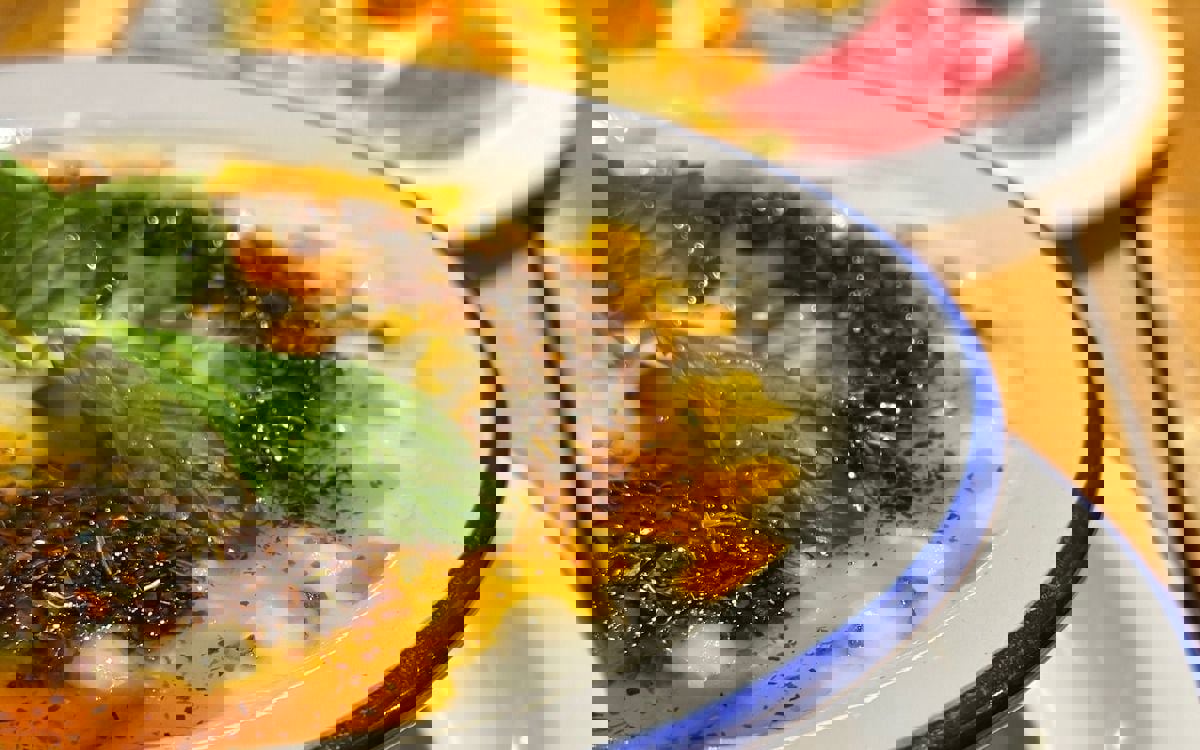
As you said, what we do in our kitchen is not just creating a “meatless version”; it’s rebuilding a feeling, a memory. Because food touches not only the stomach but the memory as well. When we veganize dishes like keledoş or beyti, we change the ingredients—but we try not to change the story the dish tells.
Take keledoş, for example. Traditionally, it is made with bone broth and yogurt. We prepare it with plant-based yogurt and vegetable stock, but the issue is not simply “finding an alternative.” When we make that dish, we try to preserve the spirit at its origin, the communal labor, the creativity born of poverty, the ethos that centers not on meat but life itself.
Some dishes are rooted in traditions that were originally “meatless,” yet over time come to be defined by meat. Dolma, for instance. For thousands of years, it has expressed the creativity of the poor kitchen. What we try to do is honor that origin and remind people of this tradition of “making something out of nothing.” In that sense, we are not exactly “veganizing”; we are revealing a forgotten form.
What we feel when recreating a dish is a connection built not through nostalgia but through memory. Because sometimes the emotion of a dish lies not in its ingredients but in the intention of the one who cooks it. And we try to keep that intention alive.
Ethics, ecology, and the balance of labor
Thinking about a form of justice that does not center the human - about the ecological sustainability of vegan justice and its commitment to fair labor I'd like to ask: On what principles do you base your menu policies and operational practices at Gabo, and how do you implement them in practice? I’m thinking of issues like ecological footprint, seasonal and local produce, fair labor, wage/shift standards in the kitchen, and price accessibility.
At Gabo, we have never seen the kitchen merely as a site of production; we’ve always understood it as a space of relationships. Because what we call vegan justice is not limited to protecting animals—it is a form of justice that also embraces the soil, labor, water, and people.
Our menu policies grow out of this philosophy.
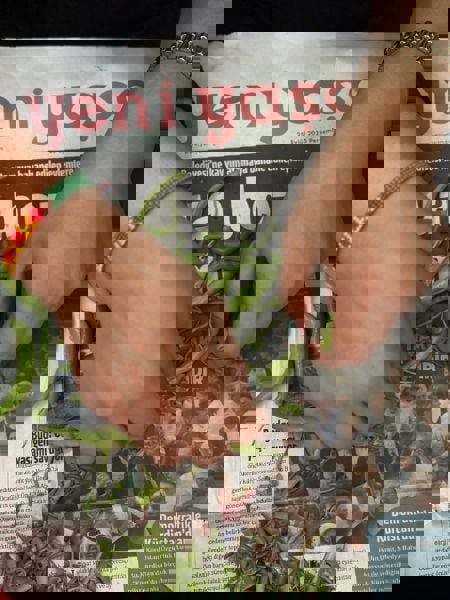
Our first principle is seasonality. Because every out-of-season ingredient essentially means asking something extra from nature. Our menu changes twice a year: summer and winter. For example, when the season for fresh beans ends, we remove that dish from the menu. In its place comes something aligned with the spirit of the season. This creates a rhythm that is in harmony with both nature and local producers.
The second principle is locality. We try to shorten the supply chain as much as possible. We buy our lentils from Kocaköy, our tahini from Suriçi, and our rice from Karacadağ. Because we know that where an ingredient comes from is just as important as who it comes from.
The third is fair labor. In our kitchen, there is no vertical hierarchy - only a horizontal one. Everyone eats at the same table, everyone has an equal voice. We try to shorten working hours, keep wages as fair as possible, and sometimes even choose to sacrifice profit rather than raise menu prices. Because an “ethical menu” is not only about what’s on the plate- it’s about the hands that bring that plate into being.
Another issue is accessibility. We don’t want veganism to be perceived as something “luxury” or “elitist.” When setting our prices, we always ask: “Can someone choose this meal for an ordinary lunch break without worrying about making it to the end of the month?” Gabo’s ability to survive for ten years is partly due to this balance: we operate neither strictly according to market logic nor entirely through romantic idealism. You could call it a kind of economy of conscience.
In the end, we’re not just cooking food; we’re trying to show that a way of life is possible. And we do this not through grand declarations, but through small, consistent practices. A dish cooked in season, a fair work shift, an accessible price… These are the ingredients of our recipe for justice.
Beyond meat–masculinity–power
To follow up on the previous question - and keeping ecofeminist literature in mind - I’d like to ask which anti-hierarchical principles guide the trio of language–labor–plate at Gabo, a place founded on ethical and political choice. Put differently: How does Gabo transform the “masculinity and power codes” embedded in kitchen labor and guest relations? What conscious interventions do you make, what have you been able to change, and where do you encounter resistance? I’m curious about how your team works together and how you build dialogue with your guests.
For us, the kitchen is not merely a place where food is prepared - it’s a space where power is redistributed. From the beginning, Gabo has tried to break down roles like “male chef,” “female assistant,” “boss–waiter.” We do this not through lofty theory, but through the small gestures of everyday life. For example, when deciding which dishes will enter the menu, everyone in the kitchen has a say. We don’t have anything like a “chef’s signature dish.” Because that “signature” is often a gesture of authority - and we try to turn it into a collective signature.
We take the same care with language. No dish at Gabo has a name that implies ownership. And in our menus, during service, or in conversations with guests, we avoid hierarchical forms of address such as abla (big sister), beyefendi (gentilmen), or patron (boss). We say “guest,” not “customer,” because the relationship is less commercial and more of a human encounter.
In kitchen labor, we make a conscious effort to make women’s often invisible labor visible. The gastronomy world still operates under a male-dominated hierarchy: the “chef” is male, the “cook” is female. At Gabo, these roles dissolve. Our women staff are central to service, communication, and planning; our men staff take active roles in cleaning and maintaining the kitchen and bathrooms. In other words, instead of aiming for a table that “has a woman’s touch,” we try to build a table “touched by everyone.”
Ecofeminist thought reminds us that the mindset that exploits nature, animals, women, and labor is one and the same. So we try to create small but concrete ruptures in every link of that chain. In short, every relationship formed around the table and every task shared in the kitchen at Gabo is a small rehearsal for a fairer world. Our goal is not a “grand” revolution, but to notice those micro-powers woven into daily life—and to dismantle one of them, every single day.

‘Someone must have left you cat food’
As someone who feeds dozens of cats every day - strays, regulars, those in the city center and those on the margins - you often say “someone must have left you cat food” instead of “you got lucky.” So tell me: looking back at Gabo’s journey, what moments does this phrase capture for you?
When I say “someone must have left us cat food,” I’m thinking of the moments when everything seemed to hang by a thread, yet somehow the path still opened. Because I’ve always believed this: luck isn’t coincidence. Something or someone carries you in ways you can’t see. And throughout Gabo’s journey, there were many of those invisible carriers. Sometimes it was a staff member, sometimes a guest, and sometimes even a cat I was feeding on the street.
In those first months, things naturally weren’t going as we hoped - we didn’t even know how we would pay the electricity bill. And just then, someone would walk in and place a large order. Or when someone in the kitchen narrowly avoided what could have been a serious accident, I would quietly say to myself, “someone must have left us cat food.” Because to me, that phrase expresses something truer than “you’re lucky”: it means that something - some force, some kindness in the universe - has left you a little share. And you continue on with that.
In a way, Gabo itself is like that cat food - given, protected, sometimes running low, but somehow always replenishing. And maybe the most beautiful part is that it no longer belongs just to me; it belongs to the city, to the kitchen, to the cats, to the people - to anyone who wants to meet the world with a bit of kindness.
The Gabo shade of mustard yellow
I know the team is going through an exciting time: Gabo is leaving Ofis and moving to a new space. Will we see what we might call the “Gabo shade of mustard yellow” - your visual identity - at the new address? What should regulars and first-time visitors expect? And tell us: will we be gathering at the new Gabo before the new year?
Yes, there is a sweet rush in all of us these days. After ten years, Gabo is leaving the Ofis neighborhood, but it’s taking its spirit along. For us, this move is not so much a “renewal” as it is a continuation. Because Gabo has never been just a physical space; it has always been a sound, a smell, a way a table is set, a way of looking. And we’re carrying that way of looking to the new place.
That “Gabo shade of mustard yellow” will definitely be there - but not as an exact copy. We’ve changed, and the city has changed too. The new space will have earthy tones, clean lines, plenty of daylight, and details crafted by hand. Textures made through craft, handwritten menus, small illustrations on the walls… But most importantly, that familiar warmth: the feeling of someone saying, “Welcome, shall I put on some tea?” as soon as you walk in.
There will be a few surprises on the menu as well - seasonal, a bit more experimental, yet still carrying the comfort of home cooking. Regulars will find old friends; newcomers will feel something like, “Time moves a little slower here.”
And yes - before the new year, we will absolutely be meeting at the new Gabo. Against the city’s cooling winter air, we’ll gather in the warmth of a pot of soup steaming on the stove. Gabo will remain what it has always been: a warm place, a table visited by kind-hearted people.
Finally, could you briefly summarize the main reasons based on your own experience for being vegan and advocating veganism?
For me, veganism is not a “list of prohibitions”; it is a way of relationship. It has more to do with how I live than with what I eat. At first, it was simply an ethical stance: I asked myself, “Is it possible to live without harming animals?”
Then I realized the issue isn’t only about animals but it transforms your entire relationship with water, soil, labor, and conscience. The most important reason for being vegan, for me, is a sense of justice. Seeing a living being, a tree, a river not as a “resource,” but as a “living presence.”
Another reason is empathy. Once you have seen fear in a cat’s eyes, you cannot forget that the same fear exists in every living creature.
And finally, simplicity. Veganism has shown me that you don’t need much to live well - just a bit of conscience, a bit of care, and a willingness to share. For me, it is not an identity, but a form of kindness toward the universe and every living being - a way of respecting the right to life.
(SA/VK)