










The trial of journalist Elif Akgül and politician Mehmet Saltoğlu, both prosecuted for alleged “membership in a terrorist organization” following a criminal case targeting the Peoples' Democratic Congress (HDK), an umbrella organization of pro-Kurdish and leftist groups, continued with its third hearing today. Akgül had previously spent 101 days in pretrial detention at Bakırköy Closed Women's Prison.
During the hearing at İstanbul’s 25th Heavy Penal Court, Akgül and Saltoğlu delivered their defense statements in response to the prosecutor’s opinion seeking conviction. Present at the hearing were Akgül’s lawyers, Hazal Sümeli and Tora Pekin, and Saltoğlu’s lawyers, Meral Hanbayat and Gökay Işık.
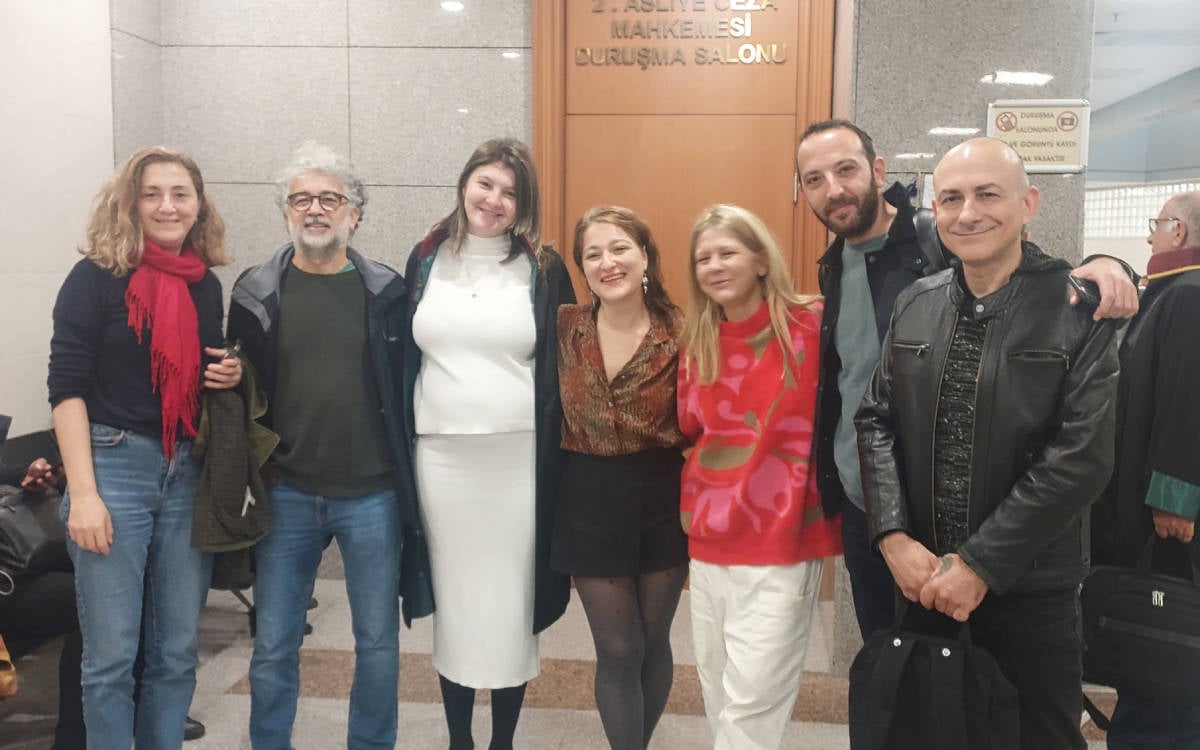
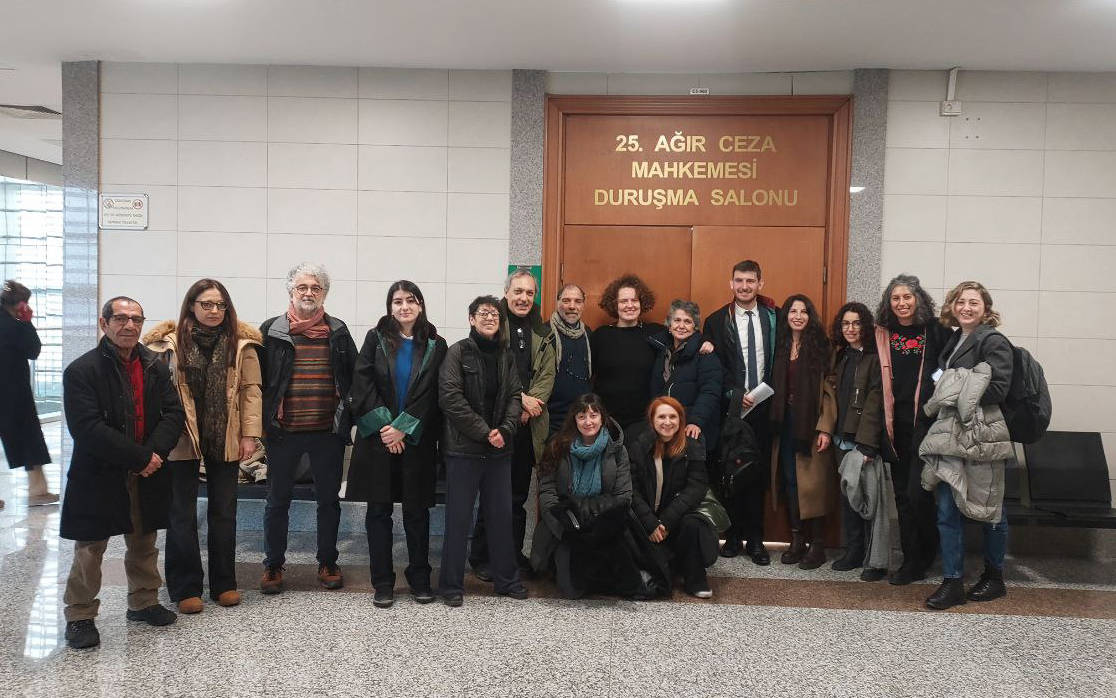
The session was observed by Erol Önderoğlu, Turkey representative of Reporters Without Borders (RSF), along with a large group of journalists.
'There are court rulings that HDK is not a terror group'
Speaking first, Elif Akgül argued that the indictment violated her constitutional rights to freedom of the press and freedom of assembly, and said the prosecutor’s opinion repeated those violations.
She added that the case file criminalized her participation in HDK congresses and that the only evidence presented was unlawfully obtained wiretaps.
She continued, “The prosecutor’s opinion claims HDK is a continuation of the Democratic Society Congress (DTK). But the prosecutor lacks the legal basis to support this claim. Not a single piece of evidence has been submitted. Moreover, there are court rulings that HDK is not a terrorist organization.

Journalists' union denied visit to jailed reporter Elif Akgül
"The prosecutor ignored all findings in my favor. We can talk about neglect of duty in this regard.
"The prosecution has not questioned who obtained the wiretaps. These recordings were collected by prosecutors and police officers affiliated with the Gülen movement. In similar cases, there has not even been an effort to assess such data. We are talking about unlawfully obtained material. I say ‘data’ because these are far from being considered legitimate evidence.
"In its current form, the indictment and the opinion are a sequence of delusions. Rather than merely asserting my innocence, I am calling on you to uphold the Constitution of the Republic of Turkey.”
'There is not a single piece of evidence'
Following Akgül, Mehmet Saltoğlu also responded to the prosecutor’s opinion. He emphasized that the HDK is a democratic entity with no ties to any illegal organization or activity.
“I have been involved in politics for 50 years. In all my political activities, I have never had any connection to illegal entities,” he said.
He added, “I consider the prosecutor’s attempt to link me to an organization via ideas expressed within the HDK to be an abuse of my right to engage in politics.”
Saltoğlu went on to say, “There is no concrete evidence or proof in either the indictment or the opinion to suggest that HDK is connected to any illegal organization. Yet, my attendance at its general assembly and meetings is being treated as a crime.”
‘DTK was not a terrorist organization’
The defense attorneys then took the floor. Hazar Sümeli from MLSA, representing Akgül, stated that there is a debate about whether HDK is an organization and said, “The indictment claims HDK is the continuation of DTK. However, the Constitutional Court has ruled in the cases of Selahattin Demirtaş and Aysel Tuğluk that DTK is not an organization. It explicitly stated that DTK does not possess organizational characteristics.
"HDK is a democratic structure that operates legally. Its co-chair Meral Danış Beştaş recently met with the President.
"The prosecution of my client for being a member of such a legal and public institution constitutes a clear violation of rights.”
Tora Pekin added, “Even the Court of Cassation does not categorically define DTK as a criminal organization. In the Aysel Tuğluk ruling, it attributed the rhetoric of democratic autonomy to the individual, not the institution.”
He noted that the court had asked the prosecution whether HDK is considered a terrorist organization, and the prosecution responded, “We have no such classification.”
Pekin criticized the prosecutor for failing to collect exculpatory evidence regarding his client, asking, “The prosecution's stance on HDK is clear. So why didn’t the prosecutor include that statement in the opinion?”
‘These are cases aiming to restructure the political field’
Meral Hanbayat, representing Saltoğlu, said: “An organization is being cited, and the trial proceeds purely on legal articles without linking the defendants to any concrete evidence. These are context-driven cases, entirely devoid of evidentiary basis. They aim to restructure the political field.”
Gökay Işık questioned the logic of the accusations: “HDK once said, ‘We can’t make decisions because everyone holds different views.’ How can a group that can’t reach decisions be a terrorist organization?”
The presiding judge then asked the defendants for their final statements. Elif Akgül said:
“The Constitution is a social contract. As a citizen of this country, I do not want to be deprived of my freedom because of a gang infiltrating the state. I want the state to protect my constitutional rights. I want legal security. I want to live in a country where the state and judiciary uphold my constitutional rights.”
Saltoğlu reiterated that he had engaged in lawful politics throughout his life as an elected official, rejected the charges, and demanded acquittal.
After a recess, the court announced its decision, ruling that there was insufficient evidence to prove the charges. Elif Akgül and Mehmet Saltoğlu were acquitted. (HA/VK)