









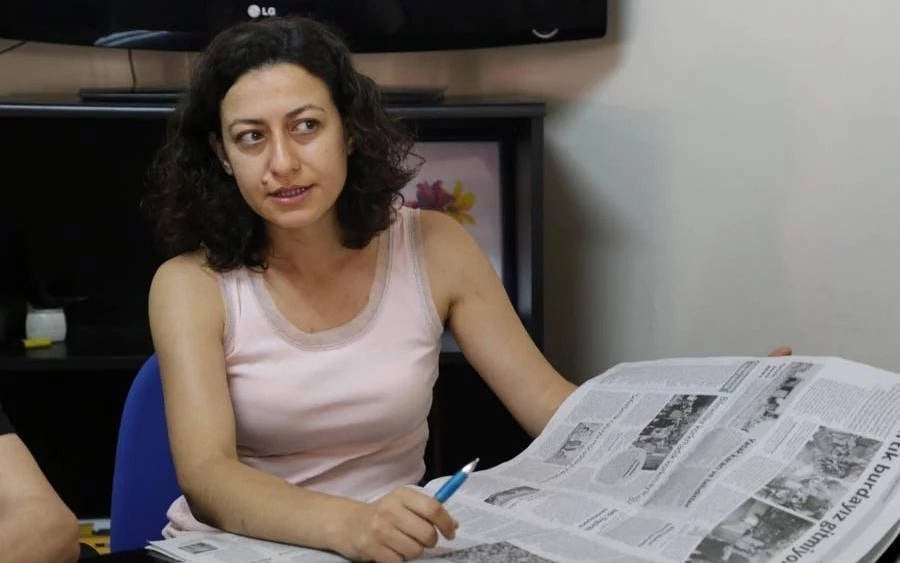



Journalist and DİSK Basın-İş union's disciplinary board member Derya Okatan sent a message from prison following her arrest on Oct 2.
Okatan, who was transferred to Bakırköy Women’s Closed Prison, said in her message that she was in good health and good spirits:
“Unfortunately, in the 20th year of my career, I too have now seen the prisons that almost every journalist in Turkey passes through at least once... But I’m in good health and good spirits. I hope the mistake that led to my arrest will be resolved as soon as possible and that I will return to you. Thank you very much to everyone who has shown solidarity. My greetings and love to all my friends....”
Jailed over a drive seized in 2019
Okatan was arrested over an external hard drive that had been seized in 2019 as part of a separate investigation.
The İstanbul Provincial Gendarmerie Command said it found PowerPoint, Word, Excel and PDF files in a folder on the drive.
The İstanbul 1st Penal Judgeship of Peace ordered Okatan’s arrest after concluding that the files included “classified documents concerning Çorum and Tokat that should only be in the possession of security forces.”
During questioning by the judgeship, Okatan said the drive had previously been seized as part of another investigation. She said she used it to store her movie archive and had nothing to do with the documents:
“The hard drive, said to be a WD drive, contains data believed to have been produced by the state. Most of it is intelligence information. I saw these for the first time at the gendarmerie. I’ve had this external drive for quite a long time. I don’t know whether someone else put them on it or what happened, but there has clearly been a mistake.”
Okatan noted that a significant portion of the documents concerned Çorum and expressed her surprise:
“I’m a journalist. I worked as a journalist in İstanbul for many years, and since 2018 I have been reporting in Ankara. Even if I said I had obtained these as a journalist, these documents would be of no use to me whatsoever. I don’t even know anyone from Çorum, and I’ve never been there. I’m in complete shock. I don’t know how this happened, and I reject the accusation.”
BIA Media Monitoring Reports
‘The drive had already been in state custody’
Okatan also said she had been detained in 2019 over her journalistic activities and that her computers and hard drives were seized at the time.
She said she was not asked any questions about these documents then and argued that it should be investigated how the same digital material came to contain them years later.
“I was detained in Ankara because of my journalistic activities, and the same computer and external hard drive were seized. I don’t know whether these files were there at the time. I used that drive as a movie archive. To me, it was just something sitting in a drawer. Nothing came up then, and I was never asked about it.”
Okatan said she could not remember whether she had used the hard drive afterward, adding that her computer had broken down and she had bought a new one.
“There should be records of this at the courthouse. My computer was broken after I got it back, and I had the red laptop repaired, but I may never even have opened the external drive after getting it back. When were these files put on it? When were they uploaded? There is no information about that.”
‘I wish the gendarmerie had included this information in the case file’
Okatan also questioned why the case file did not contain technical data on the history of the digital material. She continued:
“I wish the gendarmerie had included this information in the file by now. I’m genuinely very surprised by all this. I have absolutely nothing to do with it. I wasn’t able to see the grounds stated in the referral letter.”
Ergin: Files date from 1990 to 2003
Okatan’s lawyer, Ziya Ergin, also rejected the accusations during the judgeship hearing. In his defense, Ergin highlighted two points in particular: that the drive had previously been in state custody and that the documents were old. He told the judgeship:
“There are two important points for us here. The first is when these files were placed on the hard drive. The second is that the data on it covers the period from 1990 to 2003.”
Ergin recalled that Okatan had been detained in 2019 and that her digital materials had been taken into the custody of security forces at the time. He continued:
“My client was detained in 2019, and all of her materials were seized. She did not use them afterward. When we look at the case file, the latest access or modification date is 2010.”
‘The hard drive may have been mixed up’
Ergin said it should be investigated how the documents ended up on the hard drive. He also raised the possibility that the digital material may have been mixed up with other material:
“The file shows the date on which it was modified. Whether it was under my client’s control or whether she obtained it from somewhere, are we to believe she never opened it or looked at it since 2010? On the other hand, for this offense to have occurred, the material must still currently be classified.
“What we want to know is how this data appeared on a hard drive alleged to belong to my client. There may have been a mix-up. Perhaps the hard drive itself was mixed up with another one. My client has a child she is responsible for, has a fixed residence, poses no flight risk and has no opportunity to tamper with evidence.”
Ergin also said the documents consisted of intelligence activities and records of surveillance conducted in Çorum between 1990 and 2004.
He said it should also be investigated whether documents dating back 20 to 35 years could still be considered classified on national security grounds today.
'How the documents got onto the drive must be investigated first'
DİSK Basın-İş also called for Okatan’s immediate release in a statement issued after her arrest.
The union noted that Okatan’s external drive had been seized in 2019 and that a forensic image had been made of it at the time. It called for authorities to determine when and how the documents at the center of the accusation were placed on the drive.
“We condemn the fact that journalist and DİSK Basın-İş Union disciplinary board member Derya Okatan was referred for arrest without even being questioned by the prosecutor and was subsequently arrested on Oct 2. This decision is not only an interference with a journalist’s freedom, but also a serious attack on the public’s right to information, press freedom and the profession of journalism.
“Derya Okatan, who has worked as a journalist for more than 20 years, has repeatedly faced investigations, been detained and had her digital materials seized because of her professional activities. She has now been arrested on the basis of documents said to date back many years. However, the external drive cited as grounds for the arrest was reportedly forensically imaged and examined in 2019 as part of another investigation. Okatan says she did not use the drive after that date, while the files at the center of the accusation reportedly show 2010 as their last modification and access date. Derya Okatan also says she saw the documents for the first time while giving her statement.
“In such a situation, the proper course of action is not to arrest a journalist, but first to determine when, how and by whom these documents were transferred to the external drive. It is unacceptable to order detention before comparing the forensic image taken in 2019 with the current external drive, investigating whether the documents were added later, and establishing any technical evidence showing that Derya Okatan knowingly obtained, opened or used these files. Digital material whose integrity remains in doubt cannot be used as grounds to deprive a journalist of her liberty.
“The prosecutor’s request for her arrest without first taking the journalist’s statement, and the court’s acceptance of that request without adequately considering the fundamental questions raised by the defense or the proportionality of pretrial detention, raise serious concerns about legal safeguards. Pretrial detention cannot be turned into a form of punishment or a tool for silencing journalists.
“We call for Derya Okatan’s immediate release, for the accusations against her to be assessed in line with universal principles of law and press freedom, and for an independent expert examination to establish when and how the documents in question were transferred to the external drive by comparing it with the forensic image taken in 2019.”
(HA/VK)

