



LGBTI+ organizations, rights advocates, activists and venues where queer people gather have faced investigations since the launch of operations dubbed “My Family Is Safe” on Sep 12.
Among those arrested was Janset Kalan, a board member of the Kaos GL Association and a trans rights defender. A graduate of Marmara University’s Department of Political Science and International Relations, Kalan completed a master’s degree in Eastern European Studies at the University of Bologna.
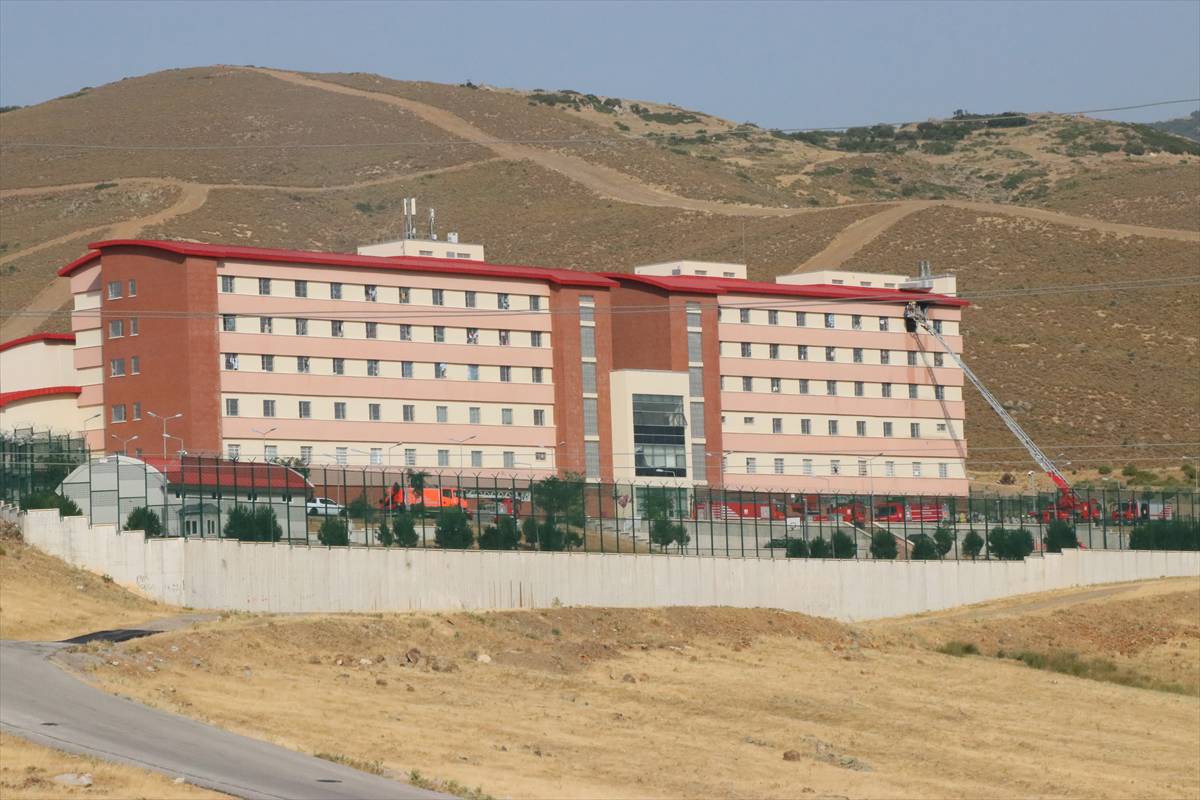
Her articles have appeared on KaosGL.org since 2010, and she has worked with various LGBTI+ organizations, including Queer Adana and Pembe Hayat. Kalan, who has been advocating for trans rights and against discrimination and violence for more than a decade, was arrested during the “My Family Is Safe” operation on Sep 12, 2026, and sent to Sincan Prison.
Kalan responded in writing to bianet’s questions from Sincan Closed Prison. We spoke with her about whether it is possible to be “well” in prison, the conditions faced by trans prisoners, isolation, and how being able to touch another person can become a “privilege” behind bars.
Before answering the questions, Kalan wanted to describe the communication conditions in prison and the situation of the friends imprisoned with her:
First of all, I’m sorry for responding late. Unfortunately, I hope you can understand the very real reasons behind the delay: some of the limitations inside the prison, our lawyers having to travel back and forth, our limited financial means, the difficulty of managing time, and so on.
Eight of us, members of Kaos GL’s executive and supervisory boards, along with an independent woman journalist friend of ours, have been on the Sincan Closed Prison campus for some time. Our lawyers are therefore making an extraordinary effort, within the limits of what is possible, to meet with all of us and make sure we are doing as well as we can.
Several lawyer friends are also trying to visit other trans and gay prisoners being held here, whether convicted or awaiting trial. Many cannot afford a lawyer. Many also have no visitors and no one they can contact to let their families know where they are. Some do not even have money to buy basic necessities from the prison canteen. Under these circumstances, delays are inevitable.
Before answering your questions as best I can and putting my thoughts into words, I wanted your readers to hear once again about the limitations I described above. I’m from Adana, and we have a saying there. It’s a pretty sexist one, but I still wanted to mention it: “It’s easy to divorce someone when you’re single.”
In fact, as I spend time with other prisoners here and listen to the stories of how their lives unfolded, that saying keeps coming back to me. And when I think of the horrific cases shown on programs like Müge Anlı and Esra Erol, or news reports about femicides, violence, gangs, fraud and so on, it is impossible not to remember it.
Something a prison officer said also reminded me of that saying. He told me: “I also come from a poor family and grew up in a neighborhood where illegal activity was widespread. But I educated myself and became a civil servant. The people here serving time for various crimes could have done the same.”
My answer was very clear: “You should not turn your own story into an opportunity to judge someone else for not having the same one. You cannot reduce crime by placing the burden of a structural problem on individuals.”
I hope your readers will also read this from a perspective that goes beyond what they know, what they have seen and their own personal stories.
'Don’t expect anyone to find a sense of well-being here'
You said from prison, “I don’t want to lie by saying I’m fine.” How are you today, and how would you describe the conditions of your imprisonment?
It has been two weeks since the letter I sent to Kaos GL for publication. Of course, I no longer carry the same anger, resentment and anxiety brought on by uncertainty. I won’t repeat how horrible those three days in police custody were.
At the same time, there were many other things I did not mention in my letter. I don’t feel obliged to write about them. I am perfectly capable of understanding what people want to hear, how much they want to hear and in what language, as well as the kind of censored framework in which the public expects to hear certain voices. So anyone who wants to can write and act out whatever speculative scenario they please. I am responsible only for what matters to me, and for what I have personally experienced and witnessed.
I could not address anyone with the lie that I was fine. I still won’t say I’m fine today. “I’m fine” is not an ordinary answer for me. No one should expect to find a sense of well-being here. Nor is anyone deprived of their freedom speaking from a genuine state of well-being when they say, “I’m fine.”
I believe it is an insincere and unreal “I’m fine,” something you say so that your loved ones, those close to you, your community and people outside can feel better, and so that you can make your own circumstances a little easier to endure.
What I have to say is not the same as the stories we are used to reading about people imprisoned because of their political views, activities or political identity, or for exercising freedom of expression, freedom of association, the right to protest or artistic expression.
My language does not speak, in the language of the left, of the more familiar and respectable forms of revolution, resistance and solidarity. I am not being held in a place for political prisoners, either. I am not my sisters and fellow travelers in the LGBTI+ movement, Yıldız Tar and Duru.
I would also advise you not to read my sentence, “I don’t want to lie by saying I’m fine,” solely through the conditions of my imprisonment.
We question prison conditions, but it is called a prison for a reason. Let the Human Rights Association (İHD), the Human Rights Foundation of Turkey (TİHV) and the Civil Society in the Penal System Association (CİSST) speak about that. You can also request a report from our lawyers. This should not be my job.
Turkey’s justice system appears oblivious to the presumption of innocence, while prisons are built around a male-dominated architecture of punishment, a structure that strips prisoners of their humanity and turns them into monsters. As convicted or remand prisoners at the mercy of those who hold power, we are only “fine” to the extent that we are able to survive the conditions we are placed in.
Let me ask you, as a journalists, and your readers: What do you expect?
'Just imagine how invisible trans prisoners are'
As a trans prisoner, what problems do you face that are different from those faced by other prisoners?
To answer that question, I would need to have met other prisoners, spoken with them and learned what they have experienced. You are asking me to make a comparison, and I do not have enough information to do that.
But I can say this very clearly: LGBTI+ prisoners, convicted or awaiting trial, do not even make up one-thousandth of the total prison population. When every architectural, physical, social and material condition has been designed through a male-dominated lens, you can imagine for yourself the subjectivities and invisibility of trans prisoners, their needs, their poverty and deprivation.
Despite everything, I am glad to be a trans woman, and I am glad I am being held together with other trans women. The laughter and banter I share with my sisters is the most precious source of strength keeping me standing tall here.
I hope the other queers will soon be taken out of their solitary cells and placed in wards, as I was.
'Being able to hug someone becomes a privilege'
You said, “I had never imagined that being able to hug another person could be a privilege.” How do isolation and restrictions on physical contact affect your daily life?
I have been in the ward for a week now, and together with my sisters here, I too have that privilege.
I am so glad they are here. I am so glad I met them, that I was able to write down their stories and pass them on to our lawyers. I am also glad I was able to learn from them the stories of all the other queers being held here.
'Advocacy cannot be built on stock phrases'
With your call to “remember imprisoned trans people,” what specifically do you expect from the LGBTI+ movement and human rights organizations outside?
I won’t give a long answer to this question. I don’t think it has the kind of simple answer that can be given to an interview question. By critically examining themselves, they can see how inadequate action and advocacy become when they are not grounded in knowledge of the situation.
Recently, I sharply criticized a lawyer friend from İHD who came to visit us. They immediately became defensive and tried to explain how much work they were actually doing. Unless they move away from this arrogance, like any social movement that refuses to examine itself, they will keep repeating the same stock phrases, as if singing, “There’s a village far away.”