



The research and archive complex Salt is İstanbul’s answer to the question of how free and public exhibitions might respond to outstanding needs in a society built on the exclusivity of capitalist profit for extractive industry, exploiting people and the environment, while affecting the subtler realms of political ideology.
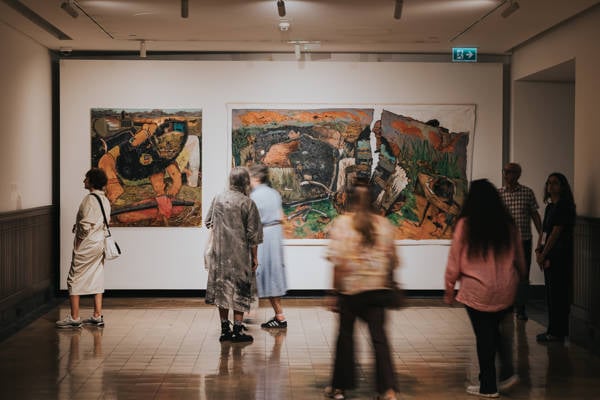
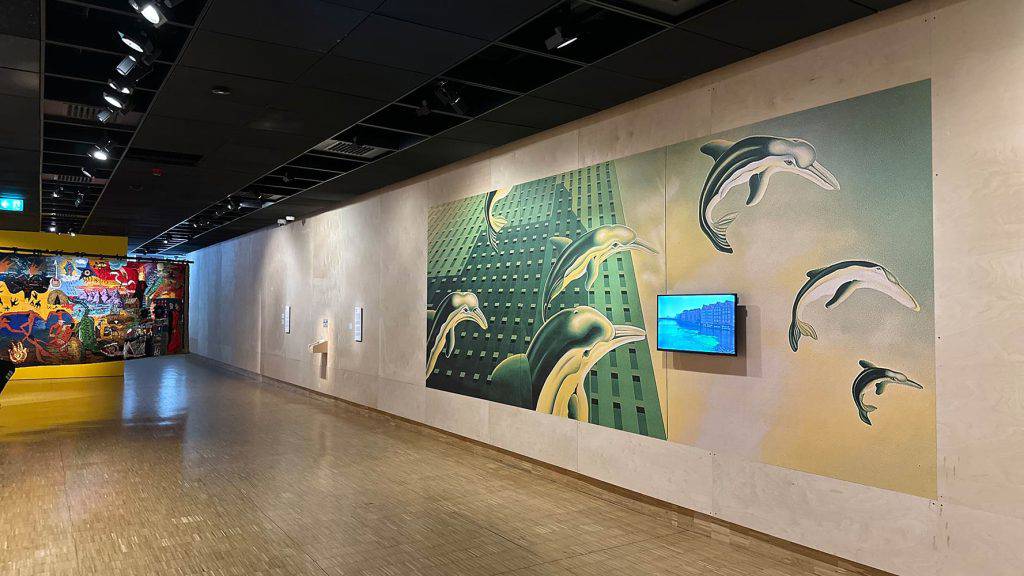
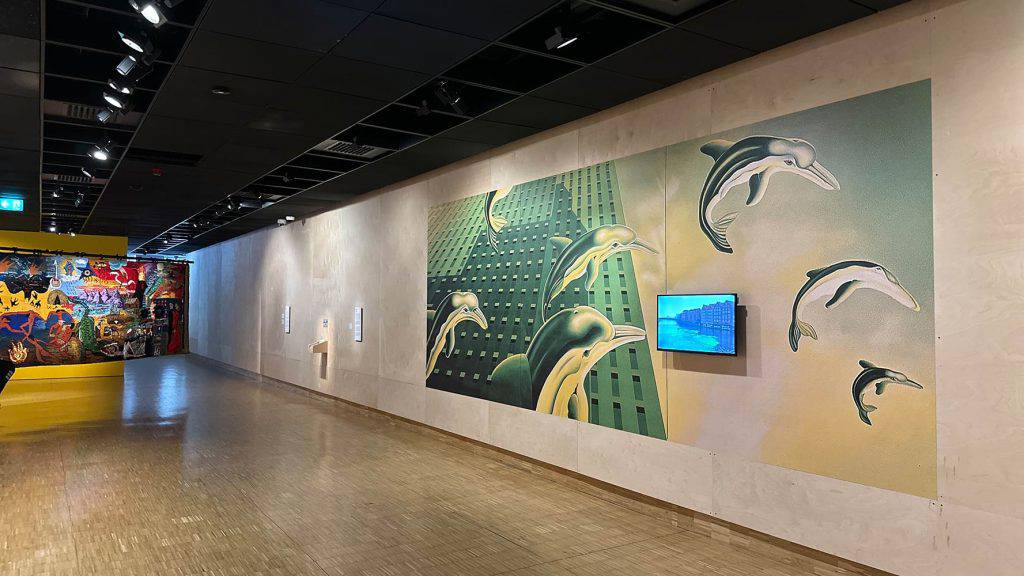
The Lives of Animals, the latest series of cultural programming at Salt Beyoğlu, adapts the title of J.M. Coetzee’s book-length essay into a curation of pedagogical, multimedia productions, foregrounding artwork by the late German-Iraqi activist Lin May Saeed with a host of prolific creatives spanning geographies and decades, all of whom dedicated their outputs to the cause of stimulating social awareness for the impacts of industrial infrastructure on animal life.
“Hopefully, the publication of research, the development of educational programs, and the promotion of this research subject will contribute meaningfully to improving animals' living conditions—and ultimately, to the downfall of industrial production, as industrialization is responsible for the greatest harm to animals,” Joanna Zielińska, programmer of the exhibition, told bianet.
"In both art and life, animals still appear as protagonists of magical, spiritual worlds—and at the same time as food on a plate. These two perspectives are mutually exclusive in real life,” Zielińska continued.
One of Saeed’s striking works on display is The Liberation of Animals from their Cages XXII / Woman with Kid (2019), and what stands out is not only its figurative representation of a woman holding onto a baby goat, but that the artist constructed the sculpture from steel. Decidedly minimalist in tone, Saeed’s work sacrifices aesthetic craft for sociopolitical effect.
Zielińska worked alongside fellow programmer Fatma Çolakoğlu, leading a team of researchers, designers and editors, contextualizing the blunt directness of Saeed with a sensitive reading by Argentine artist and PintorAs feminist art collective co-founder Ad Minoliti, whose piece, Nature is Queer — Tribute to Lin May Saeed (2024) covers the breadth of a mural to introduce the second hall of the three-floor exhibition space, announcing its critique of established animal-human hierarchies through plays on geometric, optically-illusive formalism.
Repositioning animals as 'subjects of agency'
“Rather than presenting animals as symbols or metaphors secondary to human concerns, the exhibition repositions them as subjects of agency, emotion, and ethical urgency,” Deniz Ova, Salt's executive director, told bianet. "In the context of Turkey, where conversations around animal rights often remain polarized or instrumentalized, we hope the exhibition offers a more layered and nuanced perspective.”
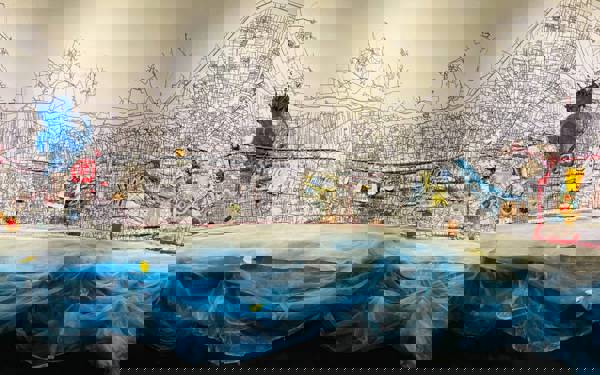
In the wake of previous, equally timely programs, such as Climavore: Seasons Made to Drift on how human diets affect climate change, or Notes on Air, reimagining air pollution, and the ongoing screening series, Is This Our Last Chance? on ecological crises, The Lives of Animals offers an exhaustive source of documentary reflection on Turkey's recent nationwide debate over the treatment of stray dogs in its cities. Mine Yıldırım’s work, Between Care and Violence: The Dogs of İstanbul is a trove of archival investigation, excavating journalism, photography, video, cartoons, and all orders of paper trails and ephemera to refocus popular attention, beyond the fleeting news cycle, to the government-sanctioned mass murder of stray dogs in Turkey. Replete with explanatory wall texts, it is a powerful visual and textual assemblage, chronicling the tragedy of anthropocentric policy against efforts to legislate animal protection.
“Artists and activists such as Mine Yıldırım, Lin May Saeed, and Sue Coe contribute to educating new generations by spreading compassion and care. Institutions cannot tell people what to do, but they can expose injustice and open people up to different perspectives,” explained Zielińska.
Anatolian Plant Legacy
More, the current public program at Salt does not stop with fauna, but enters the realm of flora, a stratum of biodiversity worlds greater than living beings with independent means of motion. In the Kitchen area of the historic Siniossoglou apartment building that houses Salt Beyoğlu, the exhibition, Anatolian Plant Legacy traces a tradition of naturalist illustration to document the variety of flowers, herbs, fruits and vegetables that has ever thrived on the Asian landmass of the Turkish countryside.
Featuring 80 artworks by 47 artists, and programmed by both a scientific and artistic jury, Anatolian Plant Legacy is the result of collaborations led by the Flora Research Society and guided by the Turkish Plant Names Committee, the Herbarium Network Committee and the Botanical Artists Committee. Its drawings, paintings and presentations of historical literature spotlight the 3,649 local endemic species, making Turkey more diverse in flora than anywhere else on the European continent.
“Efforts to protect this richness have taken many forms, but critical gaps remain. Turkey is one of the few countries where new plant species are still being discovered every ten days, and yet, comprehensive conservation frameworks lag behind,” Burçin Çıngay, a member of the exhibition's organizing committee, told bianet.
“We view plant conservation as a form of cultural and ecological recovery. Botanical art, in this context, is not just a form of remembrance—it is a blueprint for restoration.”
The exhibition can be seen at Salt Beyoğlu until Aug 10.
(MH/VK)