









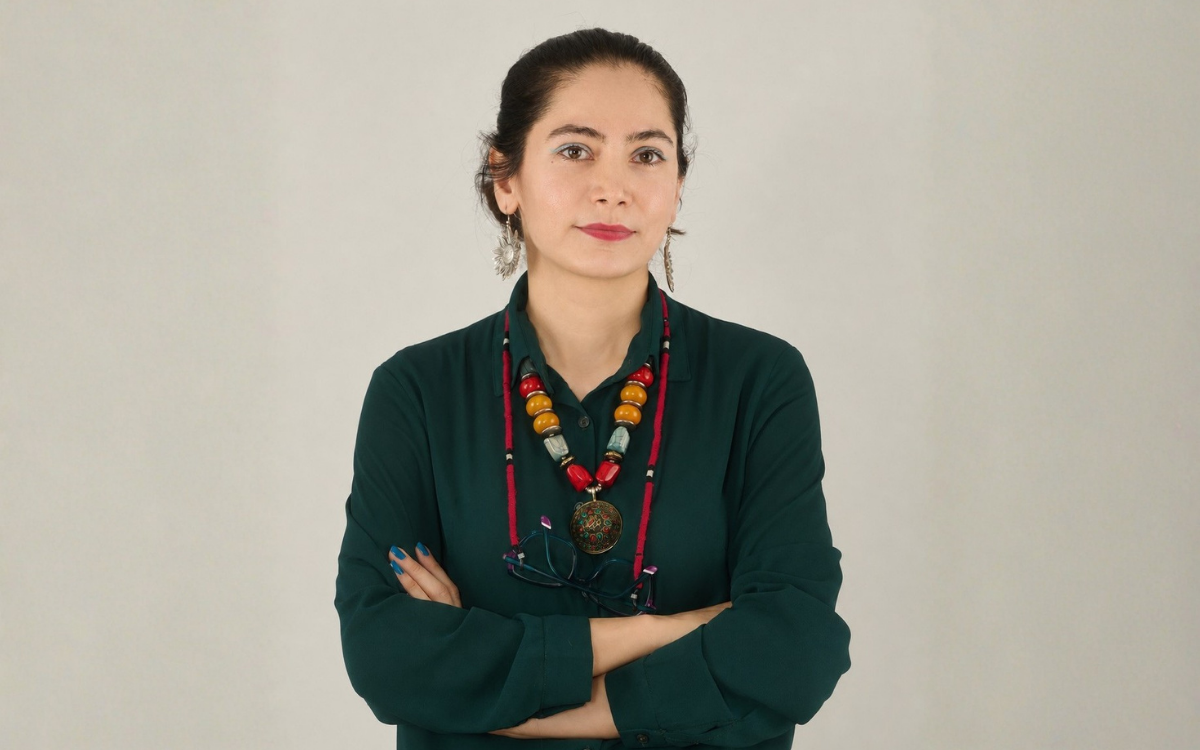



Shiva Akhavan Rad is an independent Iranian journalist living in Tehran.
Rad says that in her youth, she kept a personal blog under a pseudonym, where she wrote about love, dating, romantic experiences, the books she read and the films she watched. She says the blog gave her a small but meaningful space of freedom: “That blog gave me a space where I could narrate part of my life as I was actually experiencing it—something that was not possible for me in public.”
Fast forward to today, she points to how significantly the outlook of daily life has recently changed: "For me, the Jin, Jiyan, Azadî movement marked the beginning of a shift in which compulsory hijab effectively lost much of its authority over everyday life. Today, the image you see on the streets of Tehran is something that might have been unimaginable to many of us ten years ago."
Rad reflected on what it means to be a woman in Iran, where the women’s movement stands today, and her experience as a journalist.
Control over the body
What does being a woman in Iran mean in public and private spaces? What are the main factors that determine or limit the spaces in which women can exist as women in everyday life? What are the legal, social, and cultural boundaries that clearly distinguish women’s lives from men’s?
From an early age, I was a rebel. Many of the freedoms that my family and society restricted for me seemed so self-evident that I simply could not understand why there should be any restrictions at all; why I should have to negotiate or answer for something simply because I was a girl, or why I should be denied the right to do something or have something that came naturally to me.
There were many situations in which I simply did not have the power to push back. Later, I learned how to protect myself better: by keeping my distance, making myself less visible, avoiding confrontation, and sometimes staying silent when there was simply nothing I could do. But in silence and in private, I continued to live on my own terms.
Even today, when I enter an environment or a group where freedom and human dignity are not taken seriously, I would rather leave that place and that group.
When I was younger, I had a private blog where I wrote under a pseudonym about romantic experiences, love and dating, the books I was reading and the films I was watching. I wrote about things I could not talk about publicly under my real name. That blog gave me a space where I could narrate part of my life as I was actually experiencing it—something that was not possible for me in public.
Part of this inequality and discrimination is rooted in culture and tradition, while another part is connected to Iran’s political system. The Islamic Republic is governed according to Islamic laws, and many people, including those who do not believe in Islam themselves, are forced to live under laws they do not believe in.
At the same time, I do not think all of these issues can simply be attributed to religion. Even among people who consider themselves anti-religious, certain traditional and discriminatory attitudes can become so deeply internalized that they continue to be reproduced.
One of the clearest differences, in my view, is that women do not have full control over their own bodies. At that point, we are no longer dealing simply with traditional attitudes or family pressure; the state directly intervenes in this area.
Limitations of legal protection
At what moments do women in Iran feel the inequalities and limitations arising from being women most strongly? When and how do you think this awareness develops in women’s lives? What was your own awareness and experience regarding this issue?
Women’s awareness of inequality does not always begin with a major event or a single defining experience. Sometimes it begins the moment a child realizes that something is forbidden or restricted for her, while it is completely normal for her brother or for a man.
These inequalities later reveal themselves in much more serious situations: in courts, in questions of child custody, and in cases involving violence and self-defense. In some cases, even a woman who has killed an attacker while defending herself against rape may face a murder charge and extremely severe punishment, including qisas (retribution in kind, which can include the death penalty).
In such situations, the difference between women’s and men’s rights and circumstances is no longer simply an everyday difference; it can become a matter of life and death.
At the same time, I do not think we can look at all experiences of inequality in Iran today solely through the lens of gender. Women certainly face restrictions and experiences that men do not, but there are also many issues that women and men experience together. Regardless of gender, we are all living under an authoritarian political and social structure, and in recent years, the economic crisis, inflation, poverty and widening class inequality have affected so many people’s lives.
That is why I do not agree with portraying Iranian women and men as always standing on opposite sides. My experience has been that many Iranian men support women and stand alongside them. I think it is important to distinguish between the Iranian government and the Iranian people. If we look at Iranian society today only through the lens of women versus men, we miss a large part of the reality.
Solidarity expanding to daily life
How did the “Jin, Jiyan, Azadî / Zan, Zendegi, Azadi” movement that spread from Iran to the world in 2022 affect solidarity among Iranian women? What remains today from the forms of solidarity and organization that emerged at that time? Today, how do women create spaces of resistance, solidarity, and organization for themselves in everyday life?
I think a significant part of that solidarity is still there, although not necessarily in an organized form or through clearly defined groups and organizations. What matters to me is that this solidarity was never limited to women; Iranian women and men supported one another, and they still do.
Perhaps the most important change for me was that some things we had once only been able to imagine in our minds entered the streets and everyday life.
For me, the Jin, Jiyan, Azadî movement marked the beginning of a shift in which compulsory hijab effectively lost much of its authority over everyday life.
Today, the image you see on the streets of Tehran is something that might have been unimaginable to many of us ten years ago.
For me, the importance of this movement was not only in the street protests. It was also in the fact that large numbers of people decided to make different choices about how they wanted to live—and to accept the consequences of those choices. Part of that solidarity continues today through these everyday choices.
That is why I do not see the Jin, Jiyan, Azadî movement simply as a women’s movement. I see it as part of a broader effort by people who wanted to live more freely and to have greater agency and dignity in their own lives.
Invisible boundaries in journalism
Cases involving sexual assault, self-defense, and severe punishments imposed on women occasionally spark debate in Iranian public opinion. How might such cases resonate psychologically among women? Are there legal mechanisms, institutions, solidarity networks, or safe spaces that women can turn to in cases of sexual, psychological, economic, or physical violence? To what extent are women able to access these mechanisms and how effective are they?
In many cases, women cannot turn to reliable legal mechanisms or support institutions, and informal networks—family, friends, or people they trust—often play a more important role.
The legal structure of the Islamic Republic is fundamentally at odds with legal equality between women and men, and a significant part of these laws stems from the government’s official interpretation of Islam.
The problem is not simply that women do not receive sufficient protection from violence; sometimes the law itself can place them in an extremely difficult position. For example, as I mentioned earlier, in cases where a woman has killed an attacker while defending herself against rape, she may, depending on the circumstances of the case and the laws concerning qisas, face the death penalty herself.
As a woman journalist living in Iran, what difficulties do you face? Are there situations that you experience differently from your male colleagues because you are a woman while doing your profession?
I am a freelancer, and most of my work is online. I work from home, cafés, or while traveling. As a result, I personally have not encountered many of the restrictions that women in Iran face in their everyday working lives simply because they are women.
But there is one particular incident I remember clearly. I was working at an organization where one of my colleagues harassed me for months through his comments and, especially, his messages. Eventually, I raised the issue with the head of the organization. But because he had a close male friendship with that colleague, he did nothing about my complaint and told us to sort it out between ourselves.
In the end, that “male camaraderie,” despite the fact that I loved my work, forced me to leave.
We should not imagine Iranian women’s experiences as uniform. Depending on the type of work they do and the environments in which they work, some women face far greater restrictions, while others, like me, have relatively safe and independent working environments. These limitations do not exist in the same way for every woman.
When reporting on the problems women face, do special pressures, restrictions, or areas of self-censorship emerge for journalists? What are the professional and personal risks of reporting on these issues?
If you are a journalist who is very active on social media, particularly if you write about politically sensitive issues, you may have to censor yourself to avoid arrest or interrogation, or move toward less risky areas of coverage.
I have not personally faced any direct trouble so far—perhaps because I am not a well-known figure. From the beginning, I created a kind of safety buffer for myself: I did not publish my posts on Instagram, and I did not become part of any particular circle, movement, or subgroup. These choices have allowed me to remain relatively independent, although that does not mean there is no risk.
There are colleagues who have been imprisoned, summoned, or interrogated. So even though I have never personally experienced arrest or interrogation, I am always aware that the line between writing and getting into trouble can be very thin.
'The news finds its way to you anyway'
Looking at your own life, what event or experience has affected you the most, both as a woman and as a journalist? How did this experience affect your perspective on life, the women’s struggle, and journalism?
Becoming familiar with meditation, mindfulness and self-awareness changed my path and my perspective on the world and on life. I became calmer, happier and more hopeful.
I am a journalist, but unlike many journalists, I do not constantly follow political news. I start my mornings with gratitude, not by checking negative news. I am a very positive and hopeful person, even—and especially—while living in Iran. After all, when you live in Iran, the news finds its way to you anyway: through changes in the price of the dollar and the euro, through the rising price of coffee. I do not need to spend my time constantly scrolling as well.
I might change careers tomorrow and stop writing altogether. The freedom we have, simply by being alive on this earth, to do whatever we want with our lives is immensely beautiful and exciting to me.
I no longer dwell on the past, but if I want to answer your question honestly, several traumatic experiences changed the course of my life and the way I look at it. One of them was the psychological, emotional, and sexual abuse I experienced at the hands of a well-known Iranian filmmaker. I was young and inexperienced at the time. I spent a long time working through the trauma, and eventually I managed to come through that period alive, whole, wiser and freer. But I have to say, it was a very dark time.
Today, thanks in part to the MeToo movement, things have changed to some extent. Later, when I spoke to the admin of the Persian MeToo page about publishing my account, she told me that another young woman had experienced exactly the same thing with the same filmmaker. The pattern was so similar that she could hardly believe that the two of us were two different women.
He made films about young people and was deeply concerned with their lives and experiences, yet he himself was exploiting them.
One of the things that came out of that experience was that I ended up becoming a journalist instead of an actress.
Being reduced to symbols
What do you think is the point that those who follow the struggle of women in Iran from the outside overlook the most? What would you particularly like to tell those who want to understand the lives and struggles of Iranian women today?
The problem is that Iranian women are often expected to always represent something: either victimhood or resistance.
I myself might write about political and social issues one day, spend another day volunteering and working on a farm while traveling, or simply want to cook.
This part of life is less visible in the stories coming out of Iran that are seen and followed from outside the country.
If someone really wants to understand the lives of women in Iran, they also need to see this everyday, less visible side—not only the visible moments of protest and resistance, but also the complexities, choices, and even contradictions of women’s lives. (EÖ/VC/VK)


