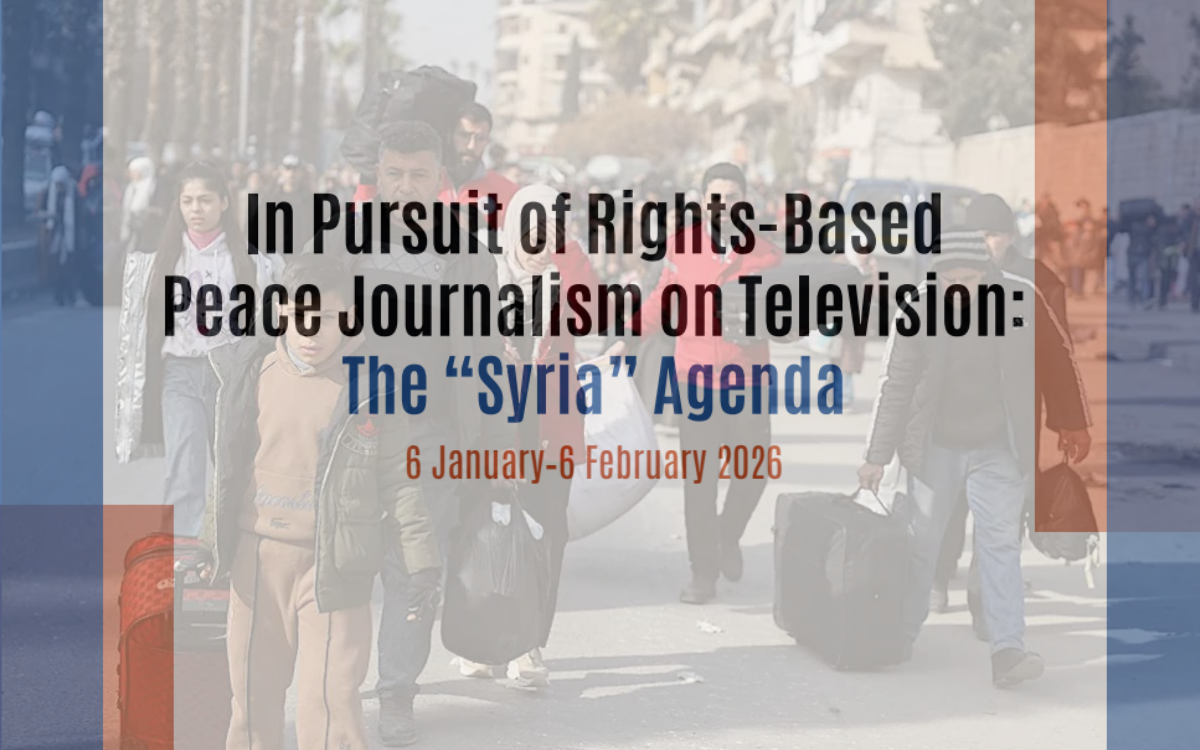







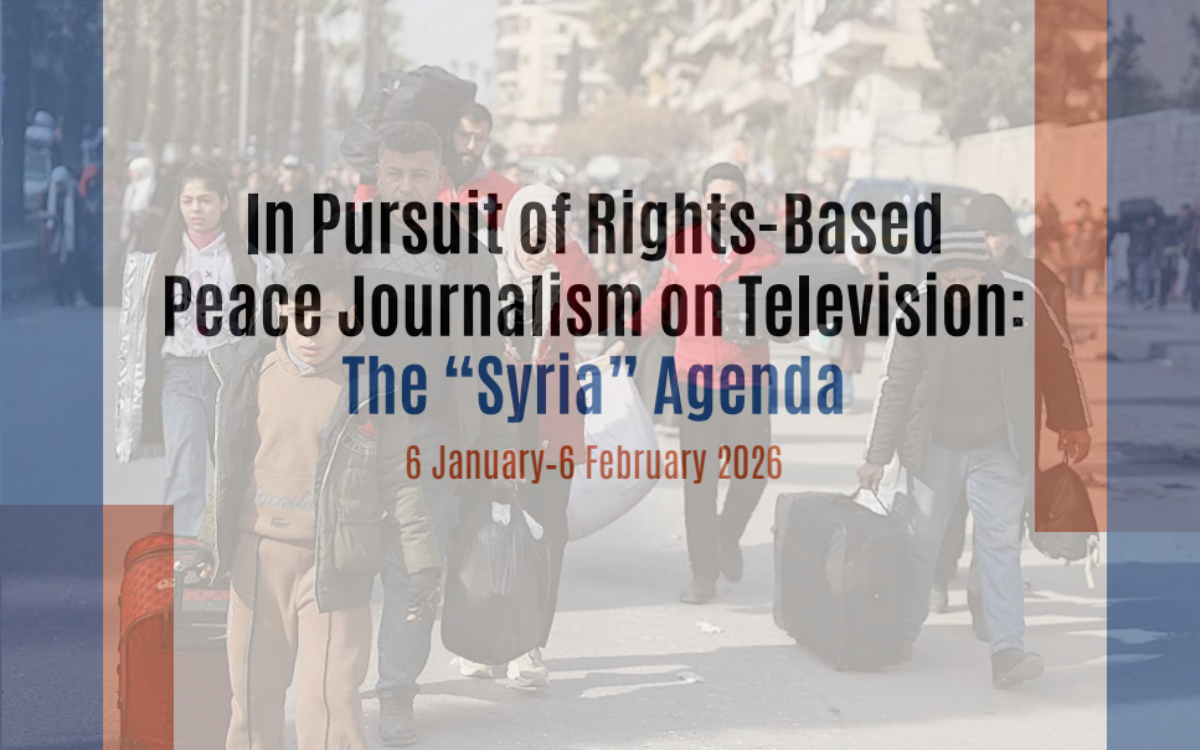



Professor Nazan Haydari conducted a research study examining the way that Turkish media channels discussed North and East Syria, also known as Rojava. She found that polarizing, militaristic and “othering” language was consistently used in reporting on Kurds. The frameworks used to discuss Kurdish issues in Syria also largely revolved around security and military concerns, rather than political representation and equal citizenship.
When news media did use rights-based peace journalism language, it tended to correspond with diplomatic updates.
Her study examined major TV news and political program coverage, including CNN Türk, atv, İlke TV, Sözcü TV, Halk TV, and NOW TV during the period between January 6 – February 6, 2026, through a rights-based peace lens. The research conducted a large data analysis of 225,460 sentences obtained from 303 broadcasts, qualitative discourse analysis and anonymous interviews conducted with television journalists.
The final 112-page report titled "In Pursuit of Rights-Based Peace Journalism on Television: The 'Syria' Agenda” was supported by Civil Rights Defenders and published by the IPS Communication Foundation/bianet.
Coverage between conflict, ceasefires and rising tensions
The time period of the study coincided with several turning points in the Syrian political situation. This allowed for comparison in how Turkish news media covered conflicts, ceasefire and other other political developments.
During the period of the study, fighting broke out between the Kurdish-led Syrian Democratic Forces (SDF) and the Syrian army on Jan. 6, a ceasefire and Kurdish integration process was announced on Jan. 18, a controversial incident where protestors lowered a Turkish flag in Syria occurred on Jan. 20, hair braiding (kezî) protests broke out on Jan. 21, protests were held in İstanbul on Jan. 24 against the Syrian government attacks on Rojava, fighting took place between SDF and the Syrian government again in Kobanî and on the Hasakah countryside on January 26, and a consensus was reached between Damascus and the SDF on Jan. 30.
This period also coincided with the Kurdish peace process in Turkey, allowing for readers to understand how the Turkish media’s approach to covering Kurdish issues and editorial preferences may shift based on larger political developments.
The study demonstrated that between the period from Jan. 6 to Jan. 13, when there was conflict between SDF and the Syrian army, the Turkish media heavily utilized security, operation and organization-based language.
Media coverage from Jan. 18 to Jan. 19, upon a ceasefire announcement between SDF and the Syrian government, used language indicative of politics and negotiations. However, this pattern was quickly reversed days later, on account of the noteworthy “flag lowering” incident, when during protests along the Nusaybin-Kamışlı border a Turkish flag in the former customs area was allegedly lowered by demonstrators on the Syrian side. This drew the strong ire in Turkey.
The report outlines this pattern — one of where military and diplomatic developments dictate the type of language used in coverage — as fundamentally harmful to rights-based peace journalism. In this cycle, rights-based peace language is only temporarily used and then inevitably discarded based on broader diplomatic developments — instead of being regularly applied through consistent editorial principles.
Kurdish solidarity protests were often excluded from coverage
In addition to analyzing outlet coverage, the study also examined what events were excluded from broadcast.
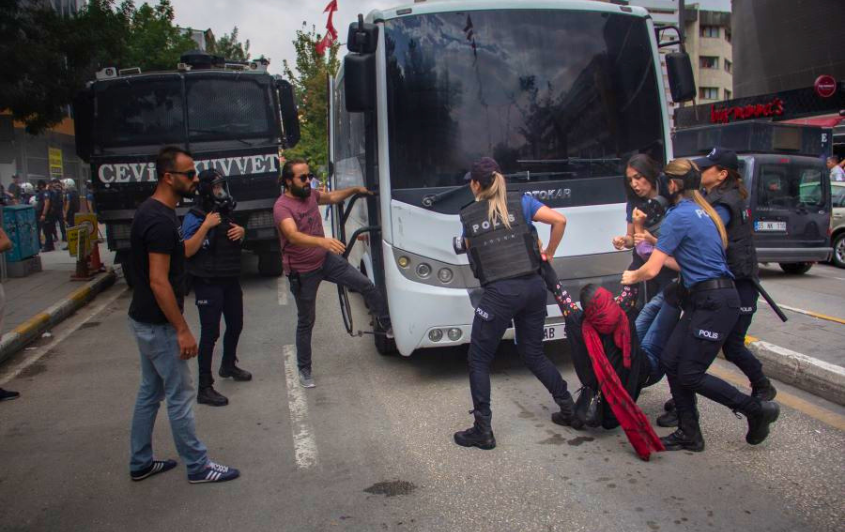
For example, hair-braiding protests in solidarity with Kurdish women fighters killed in Syria that began on Jan. 21 and marches organized in İstanbul on Jan. 24 against attacks on North and East Syria received limited coverage or were not featured at all on the majority of the channels analyzed in the study.
The report said that the erasure of certain voices is even more dramatic when it comes to issues pertaining to women. TV reporting tended to focus on official agreements and military developments, thus often leaving women's solidarity, bodily violence, and political demands expressed through street protests off of the agenda.
Differences between channels
The report said that CNN Türk, NOW TV, and Halk TV all used expressions tagged as hate speech when talking about the Kurdish issue at rates significantly higher than general channel averages. However, the study also noted that percentage figures surrounding negative language should not be interpreted as an “ethical violation ranking,” because some sentences may wrongfully receive a “negative sentiment tag” by the large language model in instances such as criticizing existing violence. Separate analysis done during the qualitative part of the study addressed the broader context around these sentences.
Additionally, one of the key differences between channels arises in the frameworks they use to discuss the developments, rather than solely how much airtime they give to the Syria agenda.
According to the report, atv’s use of polarizing language remains at 8.6% normally, and rises to 57.3% in sentences related to the Kurdish issue. Meanwhile their rate of “othering” language when talking about the Kurdish issue rises from 3.5% to 50.3%. Additionally, Atv’s coverage addresses military intervention within the framework of "necessity" and "inevitability."
When discussing Kurdish issues, CNN Türk’s usage of polarizing language rises from 11.6% normally to 37.7%. And their rates of “othering” language rise from 4.5% to 27.2%. CNN Türk’s narrative framework is constructed predominantly around security, central state authority, and Turkey’s border security
NOW TV does not give as much coverage to the events in Syria generally, but when they do, it gives weight to official sources and security-based narratives. Sözcü TV did cover military developments, diplomatic contracts and technical field information. However, Syrian central state authority and Turkey’s security concerns continued to form the baseline framework.
The report identified Halk TV as the platform with the most inconsistent editorial policy. The channel opens space for negotiation processes, political solution possibilities, protests and civil actions. However, despite this, it also produces problematic discourses due to tensions between textual narratives and audiovisual dramatization.
Among the channels included in the study, İlke TV stands out as the one most closely aligned with rights-based peace journalism. Kurdish identity is directly visible in the channel’s news coverage. Additionally, ceasefires and agreements are discussed not only in terms of military developments, but also in terms of linguistic and cultural rights, citizenship, political representation, local security, and constitutional guarantees.
The study noted that across channels the focus on security discourses is not limited to only pro-government broadcasters. Even among channels that defined themselves as in opposition to the Turkish government, many similar patterns persisted. Opposition channels could criticize government policies and put more distance between themselves and official statements. However, state-centered coverage, security expertise and the distinction of “legitimate actors” persisted in their broadcasts about Syria.
The report stressed that many channels restrict “peace” to solely the re-establishment of central state authority and the liquidation of armed structures. However, in a more rights-based broadcast, political representation, equal citizenship, local governance and the re-establishment of civil life should also be addressed as parts of the solution.
The role of journalists
The study also consisted of interviews with journalists themselves. The researchers found that structural conditions in the journalism sector serve as a major barrier in rights-based peace coverage.
Regardless of an individual journalist’s personal sensibilities or choice of words it remains difficult to overcome structural, institutional, rights-based peace journalism, which requires addressing structural conditions, institutional operation, and daily production practices.
A journalist objecting to a problematic expression, refraining from reporting unverified news, or proposing a more inclusive source list constitutes a necessary professional stance; however, in an institution where editorial interventions exist, job security is weak, written principles are not enforced, and decisions change from person to person, this stance cannot gain continuity. Editorial independence, adequate staffing, regular in-house training opportunities, field specialization, multi-stage in-house verification, correction and oversight workflows, and journalist safety can transform individual efforts and sensitivity into institutional guarantees. Consequently, peace journalism can transform into a daily and sustainable practice of journalism to the extent that individual ethical sensitivity is backed by structural and institutional possibilities. –Professor Nazan Haydari
According to the report, journalists often prioritize the perspectives of state officials, security sources, and official institutions, not just as sources of information, but even in determining how they name an event. This results in the erasure of communities outside of being mere subjects in official statements. Journalists should instead allow communities to speak for themselves.
The report said it’s important for journalists to not speak on behalf of the “other,” but rather open up spaces for those who have been excluded to express themselves, in addition to their knowledge, experiences and demands.
What is rights-based peace journalism?
The framework of the study carries the rights-based peace journalism approach — developed by Sevda Alankuş in the Peace Journalism Handbook — into today’s television environment. Rights-based peace journalism does not view peace in journalism merely as the cessation of conflict. Instead rights, equal citizenship, political participation, gender, representation, and structural violence also become key subject matter in peace news.
According to the report, a lasting rights-based peace journalism is possible by extending the usage of peace language beyond temporary discourse used only on ceasefire and agreement days, and embedding it into the newsrooms’ daily sources, representation, verification, and editorial decisions.
Click here for the full research report in Turkish.
Click here for the PDF version of the Peace Journalism Handbook.
(HA/İK)