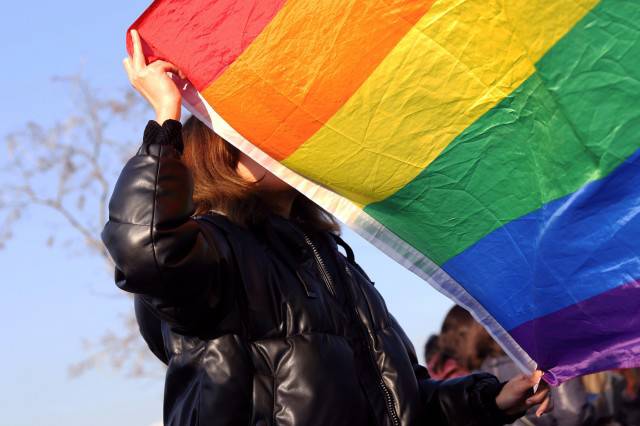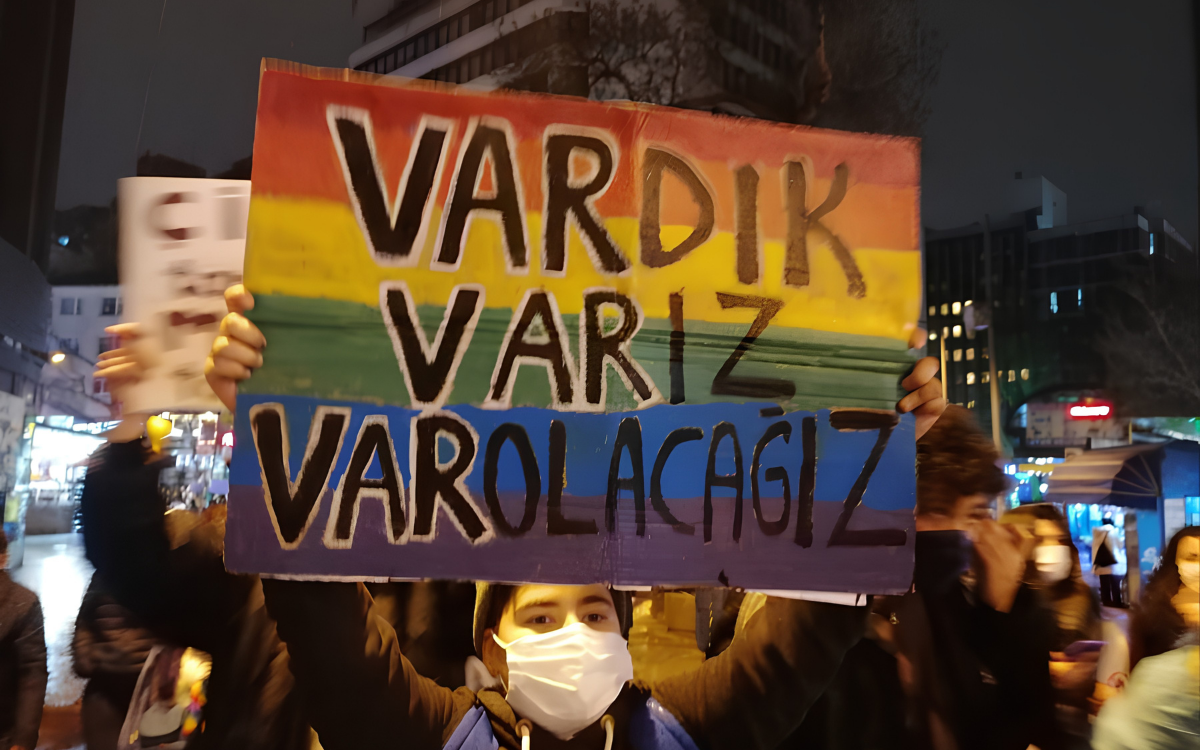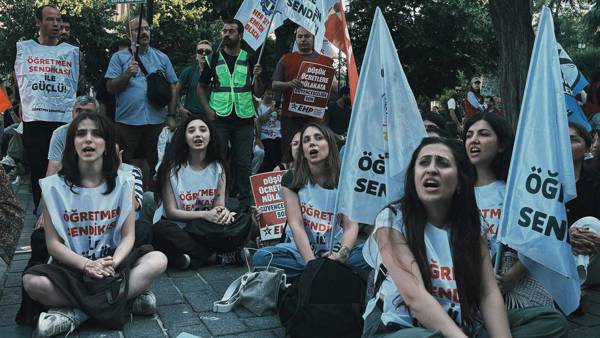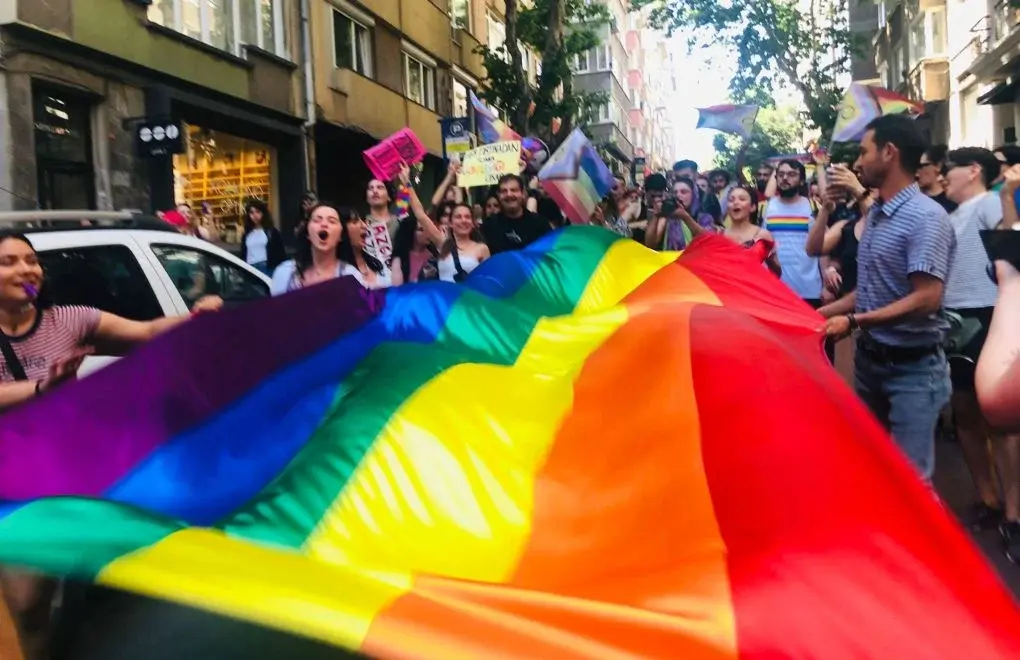








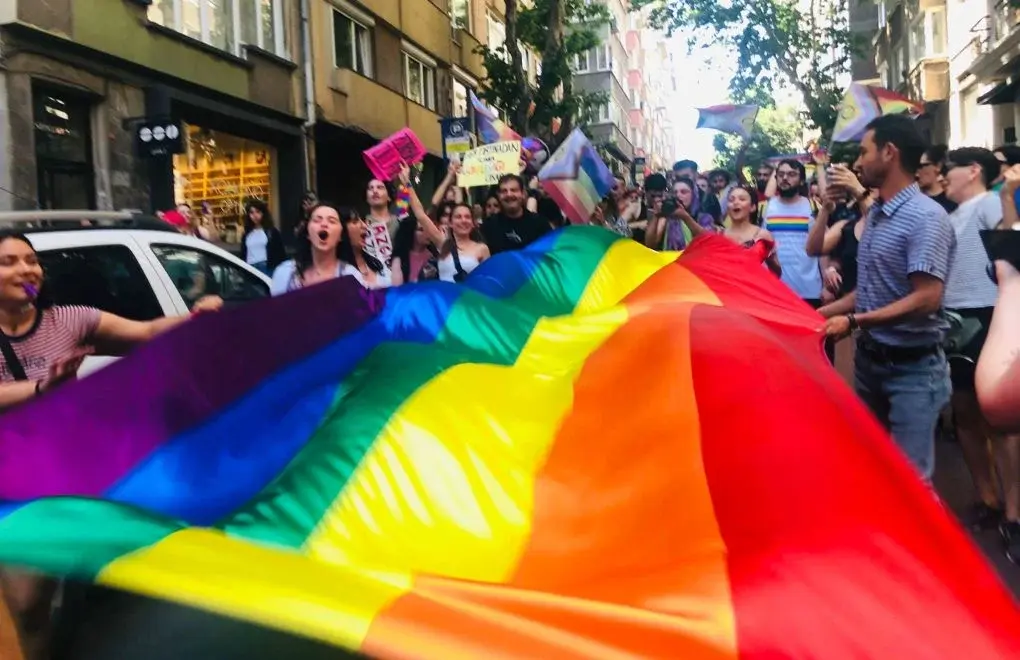



In response to the anti-LGBTI+ operations this weekend, where over 100 people were detained during police raids, protesters gathered in front of İstanbul’s Çağlayan Courthouse and unfurled a purple and rainbow banner reading, "To be LGBTI+, to organize, is not a crime! Free our friends." They met the same fate as their friends only hours later as police apprehended almost everyone at the site, totaling over 100 detentions.
Turkey’s LGBTI+ community once enjoyed relative freedom with crowded pride marches held on Taksim's İstiklal Avenue from the late 2000s until 2014. Although the law has not significantly changed, its implementation certainly has.
While being queer is not illegal under Turkish law, long-existing obscenity laws have been recently used to redefine LGBTI+ bodies, relationships and even visibility as “obscene,” and thus illegal, lawyer Serhat Alan told bianet.
For example, intimate imagery of a straight couple might be deemed casual or romantic while the same pose featuring a gay or lesbian couple could be deemed “obscene.” In practice, the legal system determines which expressions of sexuality are “normal” for society, Alan said.
He explained that the core issue is that what constitutes “obscenity” is not clearly defined in law. The legal text does not specifically reference LGBTI+s, but this has not stopped it from producing discriminatory outcomes.
“When dealing with ill-defined concepts like ‘obscenity’ or ‘general morality,’ the decisive factor becomes who interprets these concepts and through which social norms they are applied,” Alan added.
Obscenity charges are regulated under Article 266 of the Turkish Penal Code, but the criminalizing of obscenity has deeper roots, dating back to the 1926 Turkish Penal Code.
Alan said that obscenity historically referred to pornographic content and the protection of children from sexual material. Nowadays, however, obscenity investigations also target social media posts, works of art, LGBTI+ organizations and content regarding individuals’ own bodies.
Artists, social media content creators and LGBTI+ organizations have faced investigations as a result of this expanded application of obscenity. Earlier this month, a court arrested transgender actor Meli Bendeli on obscenity charges over photos she shared on social media. Queer singer Mabel Matiz has also faced multiple investigations over lyrics and music videos, and so has the pop group Manifest over an 18+ concert.
“The most significant shift in recent years is that obscenity provisions have become part of a broader monitoring of morality and visibility,” Alan said.
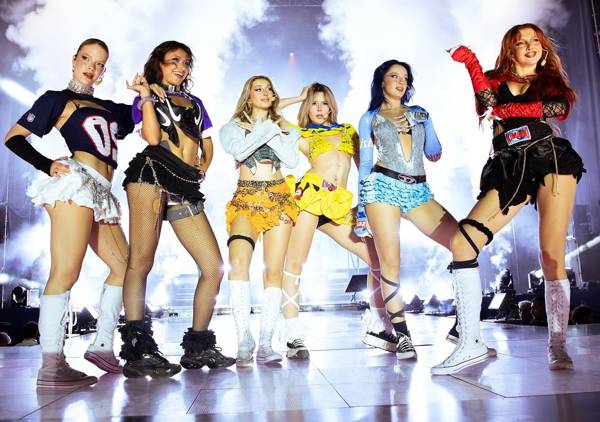
Turkey expands ‘obscenity’ investigations to musicians as 'girl band' given travel ban
A sharp escalation of pressure on LGBTI+s
Zeynep Kıyak, an activist from the Pembe Hayat Association, said that pressure against the LGBTI+ community has escalated in recent years, but this weekend was something else entirely. She never expected dozens of her friends to be taken from their homes in coordinated midnight raids or association offices to be broken into via locksmiths.
“These laws are no longer being used only against particular publications or individuals; they are now being used to disrupt the existence and functioning of LGBTI+ civil society and existence as a whole,” she said. “We see this not as neutral law enforcement, but as part of a political project built around ‘family values,’ ‘morality,’ ‘decade of family’ that seeks to erase and criminalize LGBTI+ existence."
Justice Minister Akın Gürlek confirmed that the initial probe dubbed the “My Family Is Safe” operation is part of Turkish President Recep Tayyip Erdoğan’s larger vision of “decade of the family and population.”
The campaign, heavily criticized by women’s and LGBTI+ activists, is dedicated to promoting “family values” and increasing birth rates.
Health Ministry cites ‘family values’ for hormone therapy access restrictions
“When an ambiguous concept like ‘morality’ becomes the metric for legal intervention, it allows the dominant norms of society, specifically heteronormative standards in Turkey, to be legally reproduced,” Alan said.
Although the concept of "obscenity" has long conflicted with freedom of expression, he described its current usage as a chilling expansion of the scope of an existing legal tool.
“Crucially, opening an investigation into content or blocking an event does not need to culminate in a conviction to have an effect — The intervention itself creates a chilling effect,” said Alan. “When individuals cannot predict what expression will be categorized as a crime, they begin to self-censor.”
Lawyer says private messages cited as 'obscenity' evidence against detained LGBTI+s
Decades of advocacy reduced to 'obscenity'
Yıldız Tar, editor-in-chief of the Kaos GL website, has experienced this escalation and censorship first hand. The journalist’s social media account and Kaos GL’s second website were two of 73 accounts and websites restricted by the government prior to the weekend raids.
Kaos GL’s previous website has also been blocked from access in Turkey since Jun 2025.
Tar described the laws as a “loophole” and said that they serve as “a legal weapon with boundaries arbitrarily defined by the state.”
Founded in 1994, the Kaos GL Association is the longest-standing LGBTI+ rights group in Turkey. During the weekend raids, principal and substitute members of its board of directors and supervisory committees were detained as police broke into the organization’s office using locksmiths in what was an unprecedented crackdown since the group's formation.
The board members were formally arrested on obscenity charges on Sep 16 after appearing before a judge.
The court cited evidence consisted of news articles and visuals from the website, including a photo of two women characters in the television show “Agatha All Along” kissing and a visual of two male footballers kissing.
“[The obscenity law] functions as a tool to censor us, shut down our spaces, and legally harass activists under the guise of protecting public morals, ultimately serving the exact same function as outright criminalization,” Tar said.

Journalist Tuğba Tekerek detained over interview with Georgian LGBTI+ activist
Tar noted that the government previously tried to pass more direct legislation targeting the LGBTI+ community, such as the 11th judicial package, which proposed up to three years in prison for actions "contrary to biological sex or public morality."
However, upon failing to do so due to strong backlash from Turkish civil society, the state is resorting to such “loopholes.”
Anti-LGBTI+ amendments removed from draft judicial package
Tar also believes the recent escalation in anti-LGBTI+ attacks is linked to Turkey’s deepening political and economic crises, especially high inflation and poverty rates.
“To distract the public from these systemic failures—as well as unaddressed issues like occupational fatalities and unchecked femicides—the government desperately needs a scapegoat,” said Tar. “Targeting the LGBTI+ community allows them to manufacture a new enemy.”
A broader threat
Alan said that protecting children and LGBTI+ visibility should not be framed as mutually exclusive. Protecting children from actual sexual and harmful content should not become a pretext for erasing the existence, relationships or expressions of adult LGBTI+ individuals from the public sphere.
Alan also believes that to actually protect children from pornographic materials and prohibit non-consensual or violent sexual content, this should be separated from vague concepts like “obscenity.”
“By doing so, we can protect those who genuinely require protection while narrowing the scope wherein the state dictates which sexuality is ‘normal’ and which is ‘contrary to morality,’” he said.

Popular LGBTI+ Sixties pub shut down in Ankara
Arrests have only increased since the initial operation. Over 80 more were formally arrested following the initial Sep 13 operations. A Justice Ministry circular sent to prosecutors across the country ordering action against "desexualization" indicates further operations could follow.
Kıyak stressed that the recent attacks on the LGBTI+ community also represent a threat to broader facets of Turkey's civil society.
“This operation is intended to isolate us, but its implications go far beyond the LGBTI+ community, said Kıyak. “If vague morality laws can be used to raid lawful associations, detain rights defenders, silence public speech and criminalise solidarity, then everyone’s fundamental freedoms are at stake — this cannot be left for the LGBTI+ movement to confront alone.” (İK/VK)