



The concept known globally as the "Ghost Bike" and commonly referred to in Turkish as “Hayalet Bisiklet” first emerged in the early 2000s to commemorate cyclists who lost their lives in traffic and to protest the normalization of these deaths.
In cities across the United States, Europe, Latin America, and Australia, white-painted bicycles are placed at locations where cyclists have died. These are not just memorial objects—they serve as public warnings against traffic violence, impunity, and societal indifference. The Ghost Bike installed in Bostancı, İstanbul, is part of this global movement for memory and justice. It places a local loss within a broader, universal issue.
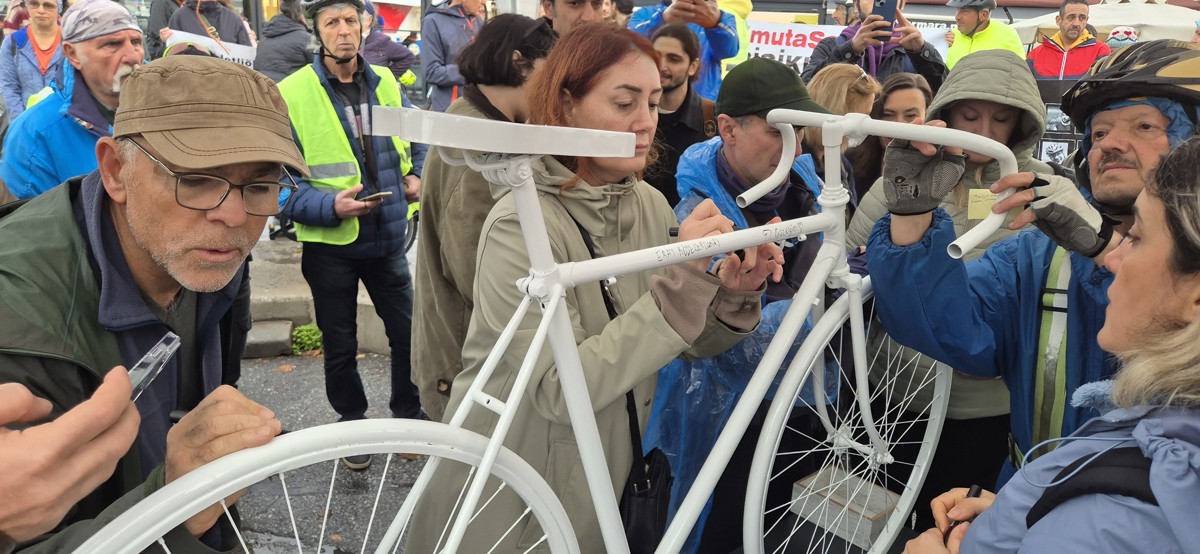
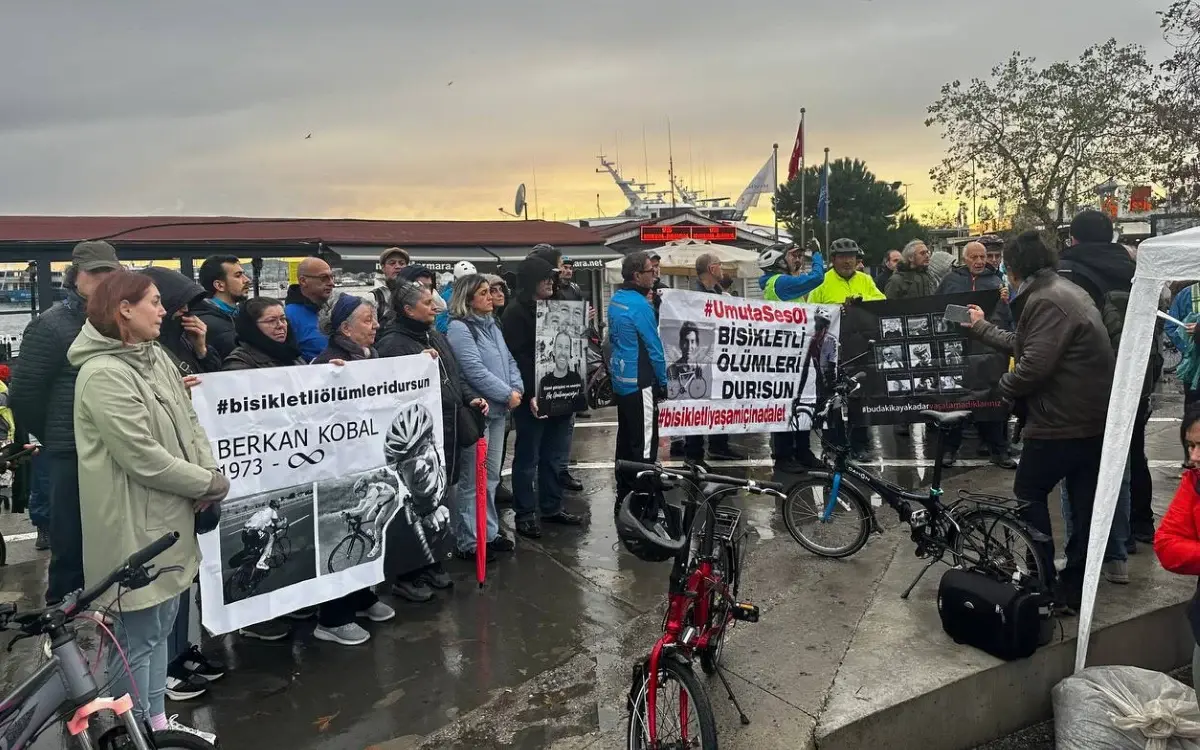
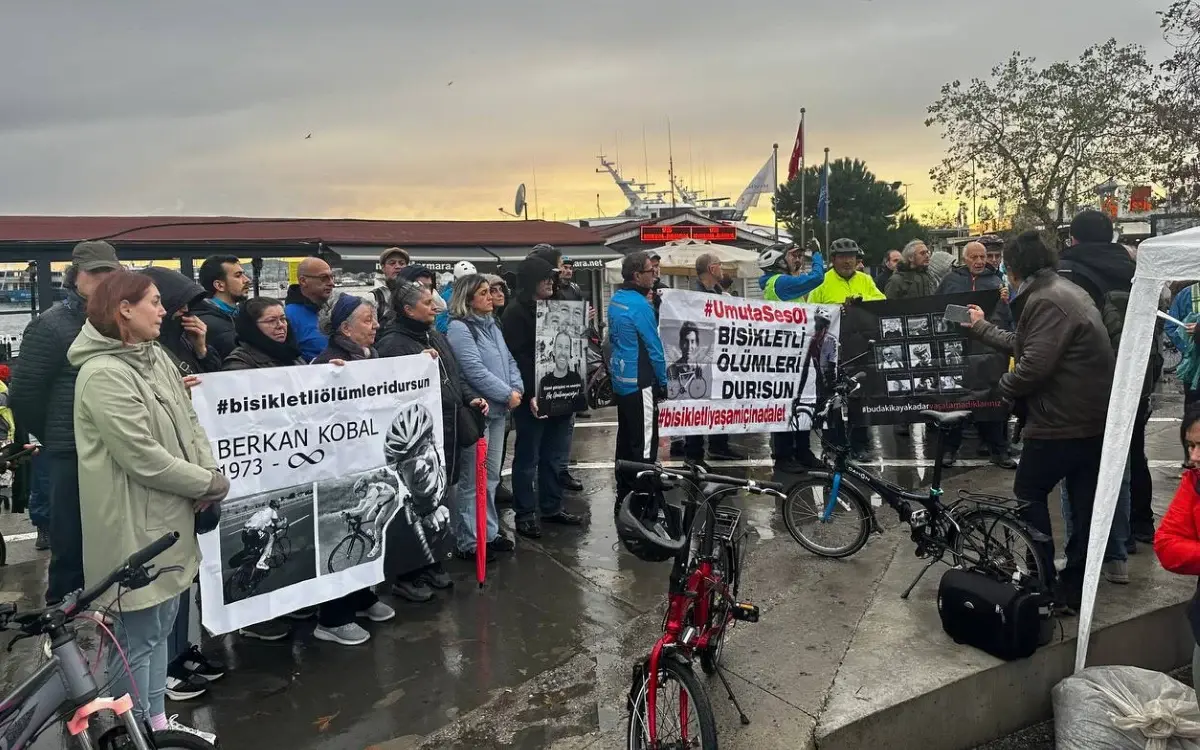
On Nov 29, 2025, the Participatory Bicycle Movement (Katılımcı Bisiklet Hareketi) established a permanent memorial space for cyclists who have lost their lives in traffic at the Bostancı Adalar Ferry Terminal. A white bicycle was installed in memory of Doğanay Güzelgün and all cyclists who have died. Participants were invited to write the names of the lost cyclists on the bike.
It was a simple yet powerful message: "We are here too, in traffic." The movement describes this effort as both a memorial and a collective protest against traffic violence. Emphasizing shared voices over individual names and collective identity over personal visibility, the group also chose to highlight its collective identity rather than individual names in this interview.
After attending the event as representatives of couriers, we kept in touch with our cyclist friends. In this interview, we wanted to hear from the Participatory Bicycle Movement about the emergence of the Ghost Bike, its meaning, and the demand for justice on the roads.
Beyond memorial
The Ghost Bike project goes beyond being a memorial, it represents a lasting call for memory and justice. How did you arrive at this point?
Above all, we are individuals who rely on bicycles for transportation. For years, we’ve tried to assert our right to the right-hand lane, to promote cycling as a mode of urban mobility, to form various groups, and to run awareness campaigns with local governments. For nearly a decade, there has been serious effort in this area, but unfortunately, progress has been very limited.

Ten years ago, we said in a video, "We no longer want to place ghost bikes for our fallen friends." The fact that we find ourselves at the same point today clearly shows the deadlock. Different names, different stories, but the same outcomes... This indicates that these incidents are not coincidences and we are facing a structural problem.
We placed this white bicycle in memory of Doğanay Güzelgün and all the cyclists who were killed by motor vehicles in traffic. Our aim was to transform the names of our lost friends into a tangible object of remembrance. Because when a cyclist dies in this country, it is usually only a brief news item forgotten within days. The Ghost Bike is a lasting mark left against this culture of forgetting.
The loss of Doğanay Güzelgün was a turning point for all of us. The fact that someone could die in broad daylight, in an urban setting, completely unprotected, shows that this was not fate, it was the result of transportation policies, lack of infrastructure, and years of neglect. That is why the Ghost Bike is more than just a memorial for us; it is a clear call for justice. It is our way of saying, “This death was not destiny, it was a policy failure.”
Invisibility
In Turkey, locations where cyclists have died quickly fade from public view. In your opinion, who or what is responsible for this invisibility?
This invisibility is not the result of one person’s or one institution’s choice. This entire system fails to recognize cyclists from the outset. Urban planning and transportation policies still treat cyclists as marginal elements on the road. The absence of dedicated bike lanes, lack of infrastructure, and denial of rights all systematically create this invisibility.
Another key issue is the language used by the media. Traffic deaths are often reported as “accidents.” The perpetrator is not being talked about, the vehicle is. Responsibility disappears. As a result, there is no public outcry. Impunity ensures that this cycle continues. When someone dies while cycling, there are no consequences strong enough to serve as a deterrent.
On top of this, society’s lack of a developed cycling culture plays a role. The bicycle is still not seen as a legitimate mode of transportation, but rather as something that’s “optional” in traffic. And that’s precisely where the Ghost Bike comes in: it uses physical space to make names visible, and it carries the question “What happened here?” into the public realm.
A shared story
The act of people coming and writing names on the Ghost Bike created a powerful collective moment. What impact did this process have on you?
We do not see ourselves as separate from those who came. Everything that happened there was an expression of a shared feeling. Everyone who felt the way we did was present, and that emotional solidarity became stronger together.
Before the event, we shared photos of cyclists we had lost on social media, reached out to families, and invited them as well. Then, together, we approached the white bicycle and wrote the names of our personal losses on it. Some wrote the names of their siblings, others of cyclists they had never met.
What we saw clearly in that moment was this: it wasn’t just Doğanay’s story. It was a story we all shared. A group mourning together is both healing and political. Because when we share grief, we also share a demand: no more deaths.
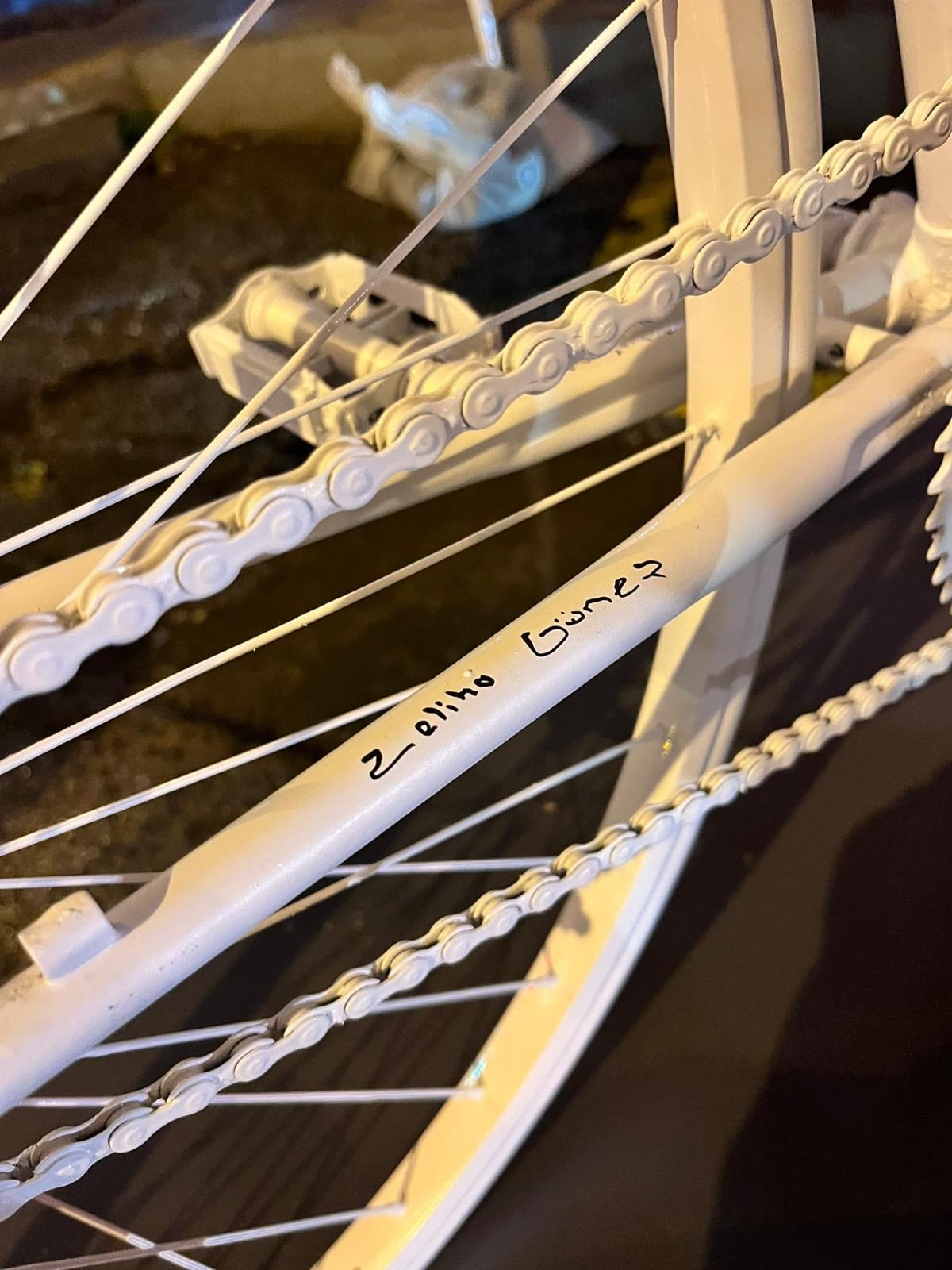
This year, for the first time, a permanent Ghost Bike was installed in cooperation with İstanbul Metropolitan Municipality (İBB). How did this partnership develop?
This process was entirely shaped by our demands. We took on the financial responsibility. Our main request was for the spot where Doğanay Güzelgün lost his life to be designated for the Ghost Bike.
It was very important to us that the bike be permanent, protected, and not subject to damage or theft. That’s why the municipality’s support was crucial. We presented our project to the Transportation Department, Transportation Planning Directorate, and the Cycling Unit of İstanbul Metropolitan Municipality. We explained that the Ghost Bike is not only symbolic, but also a public responsibility.
Thanks to this support, a permanent memorial space was created in front of the Bostancı Adalar Ferry Terminal. For the first time in Turkey, the Ghost Bike became not just a protest, but a publicly recognized reminder.
Possibility of a joint struggle
Cyclists and motorcycle couriers face similar risks. Is a shared struggle for traffic justice possible?
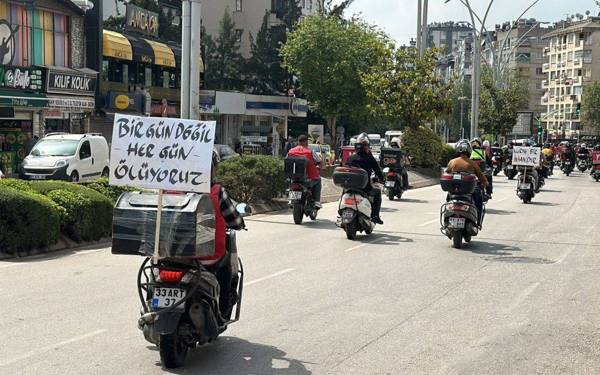
It is definitely possible, and now essential. Cyclists and motorcycle couriers inhabit the same landscape of risk: we are road users who are unseen, unprotected, and ignored. The root of the problem is the same: a transportation system that prioritizes motor vehicles and revolves around speed.
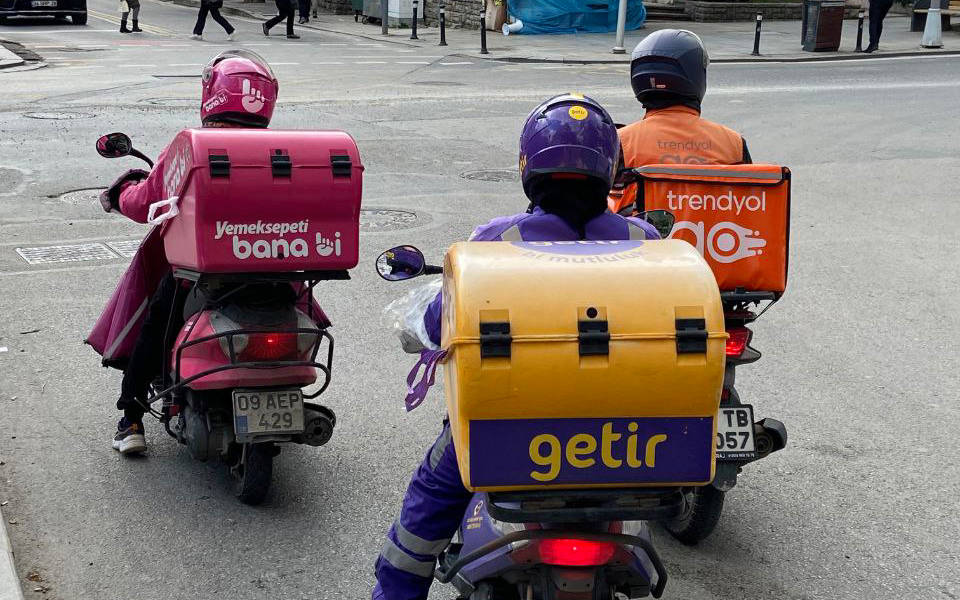
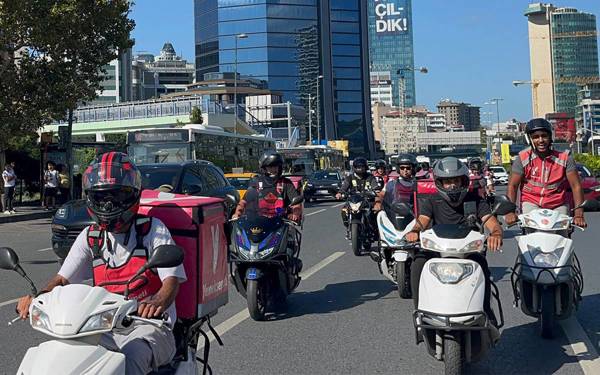
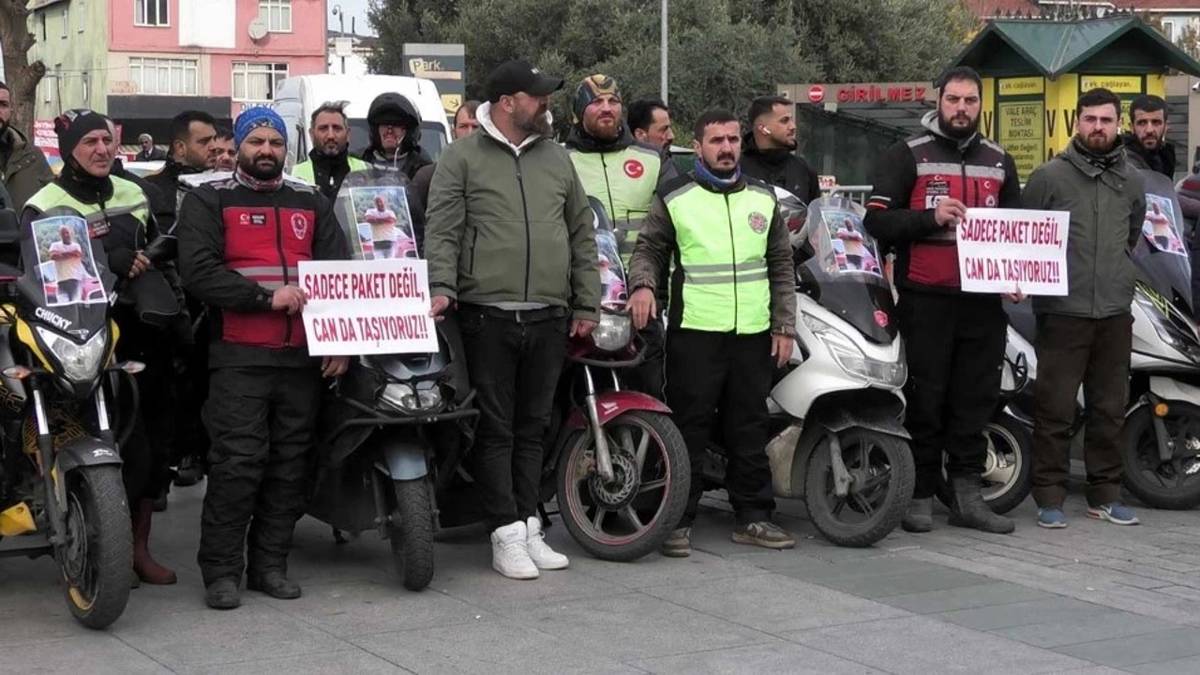
The presence of couriers at the event showed this clearly: the desire to be seen and respected in traffic is not just a demand of cyclists or couriers alone, it is a shared demand of all vulnerable road users. When we act together, we can create stronger public pressure and develop more comprehensive solutions.
What kind of formation is the Participatory Bicycle Movement? What roadmap do you foresee after the Ghost Bike?
We are not a group offering rides or experiences. The Participatory Bicycle Movement is an independent initiative that aims to merge bicycle awareness with collective action. Our goal is to highlight the importance of bicycles for a livable city through participatory efforts, and to co-create this process. This movement is a collective structure that prioritizes shared goals, shared needs, and shared demands, not individuals.
We imagine a livable city: a cycling system that is present, visible, protected, and recognized in traffic. Our actions are not limited to words; through the works we produce and the objects we place in public spaces, we aim to carry this demand into the future.
What do we want? We want the voices of everyone pedaling in this city to rise, to be heard, and to be taken seriously. We want bicycles to have a strong, visible, safe, and legally recognized position in traffic. We aim to create public awareness through the collective and united strength of all cyclists. We demand an urban system where not a single more cyclist dies. We want safe transportation.
You do not need to be a cyclist to be part of this movement. Because this is not just a struggle of pedals—it is a fight for urban rights, justice, safety, and coexistence. (MÇ/AB)