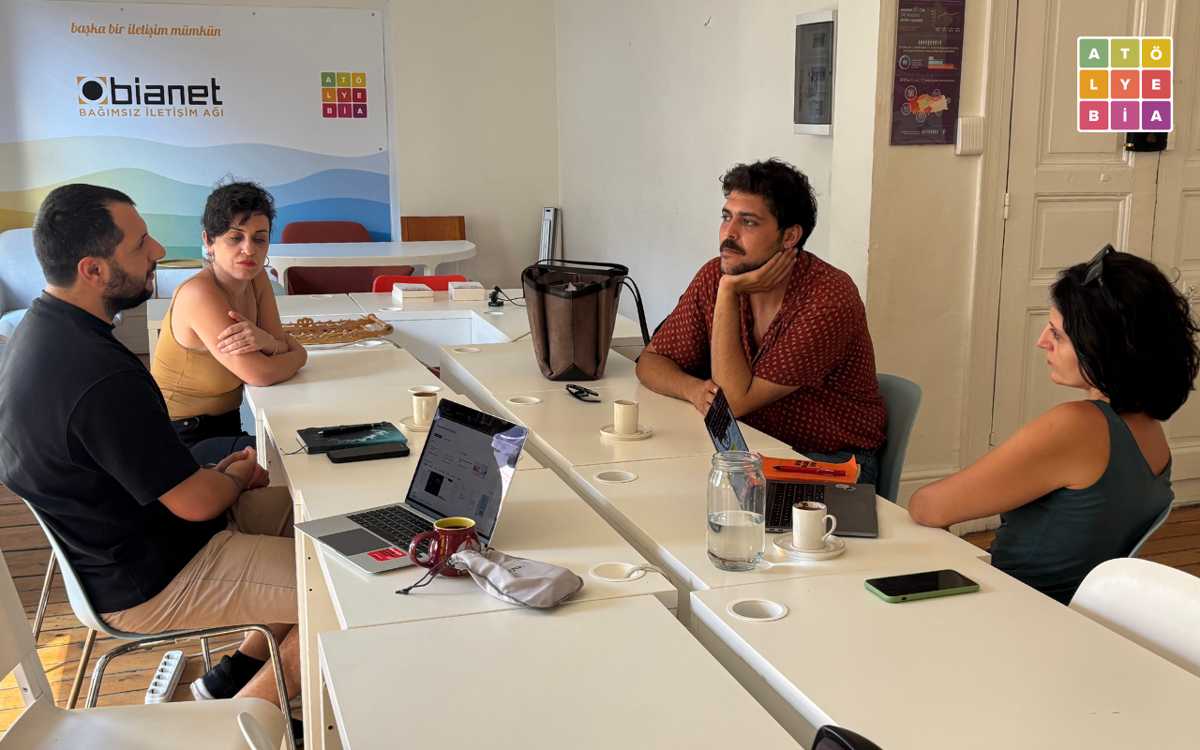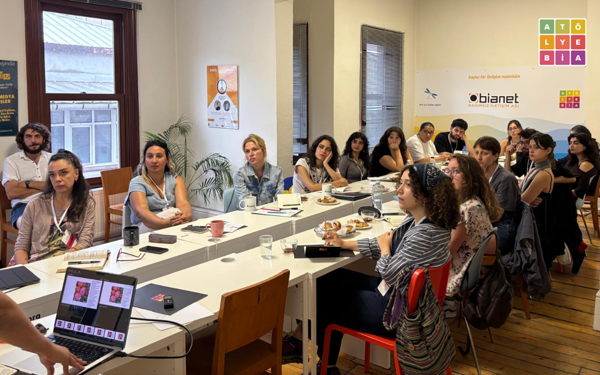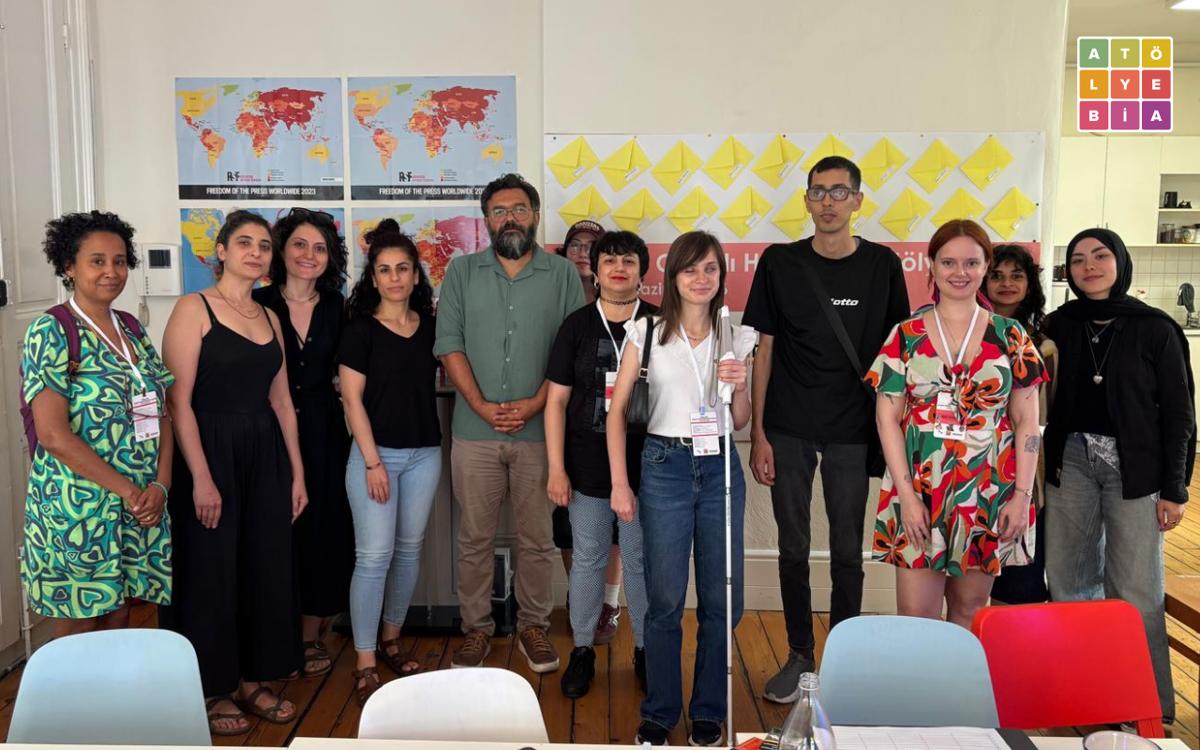








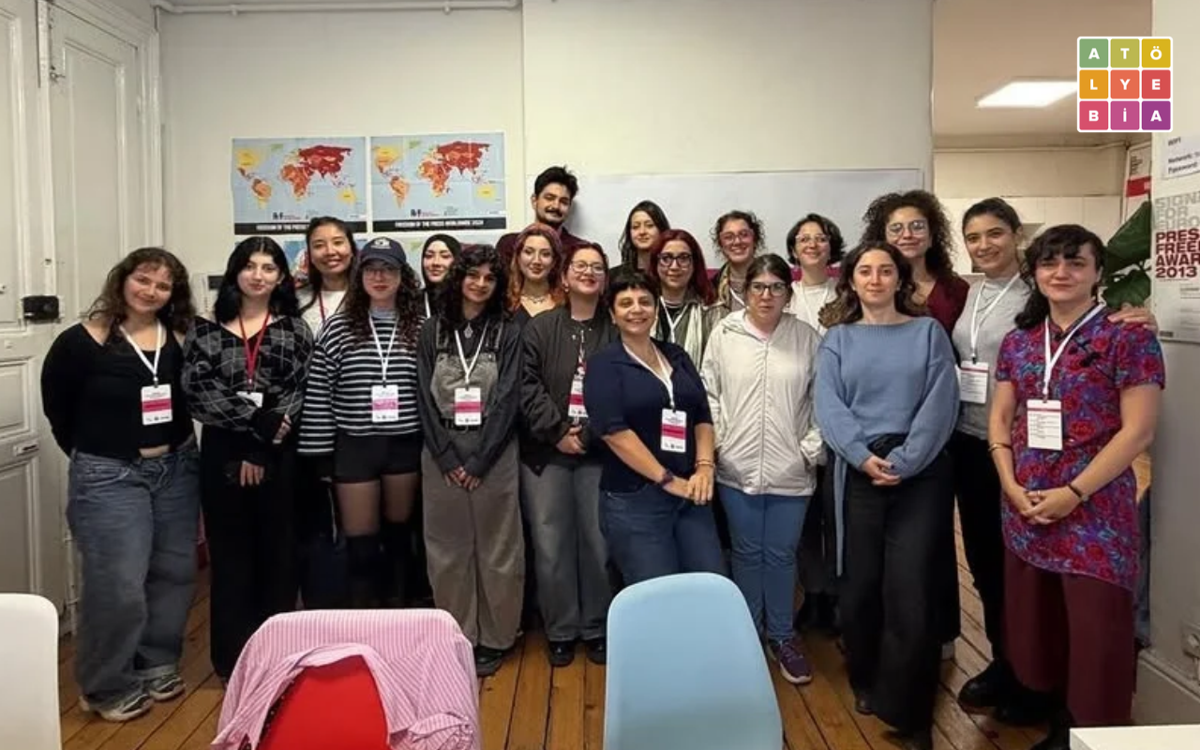



The Gender-Focused Journalism Workshop, held at Atölye BİA’s office in Beyoğlu on Sep 29, began with opening remarks and an overview by Atölye BİA Coordinator Ceyda Sungur.
During the workshop, participants explored a range of topics, from gender perspectives and feminist media to gender-focused journalism, the use of visuals without reproducing violence and court monitoring. At the end of the day, the principles discussed throughout the program were put into practice through news production.
The workshop program:
- Looking Through a Gender Perspective and Feminist Media (Nazan Haydari)
- Gender-Focused Journalism (Evrim Kepenek)
- Using Visuals Without Reproducing Violence (Özden Demir)
- Court Monitoring (Evrim Kepenek)
- Gender-Focused Journalism Workshop (Evrim Kepenek)
Haydari: ‘We reproduce all these hierarchies and inequalities’
In the workshop’s first session, Prof. Dr. Nazan Haydari met with participants for a discussion titled "Looking Through a Gender Perspective and Feminist Media." Haydari addressed the concepts of sex and gender, sexual essentialism, biological determinism, heteronormativity and patriarchy.
Haydari also discussed Judith Butler’s concept of performativity, explaining that gender is shaped within social and historical relations. She examined heteronormativity and patriarchy through relations of power, hierarchy and inequality:
We see that these systems of oppression reproduce all these hierarchies and inequalities at the individual, interpersonal, institutional and sociocultural levels. At the interpersonal level, this includes language, actions and the ways we communicate. At the institutional level, it includes laws, the economy, medicine, religion, hiring practices and, of course, the media and news production.
Participants also discussed how a gender-focused perspective applies to everyday life. They examined examples involving clothing, automobile safety systems, public spaces and kitchens, discussing the inequalities created when the male body and male experience are treated as the default.
Haydari also addressed feminist historiography during the session. She highlighted the concept of the "current," which Aksu Bora uses to describe the feminist struggle:
A wave rises and disappears, but the current is always there. Sometimes it is visible, sometimes it comes to the surface, sometimes it moves below, and sometimes it grows through large-scale collective actions. But it is always continuous.
The discussion on feminist media focused on patriarchal media practices, solidarity, pluralism and intersectionality. Haydari also gave examples from Kurdish women’s media, explaining how the journalistic practices developed by JİNHA challenged established approaches to journalism.
Kepenek: ‘We need to show where the system fails and breaks down’
In the workshop’s second session, bianet Women’s News Editor Evrim Kepenek met with participants for a discussion titled "Gender-Focused Journalism." Kepenek examined news language, source selection and forms of representation from a gender perspective.
Kepenek focused on the concepts of impartiality and fairness in journalism. She said the media can reproduce and normalize sexism. Emphasizing the need to give more space to women experts in news coverage, Kepenek noted that women are rendered invisible in many fields.
The language used in reporting on violence was also discussed through various news examples. Citing the Şule Çet case, Kepenek said journalists should avoid reproducing sexist expressions in their reporting. She stressed that journalists should not simply repeat everything they hear:
What is the journalist’s responsibility here? To filter what they hear. For example, a woman’s private life is not up for discussion. That is not open to debate.
Kepenek also explained that gender-focused journalism is not limited to reporting on male violence. She gave examples from areas including women’s right to health, access to menstrual products and the selection of experts for news stories. She said a gender perspective should come into play from the moment a journalist chooses what to report on.
She said reporting on violence should examine the broader context and the failures within the system:
In gender-focused journalism, we need to show where the system fails and breaks down. Because these are not isolated incidents. They are the result of something systemic, the result of the system.
Rethinking context in visual storytelling
The workshop continued with Özden Demir’s session, "Using Visuals Without Reproducing Violence." Demir addressed the use of photographs and videos in reporting on violence from the perspective of ethical representation. Drawing on her own work and various news examples, she discussed with participants the challenges involved in choosing visuals.
Demir emphasized that there is no single correct formula for using visuals in reports on violence. She said the same image can take on different meanings depending on the context in which it is used:
The same image can serve as evidence in one story and as exposure in another. Every ethical decision ultimately requires contextual judgment.
The session also addressed anonymizing people subjected to violence. Demir noted that methods such as blurring a person’s face or photographing them from behind may not always be sufficient. She said journalists should consider not only whether a person’s identity is protected but also how that person is represented.
Demir suggested asking what purpose an image serves when selecting visuals. Noting that an image can provide information, evidence or testimony, she highlighted the question: "What does this image contribute to public knowledge?"
Demir said different forms of visual storytelling can be used when reporting on violence. Locations, objects, perpetrators and structural conditions can also be depicted, she said, allowing journalists to convey different forms of testimony without exposing the body of the person subjected to violence.
Court monitoring and news production
Evrim Kepenek led the final two sessions of the day. In the "Court Monitoring" session, Kepenek explained how journalists can follow court proceedings from a gender perspective. She gave examples from the Şule Çet and Ayşe Tokyaz cases.
Kepenek discussed the importance of obtaining hearing records, indictments and other official documents when following court cases. She emphasized the need to protect personal data contained in these documents.
Kepenek said journalists should also observe the courtroom, noting that the conduct of the judge, court clerk and bailiff can become part of the story. She explained that factors such as the defendant’s profession, position and institutional affiliations are also important for understanding the context of a case.
In the day’s final session, the "Gender-Focused Journalism Workshop," Kepenek put the principles discussed throughout the day into practice through news production. She focused on rights-based terminology, relationships with sources and approaching news topics from different perspectives.
Kepenek particularly stressed the importance of building trust when interviewing survivors of violence and said journalists should respect and protect the rights of their sources.
The workshop concluded following questions and comments from participants. (EG/VK)