









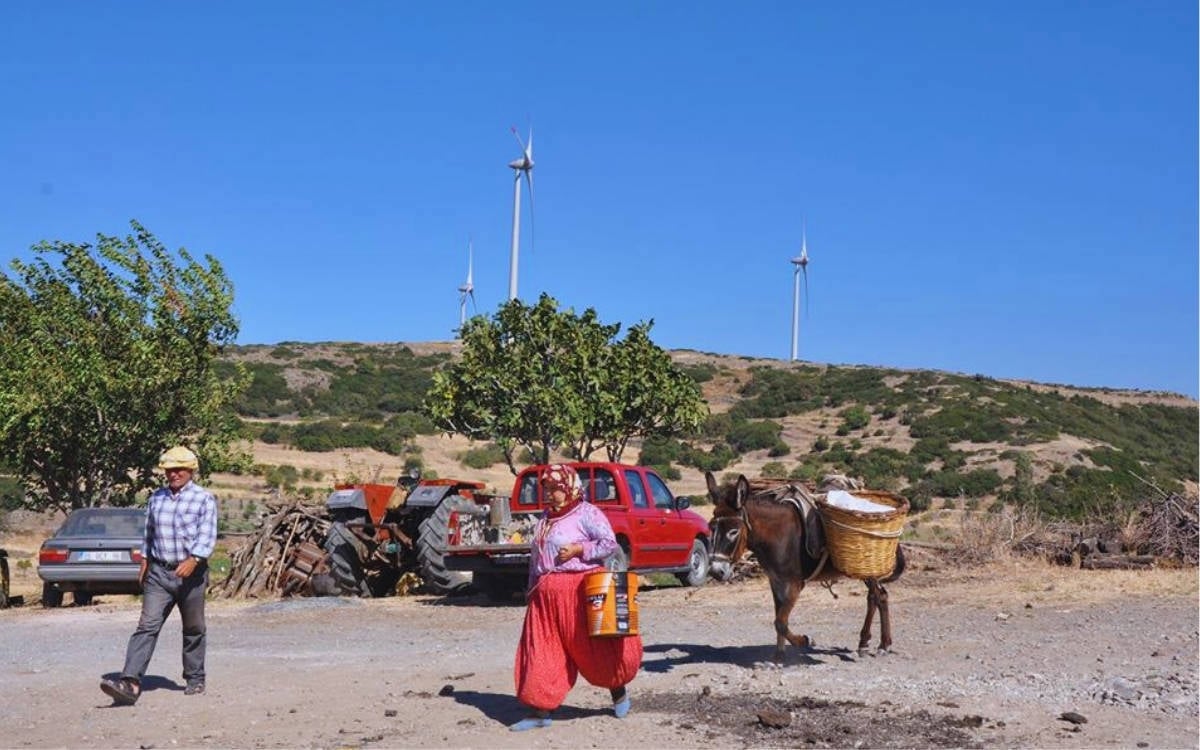



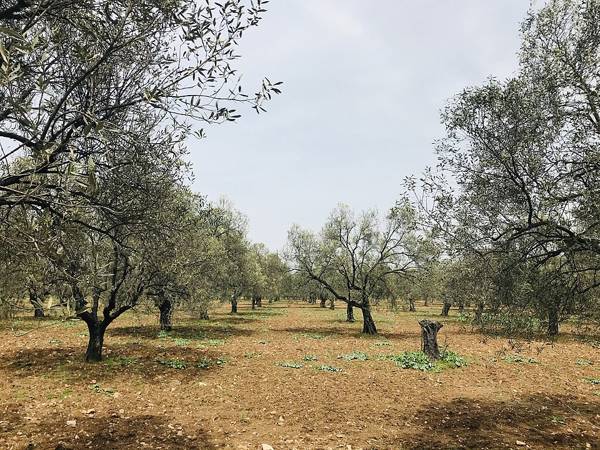
An administrative court in İzmir has suspended zoning plans and a construction permit for a solar power plant in the Karaburun district, where nearly 6,000 olive trees were cut down during a legal dispute over the project.
The İzmir 7th Administrative Court ruled that the plans approved for the Lodos Karaburun Elektrik Üretim A.Ş. company and the permit issued by Karaburun Municipality were inconsistent with planning and conservation principles and did not serve the public interest.
The ruling, dated Sep 24, concerns a solar power plant planned for agricultural land near Yaylaköy village, including olive groves and land designated for environmental protection.
The zoning plans had been prepared by the Environment, Urbanization and Climate Change Ministry, while the municipality had issued the construction permit.
The lawsuit was filed on behalf of Mustafa Şenbahar, who acquired barren land from the Treasury in 2007 for olive cultivation and transformed it into an olive grove. The local administrative office of Küçükbahçe neighborhood, which has grazing lands within the project area, also joined the lawsuit.
Court finds project contrary to public interest
In its decision, the court examined the agricultural and environmental status of the land covered by the project's zoning plans.
The plans included 624,624 square meters of protected agricultural land west of Yaylaköy, designated for specialized crop production.
They also covered 9,733 square meters of olive groves and land suitable for olive cultivation east of the village.
The court emphasized that the entire project site falls within a Special Environmental Protection Area.
It concluded that the zoning plans and the permits issued for the solar power plant violated urban planning and conservation principles, planning requirements and the public interest.
The same project's positive environmental impact assessment (EIA) decision had previously been annulled.
However, while litigation over the EIA decision was still underway, the company illegally removed olive trees from the plantation site.
Cases continue over tree removal
Lawyer Cem Altıparmak, commenting on the Sep 24 ruling, said separate legal proceedings against company officials over the removal of the olive trees remained ongoing.
A criminal case before the Karaburun Penal Court of First Instance accuses company officials of removing the trees without authorization to use the property.
Altıparmak cited the allegation that the defendants had "uprooted olive trees on the property without having actual rights of use" and "repeatedly committed the offense of damage to property involving any planted tree, sapling or vine cutting, wherever located, except in areas classified as state forests," under Article 152/1-c of the Turkish Penal Code.
A separate compensation lawsuit is also pending before the Karaburun Civil Court of First Instance.
Turkey prepares to open olive groves for mining to ‘feed power plants’
Allocation of farmland to energy companies
Altıparmak said he and his colleagues had spent more than a decade pursuing legal cases, particularly on the Karaburun Peninsula, to highlight the ecological and socioeconomic consequences of renewable energy developments.
"Although wind and solar power plants do not emit carbon, they require enormous amounts of land. Particularly in the Aegean, Marmara and Central Anatolia regions, thousands of decares of Treasury land, agricultural land, forests and pastures are allocated to companies for wind and solar power projects," he said.
The lawyer argued that areas officially categorized as "unused land" or "marginal agricultural land" are often communal resources that local communities have relied on for generations.
"Transferring these lands to companies disconnects local communities from their subsistence economies, forcing them into wage labor or migration," he said.
Olive groves turned into mining fields overnight: 'This is not just an environmental issue'
Commercial interests framed as environmental concerns
Altıparmak also pointed to differing public attitudes toward communities opposing fossil fuel and renewable energy projects.
"While villagers resisting thermal power plants may rightly gain public sympathy, villagers elsewhere who try to defend their pastures, forests and agricultural land against a supposedly 'clean energy' project can be branded by companies and civil society as 'reactionary people who slow down climate action and fail to understand the public interest,'" he said.
He argued that this distinction allowed companies to frame commercial interests as environmental necessities.
"This double standard provides an unparalleled opportunity for appropriating the commons and greenwashing by shielding companies' private commercial profits behind a lofty public interest such as 'saving the planet,'" he said.
The lawyer added that he and his colleagues would continue supporting people affected by the actions of public authorities and companies, opposing all forms of what he described as green dispossession and greenwashing. (CA/VK)

