





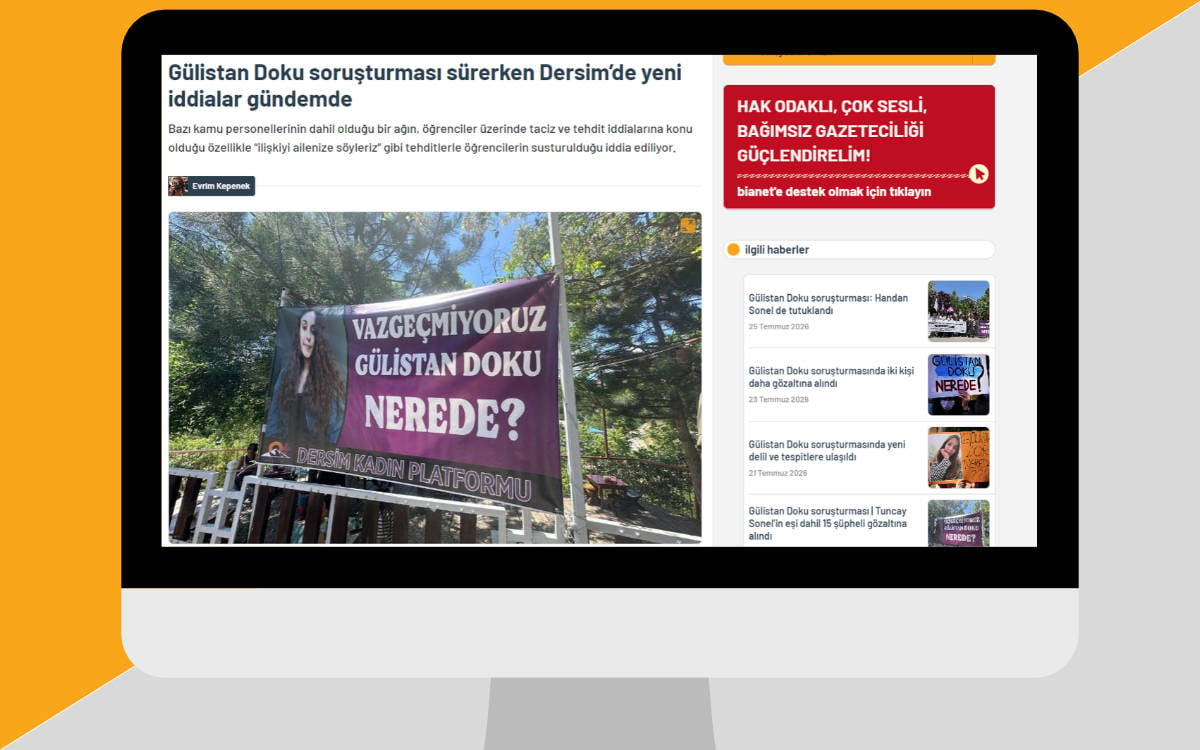


A court has blocked access to an article by bianet editor Evrim Kepenek about allegations of a harassment and prostitution network targeting women university students in the southeastern province of Dersim.
The article, published on Jun 9, covered recent developments in the investigation into the disappearance of university student Gülistan Doku, who went missing in Dersim in 2020 and has never been found. The investigation was reopened this year, and public officials, including the city's former governor, were arrested as part of the case.

Expanding Gülistan Doku murder investigation reveals network spanning state institutions
Kepenek examined claims that similar networks may have resurfaced in the city, based on interviews with women students.
The Erzincan Penal Judgeship of Peace today ordered that the article titled "New allegations emerge in Dersim as Gülistan Doku investigation continues" be removed from publication.
The Cyber Security Presidency notified bianet of the decision by email, saying it had been issued under Article 8/A of Turkey's Internet Law No. 5651. The provision allows access restrictions and content removal in urgent cases involving "the protection of the right to life and the security of persons and property, the protection of national security and public order, the prevention of crime or the protection of public health."
The presidency instructed bianet to comply with the order "immediately and within four hours at the latest."
However, the court ruling itself was not served on bianet. It therefore remains unclear whether the restriction was imposed by the court on its own initiative or following a request.
bianet complied with the order.
Article included accounts from women
Kepenek's article included allegations of harassment, threats, blackmail and pressure raised by university students, women's rights advocates and women living in Dersim.
It also reported on meetings held by women who traveled to the city at the call of the "I Need Peace Initiative" with university students, members of the Dersim Women's Platform and union representatives.
One student, describing the atmosphere at the university, said, "We don't feel safe," and alleged that the presence of military personnel on campus had increased. The student also said disciplinary investigations had been opened against students who objected to the situation.
Another student said specialist sergeants were particularly visible around women's dormitories in the evenings after some public buildings and military units had been moved onto the university campus on the grounds of earthquake risks.
The article also included allegations that some students who spoke about the Gülistan Doku case had faced pressure at the university and had been subjected to disciplinary investigations.

Former governor's son arrested as primary suspect in Gülistan Doku murder case
Harassment and blackmail allegations
Kepenek also reported claims that a network allegedly involving some public employees had harassed and threatened women students.
According to accounts included in the article, students were threatened that their relationships would be disclosed to their families, blackmailed with photographs and subjected to the sharing of their contact information with others.
Human rights advocate Gönül S. said female students had described allegations involving a group they referred to as a "sex work gang."
She said students had spoken about threats and blackmail, adding, "The students who came to us were saying, 'We don't know what to do.' We are trying to stand by them, but the fear continues." (HA/VK)

