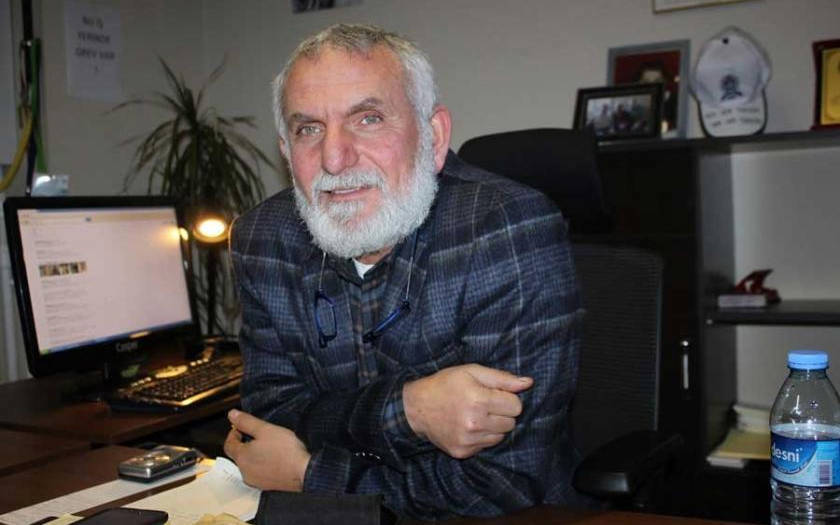

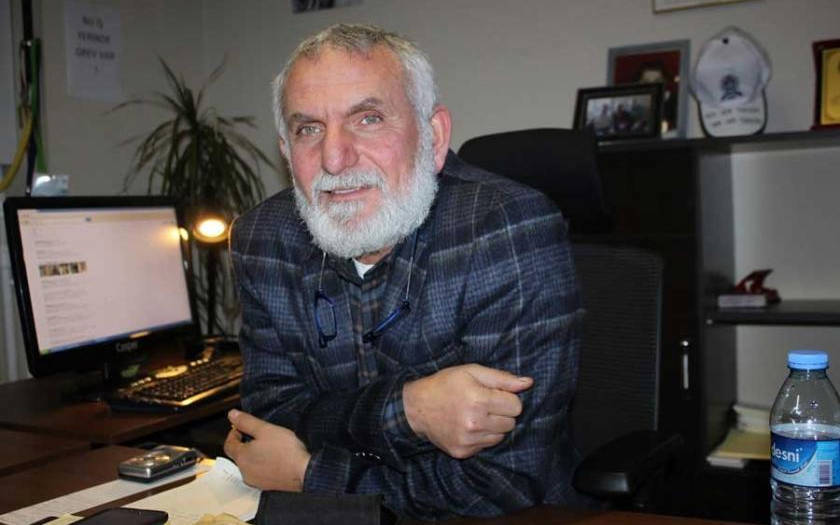



The Constitutional Court has ruled that the rights to freedom of expression and freedom of the press, guaranteed by Articles 26 and 28 of the Constitution, were violated in the individual application filed by journalist Gençağa Karafazlı, the publisher of kuzeyteve.com, a local news outlet covering the Black Sea region, after he was ordered to pay non-pecuniary damages for news reports published on his website.
The court ruled that the case be sent back to the Rize 3rd Civil Court of First Instance for retrial in order to remedy the consequences of the violation. It also ordered that Karafazlı be paid 34,000 liras in non-pecuniary damages and litigation expenses.
Damages imposed over news reports
In 2020, Karafazlı published three articles on his news website concerning two individuals, one of them a municipal council member from the ruling Justice and Development Party (AKP) and the other holding a managerial position at a state bank in Rize despite having stood trial for being a member of the "Fethullahist Terrorist Organization (FETÖ)," held responsible for the 2016 coup attempt.
The two individuals, identified as İ. and E.T., filed a lawsuit against Karafazlı, claiming the reports damaged their “honor and reputation.” On Oct 26, 2021, the Rize 3rd Civil Court of First Instance partially upheld the case and ordered Karafazlı to pay 2,000 and 4,000 liras in non-pecuniary damages. The decision was finalized upon appeal.
Karafazlı then applied to the Constitutional Court on Nov 28, 2022, arguing that the compensation ruling violated his rights to freedom of expression and freedom of the press.
Reasoning not ‘relevant and sufficient’
The Constitutional Court ruled that the damages imposed constituted an interference with Karafazlı’s freedom of expression and the press. It examined whether the lower courts had struck a fair balance between press freedom and the “right to protection of honor and reputation.”
The court noted that, given the public prominence of the individuals featured in the reports, they were required to tolerate a higher degree of criticism. It also emphasized the public interest of the subject matter and the press’s role in informing the public.
While the court acknowledged that some of the assessments in the reports could be seen as “factual allegations,” it found that the lower courts failed to evaluate whether the reports were based on factual grounds and whether the journalist fulfilled his duty of good-faith research in line with Constitutional Court jurisprudence.
‘A journalist cannot be expected to prove like a prosecutor’
One of the most striking parts of the ruling concerned the local courts’ reasoning based on a “technical” detail.
The Constitutional Court pointed out that the acquittal of one individual in the reports was based not on “effective remorse,” but on “lack of sufficient evidence.” It stated that while this distinction may be technically significant in criminal law, it could easily be overlooked by a non-expert.
The court stressed that a journalist cannot be expected to act like a prosecutor when it comes to the burden of proof. The obligation to investigate, it said, should be assessed not on the basis of absolute verification, but rather on the form the information takes at the time of publication and its reasonable reliability.
“The Constitutional Court or judicial authorities cannot dictate how journalism should be practiced or how journalists should report the news. The individual expressing an opinion has the right to determine the most appropriate tone and form of expression. In this context, it should be remembered that Article 26 of the Constitution protects not only the content of news and ideas, but also the form in which they are conveyed.
"It is inevitable in a democratic society that journalists follow the words and actions of politicians, form opinions about them, and attempt to inform and even influence the public.
"Even if disturbing, informing the public and criticizing politicians and public figures should not be punished, as it may have a chilling effect and silence diverse voices in society. Fear of punishment can hinder the sustainability of a pluralistic society.
"Therefore, in this case, the decision ordering the applicant to pay compensation could create a chilling effect on similar reports and also harm the environment for criticism.”
The Constitutional Court concluded that the damages imposed on Karafazlı could deter similar reporting and negatively affect the atmosphere for public criticism. It ruled that the interference did not meet the standard of a “pressing social need” with relevant and sufficient justification, and thus found a violation. (HA/VK)