





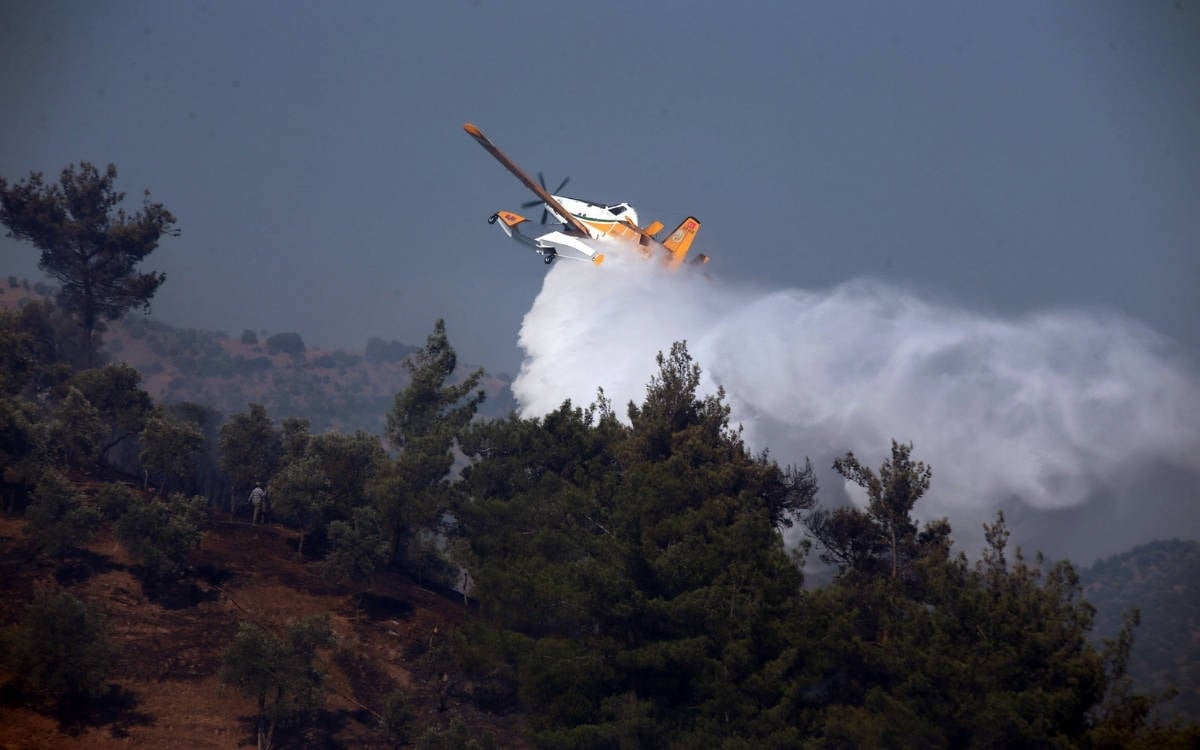



The inability to control the fires that broke out in various cities across Turkey throughout July and burned thousands of hectares of forest land for a long time drew widespread criticism. A significant portion of this backlash focused on the inadequacies in firefighting capacity—particularly shortages in equipment and personnel. However, in this era where we are facing fires that are easier to ignite, spread more rapidly, and are harder to control due to the effects of the climate crisis, focusing solely on extinguishing the fires that break out could be a losing strategy.
Assoc. Prof. Okan Ürker, an associate professor at Çankırı Karatekin University who specializes in comprehensive fire management, says that we have entered a period where flawed forestry policies from the past are compounded by the climate crisis.
Ürker emphasizes that the fires experienced over the past five years clearly demonstrate that the “current fire regime has changed,” and that relying on old methods to combat this new reality could be both ineffective and dangerous.
“The real issue we need to discuss is not how many helicopters or planes we have at our disposal,” says Ürker, who believes that the focus should be on fuel load management: "Our fire management budget is entirely allocated to aggressive suppression and active restoration after fires. However, these are not solutions that will help create a resilient forest ecosystem in the face of the climate crisis. On the contrary, it is an approach that deepens the crisis, exacerbates the vicious cycle, and ultimately wastes the budget we have allocated."
According to Ürker, the way to build a fire-resistant society is to shift our focus to the period before the fire season: “The community's energy needs to be channeled into fuel load management and control before the fire season. To build a society that is always prepared for fires, we must redirect the energy that would be wasted during the fire season to the period before it.”
Accumulated fuel load combined with climate crisis
Ürker continued, "In the 1980s and 1990s, we were able to achieve successful results against the fires we were accustomed to with fire management tools such as helicopters and fire trucks; our interventions were effective.
"However, some things have changed since then. The first new development is the climate crisis: We are now facing more intense winds that change direction suddenly and have no clear dominant direction. There are hotter temperatures, drier periods, and stronger winds.
"Second, for a century, we have focused on aggressively extinguishing fires through technical forestry. We actively restored burned areas and created pine plantations. Due to aggressive extinguishing, fuel load accumulated and a fire debt was created. Moreover, by creating monoculture pine plantations in these areas, we have essentially scattered atomic bombs across the Mediterranean.
“Finally, we excluded traditional ecological knowledge. We excluded ancient production cultures such as goat grazing in the Mediterranean. Goat grazing was an element that broke the ladder effect leading from low-intensity ground fires to more intense crown fires; it also supported our habitat mosaic by dispersing the seeds of local plant species. Such technical forest management also increased the fuel load and played a role in leading to mega-fires.”
'Fires will now occur throughout the year'
Ürker concluded his assessment by emphasizing the need to focus on how the fuel load is managed:
“From now on, these fires will occur throughout the year, across all regions of Turkey. The real issue we need to discuss is not how many helicopters or planes we have at our disposal. We need to focus on how to manage the fuel load. We need to question how we can shift our policy from aggressive suppression to fuel load management and transition to comprehensive fire management.
"For example, in Osmaneli, within the jurisdiction of the Eskişehir Forest Regional Directorate, roadside vegetation clearance or forest thinning has been virtually non-existent. If a fire breaks out here, you have no chance of intervening within 10 minutes because most of the forest roads are in poor condition. Trying to extinguish the fire with planes and helicopters after it breaks out is a waste of time; it means wasting resources and personnel costs.
“Additionally, direct human intervention must be avoided in such large fires. We see fire trucks being driven right up to the fire’s edge. These are very dangerous intervention methods, and unfortunately, they recently resulted in fatalities. These fires must be managed through indirect interventions rather than direct ones. Especially in regions where we have little experience with fires, we lack the knowledge, experience, and trained personnel needed to respond to large-scale fires. This gap in education and experience can be addressed through rotation and knowledge sharing.
This article has been published in shortened form in collaboration with İklim Masası (Climate Desk) and bianet.
İklim Masası is a news service that aims to disseminate reliable information about the climate crisis to the public. Its writers are scientists who are experts in the topics they cover.
(TY/VK)