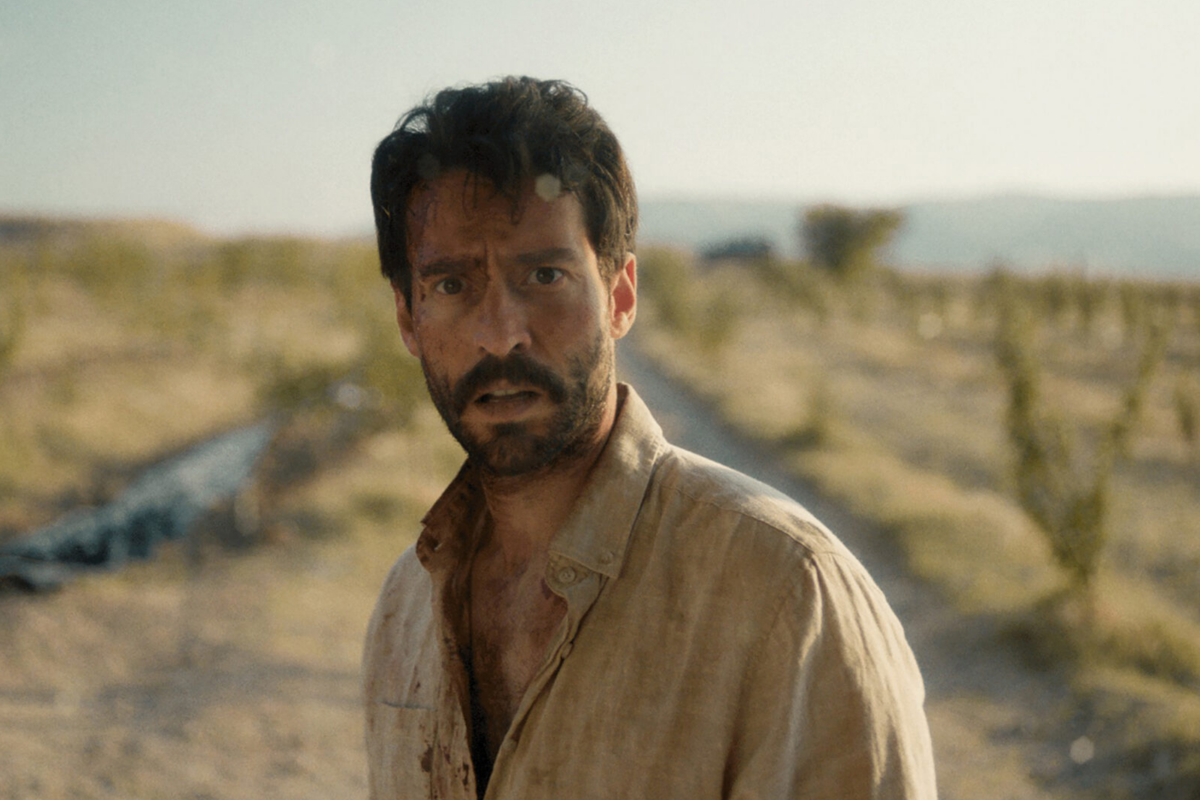








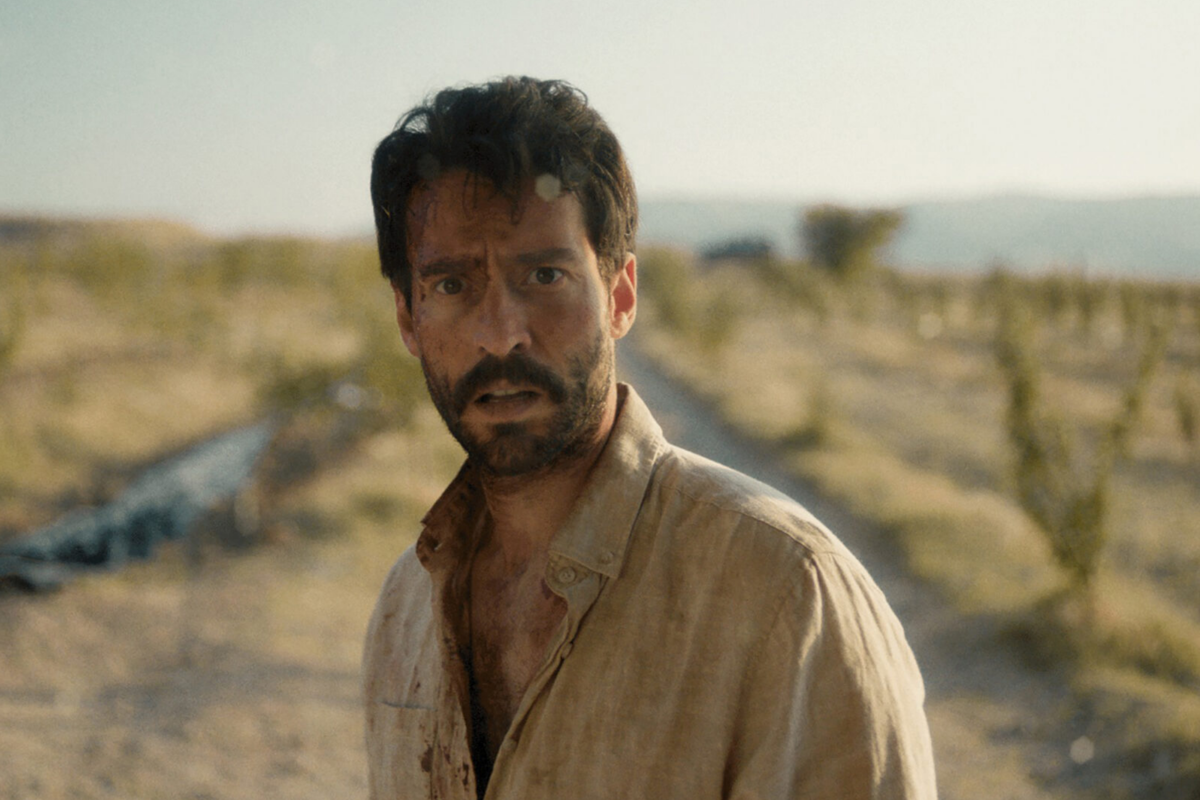



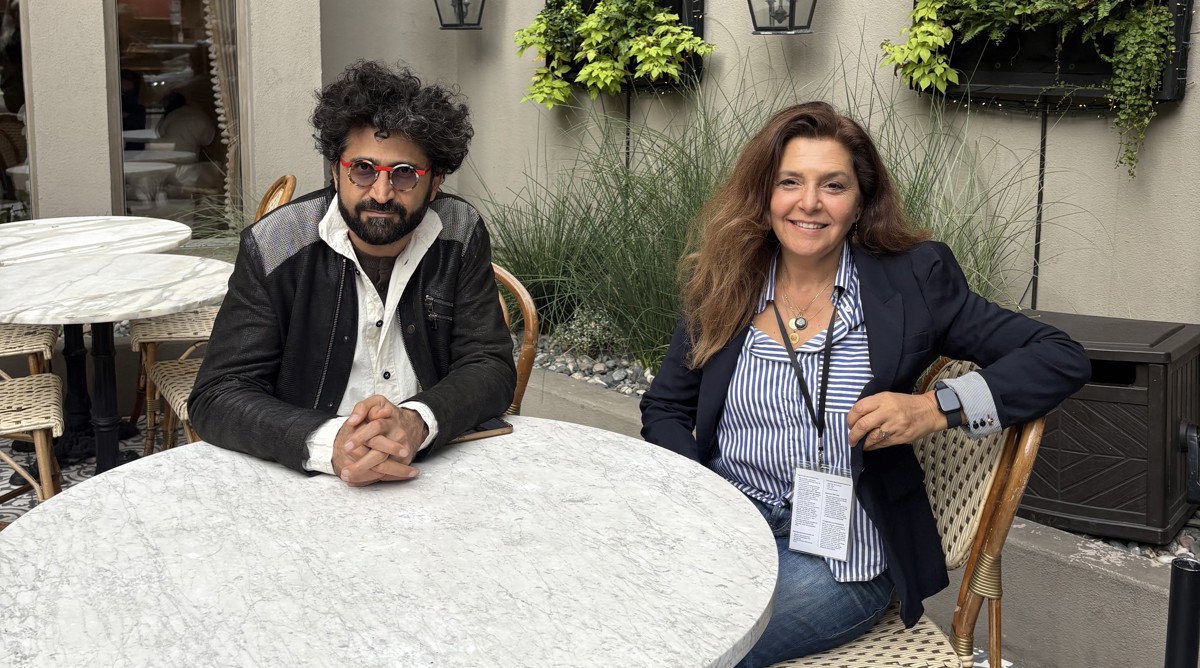
I met Alireza Khatami on a sunny day in Vancouver. He was at VIFF 2025 for the screening of his most recent film, The Things You Kill, a heartfelt psychological thriller full of surrealism and symbolism inspired by personal family trauma, which premiered at the 2025 Sundance Film Festival, winning the World Cinema Dramatic Directing Award. It has also been selected as Canada’s submission for Best International Feature at the 98th Academy Awards.
The Iranian Canadian filmmaker is known for his feature debut Oblivion Verses (2017) that won multiple awards at the Venice Film Festival. He later co-directed Terrestrial Verses (2023), a satirical depiction of life under Iranian authoritarianism, which premiered at Cannes.
You have done many interviews, and there are many reviews of your film The Things You Kill. I’ll try to ask questions that haven’t been asked before. What I noticed most in your film were the portraits of Atatürk and the gigantic Turkish flags. Was that perhaps to highlight the symbolism of fatherhood in the film’s underlying theme? We’re used to seeing portraits of Atatürk in public offices, of course, but it was quite noticeable in your film. Was that intentional and exaggerated on purpose?
We didn’t exaggerate anything. Those gigantic flags were already there—we didn’t add them, but we didn’t remove them either because they worked. Atatürk literally means “The Father of the Turks,” and the film operates on two levels. We often discuss politics without considering its psychological consequences, and psychology without seeing its political roots. For me, it’s a political reading of psychology and a psychological reading of politics. The idea of “father” exists on multiple layers, and I was very conscious of that symbolism.
The film carries strong themes of masculinity and fatherhood. Ercan Kesal plays a cruel father, abused by his own father. But the two sisters seem more submissive. Why don’t they react to his violence and infidelity?
They do react, though not in obvious ways. The older sister, Meriam, tells Ali that it’s easy to criticize from a distance, but the real challenge is to live with the family. What can you do—kill the father? He’s still your father, even if he’s an awful one. Women in patriarchal societies often participate in the system while also bearing its consequences. The younger sister, Nesrin, is actually, the one who sets the story in motion. The sisters try to bring change gradually, step by step. The women reject violence; they respond with compassion, which is much harder. Ali—and Reza—see violence as the only option, but eventually realize how that, too, collapses.
Iran has more censorship than Turkey, and you chose to make this film there. But you’re also Canadian. Why not write the film in a Canadian context? The theme is universal enough.
The narrative wouldn’t work in Canada. It’s a much more individualistic society; family doesn’t carry the same weight as it does in our region. The story would fall flat if translated into a Canadian context. I needed a setting whose nuances I could truly understand. My father is half Turkish, from southern Iran, so I know some Turkish and understand the culture. I could honor the story much better in Turkey than I ever could in Canada.
Do you know enough Turkish to have worked with the actors and the crew on set?
Enough to know when I’m making mistakes. I can’t conjugate verbs perfectly, but I understand the feeling behind the words—and that’s what matters to me.
How did you come up with such an outstanding and renowned cast?
All credit goes to Ekin, Erkan, Hazar, and Ercan for their generosity in joining us. We had a small budget, but the cast gave everything out of great love for the film. They connected deeply with the script and wanted to greatly support independent arthouse cinema.
The protagonist, a university instructor who teaches translation, leaves the country, and later returns—feels caught between two cultures. Was that inspired by your own experience as a teacher? Yesterday, you mentioned the film was almost autobiographical.
I call it autofiction. I play with versions of myself.
Michael Ondaatje calls that a “fake memoir.”
Exactly. Autofiction means fictionalizing a version of yourself that fits on screen. I can’t include my entire life and every voice in it. I have to cut things out and invent others to create a truthful reality.
You once said, “What Persians do best is poetry.” Do you still believe that?
A: Absolutely. We have a strong poetic tradition, and about a century ago, we went through a major transformation influenced by translation—especially from French poetry. The old ghazal form relied on strict rhyme, but poets began focusing on internal rhythm instead. That was the birth of the New Wave in Persian poetry, led by figures like Forough Farrokhzad, who is admired even in Turkey. That movement continues today. Poetry remains powerful in Iran.
Does Persian poetry get enough recognition worldwide?
Not really. The classics do, of course, but contemporary poetry doesn’t. That’s rooted in orientalism—people in the West don’t see us as thinkers, only as subjects of the Orient who “lament human rights abuses.” Political and intellectual depth is rarely granted to us.
In the film, the dean questions why the protagonist studies English literature instead of local writers like Rumi or Yunus Emre. Turkey’s education system has long reflected Westernization, though there’s now a return to classical Turkish, Persian, and Arabic texts—often framed as “glorious Ottomanism.” How do you view that trend?
Any attempt to use the past for political ends leads, in my view, to fascism. The past isn’t unproblematic. The only way forward is to acknowledge the roots of our identities—without feeling inferior to the West or superior to the rest of the world. We must look back, but move forward, like Walter Benjamin’s Angel of History. We shouldn’t try to reconstruct the past, only learn from it.
Let’s talk about Gaza. Have you read Omar El Akkad’s new book, One Day Everyone Will Have Always Been Against This?
I’ve heard of it. But I think it’s naive to expect that one day the Western bloc will collectively say, “We were wrong.”
El Akkad suggests the same.
The depth of racism in the West is immense—it’s foundational to their so-called “civilization.” They won’t suddenly feel genuine remorse. Rwanda, for example, was never discussed as a consequence of colonialism; it was framed simply as one tribe killing another. And just last week, Canada “recognized” Palestine—after more than 600,000 people had been slaughtered. That recognition means nothing. Symbolic gestures without action—no ambassadors dismissed, no embargoes, no real change—are meaningless. That’s the West today.
This brings me back to your film. The generational trauma reminds me of political cycles of violence, like the Palestinian struggle.
Yes, we’re talking about an intergenerational cycle of violence. The grandfather beats his son, the son becomes violent too, and now we reach the story of the grandson. Someone has to break this cycle—and that’s what The Things You Kill is about. Understanding where pain comes from doesn’t make it hurt less, but it’s the necessary condition for breaking free from violence.
You spent several months in Turkey. What’s your take on how some Turkish people—and perhaps Persians too—express a kind of internalized racism toward others in the region, sometimes even more than toward Westerners?
There’s both an inferiority and a superiority complex in our region. It all comes down to the inability to see the “other” as fully human. And that’s not unique to Turkey or the Middle East—racism exists everywhere.
Do you think seeing someone from the East as “inferior” is rooted in colonialism or Westernization?
Definitely. For a long time, the ultimate “father” figure in our region was the colonial power—the West, pulling all the strings. That’s how I see it.
How do we change that rhetoric?
Gradually, and through compassion. By recognizing one another in our full humanity—with all our mistakes, pain, and complexity.
But what if there’s no rule of law?
There’s no simple recipe. It won’t happen by electing one leader or another. Change begins with one step. I love the story of Bayazid Bastami, a Persian mystic. When people gathered to hear him speak, another man stood up first and said, “Everyone, take one step closer.” Bastami then said, “Whatever was worth saying, he already said it,” and left. That’s how I see it—one step closer, that’s all. I don’t expect overnight change. But one thing is certain in our region: we’ve been burned to ashes many times, and we’ve always risen again.
This is a very good place to end. Thank you. (NS/VK)