










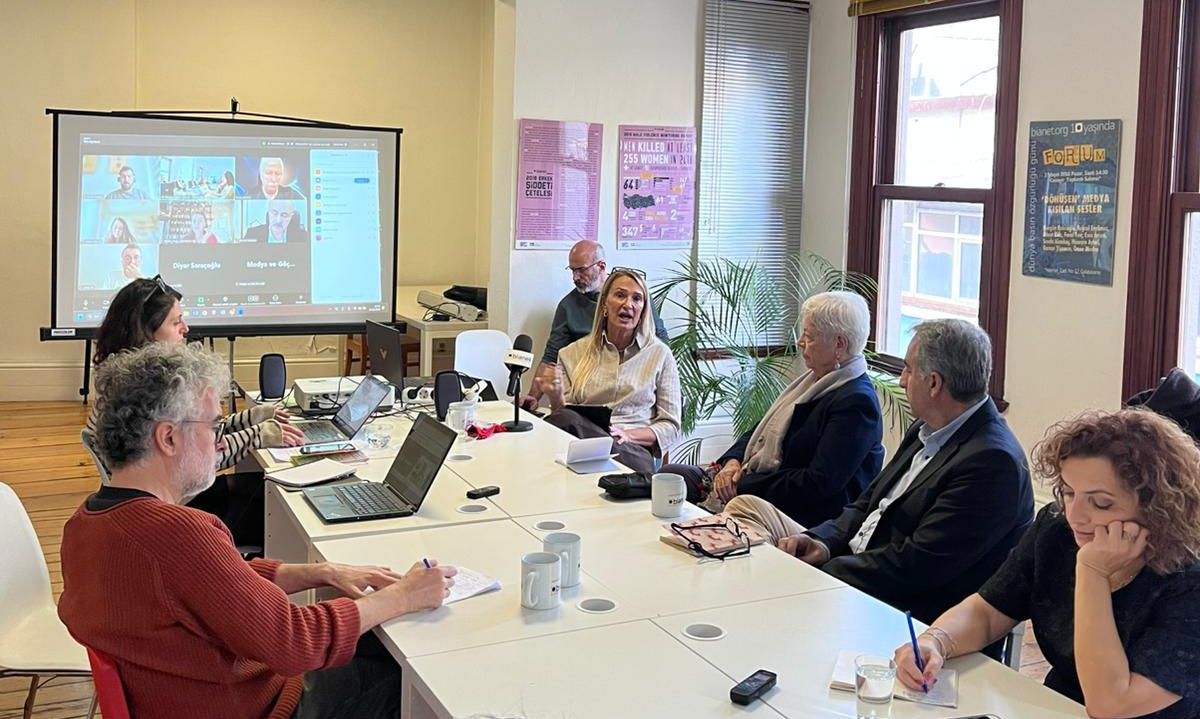
The year-end meeting of the Media Literacy Coalition, formed as part of the EU-supported Our Media project in which IPS Communication Foundation / bianet is a stakeholder, was held on Dec 15 at Atölye BİA.
During the event, which brought together academics, journalists, and representatives from rights organizations, participants emphasized that digitalization is not merely a matter of "technical training," but an area directly related to public interest, democratic stability, and social cohesion. The meeting also featured a discussion on the role of the Digital Media Literacy Guide, published in October as part of the same project.
English edition of Digital Media Literacy Guidebook is out
At the beginning of the meeting, Dr. Sinem Aydınlı, the project’s researcher and IPS Communication Foundation’s Research Coordinator, summarized the reports and studies produced within the scope of Our Media. The event continued with an opening speech by the coalition’s advisor, Prof. Dr. Yasemin Giritli İnceoğlu, who emphasized the coalition's commitment to work in the field of “critical digital media literacy.”
Giritli İnceoğlu stressed that digital media literacy should not be treated as a narrow topic, highlighting the importance of addressing it as a societal issue.
'Digital Media Literacy' series is beginning
One of the key themes of the event was that an abundance of information does not solve the problem of “reliable information.” Giritli İnceoğlu stated that the core issue is not access to information, but access to accurate and trustworthy information. She noted that standards of accuracy are shaped by visibility algorithms, power relations, and the dynamics of viral circulation.
The meeting emphasized that although the digital space appears “public” on the surface, in practice it relies on an infrastructure governed by commercial algorithms. Visibility and interaction are not regulated with the public interest in mind. Therefore, digital media literacy cannot be reduced to content analysis alone—platform economies and data policies must also be central to the discussion.
The structural dimension of digital violence and the invisibility of inequality
Another important theme was the “economy of emotion.” Giritli İnceoğlu explained that what is managed in the digital environment is not content but emotion. The micro-level calculation of emotions like anger, fear, curiosity, and anxiety undermines decision-making processes and deepens polarization.
The event highlighted that practices such as digital violence against women, targeted harassment campaigns, and hate speech are not exceptions but structural components of the digital space. Digital platforms reproduce social inequalities in ways that are “invisible but effective,” and therefore, digital media literacy cannot provide a healthy framework without a rights-based approach.

How media literate are you?
Guide’s aim: Transforming literacy into a rights-based policy
Giritli İnceoğlu stated that the most critical contribution of the guide is its effort to transform digital media literacy from an educational content into a tool for rights-based policy. This approach moves forward by addressing questions such as: “What are our digital rights?”, “Under what conditions are they violated?”, and “Do users know how to demand these rights?”
The guide addresses democratic principles such as privacy and data security, protection from digital violence, creating an online environment free from hate speech, access to transparent algorithms, and safeguarding freedom of expression, all under the umbrella of “digital rights.” In this regard, the guide is presented as a roadmap for democratization in the digital age.
Emphasis on a ‘multi-stakeholder structure’
The event emphasized that solutions cannot be limited to the capacity of a single institution. It was stated that collaboration among civil society, media, teacher communities, and independent experts is critical. Within the scope of Öğretmen Ağı, it was noted that guides for critical digital literacy practices in classrooms, as well as sessions where fact-checking methods and examples of hate speech can be discussed safely, could make a “significant contribution.”
Kaos GL’s experience in hate speech analysis and rights-based education was said to offer an “ethical framework that recognizes intersectionality” to digital literacy efforts. Similarly, the Hrant Dink Foundation’s training programs focused on combating hate speech were noted as offering a valuable path for development in this area.
Necdet İpekyüz, a Radio and Television Supreme Council (RTÜK) member appointed by the Peoples' Equality and Democracy (DEM) Party, highlighted the constantly evolving nature of digital media. He emphasized the need for an academic structure that is adaptable, interdisciplinary, and actively involved in decision-making processes. According to İpekyüz, participation should not be limited to being invited—it must also include taking responsibility.
'Our Media' partners announce media literacy education program
‘The guide should reach broader audiences’
Prof. Dr. Nazan Haydari stated that instead of approaching digital media literacy in isolation, it should be considered through sub-concepts such as critical literacy, advocacy, and accessibility. She emphasized that learning processes that are multi-stakeholder, continuous, and blend digital with face-to-face interaction create a genuine space for empowerment.
Media Ombudsman Faruk Bildirici, one of the participants, said that the questions underlying the guide provide a strong method. He suggested that creating a shorter version based on these questions and distributing it to a broad audience—from journalists to academics—could be effective.
At the end of the meeting, participants emphasized the need for an inclusive coordination/advisory mechanism composed of universities, media organizations, civil society, and teacher communities. This mechanism would serve to regularly update the guide and monitor emerging risks in the field.
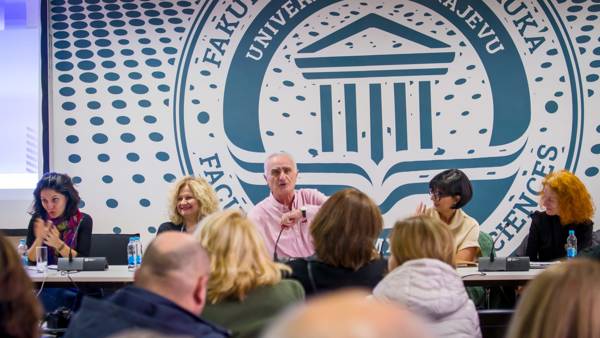
‘Our Media’ conference: Freedom of expression in times of crisis
Student experience
Assoc. Prof. Dr. Tirşe Erbaysal Filibeli stressed the importance of participation by saying, “Young people only learn when they are involved. Seeing firsthand how disinformation circulates on platforms is the most effective way to understand media literacy.”
Legal dimension
Lawyer Nihan Güneli emphasized that the production and circulation of information in digital spaces now have legal consequences. “Combating disinformation is not only an ethical or technical issue—it is also clearly a legal responsibility.” She underlined that being critically engaged with content is essential, but so is being aware of the legal framework.
‘Deepfake’ and keeping skepticism alive
Speakers noted that AI-generated images and deepfake content are damaging the relationship with reality, placing journalism institutions and the foundations of democratic debate under direct pressure. It was emphasized that within this landscape, the question “what is real?” has become one of the key issues of daily digital life.
Koray Kaplıca from Doğruluk Payı stated that with the increasing presence of “AI-generated and highly professional” content, it has become harder to detect fake examples that were once easier to recognize. Therefore, he argued, digital media literacy should not focus solely on “tool usage,” but rather on maintaining a mindset of skepticism before sharing content.
Yıldız Tar, editor-in-chief of Kaos GL, stressed the need for the guide and training materials to create a form of language that can also be effective during field campaigns and legal debates. She emphasized that when a simpler, easily understandable counter-narrative is built against misinformation, “accurate information can circulate more widely.”
Beyond ‘bad examples’: the idea of a safe line for victims
Prof. Dr. Aslı Tunç stated that the guide should not be a static document left on the table, but a living, evolving structure that engages with society. In this context, she proposed three core objectives: education, societal engagement, and victim protection.
Tunç also highlighted the importance of creating a “hotline/safe microcosm” that vulnerable groups (e.g., LGBTI+) can access quickly, with legal experts involved. She argued that in toxic digital environments, energy should be directed not at “fighting with filth,” but at building lasting and protective mechanisms.
Protecting children's digital rights
Prof. Dr. Esra Ercan Bilgiç, speaking from a child and youth perspective, referred to ongoing debates in Australia about restricting social media use for those under 16. She noted that similar discussions are taking place in Turkey regarding users under 15. However, she explained that her stance favors not bans, but measures that enhance children’s “resilience” and regulations that place more responsibility on tech companies.
Drawing from her experience with a child movement initiative linked to the Turkish Grand National Assembly (TBMM), Bilgiç stated that within the context of digital media literacy, priority should be given to passing a law that protects children’s data. She added that this initiative could serve as a point of contact for multi-stakeholder cooperation.
Prof. Dr. Kenan Çayır pointed out that while digital literacy is included in the curriculum, the approach often remains at a “protective/technical” level. He emphasized the need to develop good examples and brief guiding frameworks that can help reflect a more critical perspective in textbooks.
Sharing the experience of the “Öğretmen Ağı,” Melike Avcu explained that the renewed three-module program for teachers includes a third module designed as “critical digital literacy.” She noted that articles published on bianet serve as valuable resources for educators within this framework.
Combating hate speech
In the closing session, Buket Kapısız from the Hrant Dink Foundation presented the outcome of a project focusing on combating hate speech with AI tools. She introduced a tool (named PARİ) capable of detecting hate speech in both Turkish and Arabic texts. Due to its margin of error, she said they are proceeding cautiously about “making it publicly available,” and instead plan to move forward through collaborations with universities and critical review.
Journalism and digital rights: the need for ‘360-degree advocacy’
Erol Önderoğlu, RSF Turkey Representative and rapporteur of the bia Media Monitoring Reports, warned that the assumption that journalists are “more protected than ordinary citizens” in the digital age is misleading. He noted that today, journalism faces increasing pressure both in terms of regulation and digital rights. In this context, he underlined the importance of an international approach of “360-degree advocacy,” which encompasses a broad rights defense strategy that takes into account the threats posed by the digital era.
(VK/SA)

The regional program “Our Media: A civil society action to generate media literacy and activism, counter polarisation and promote dialogue” is implemented with the financial support of the European Union by partner organizations SEENPM, Albanian Media Institute, Mediacentar Sarajevo, Press Council of Kosovo, Montenegrin Media Institute, Macedonian Institute for Media, Novi Sad School of Journalism, Peace Institute and bianet.
This article was produced with the financial support of the European Union. Its contents are the sole responsibility bianet and do not necessarily reflect the views of the European Union.

