









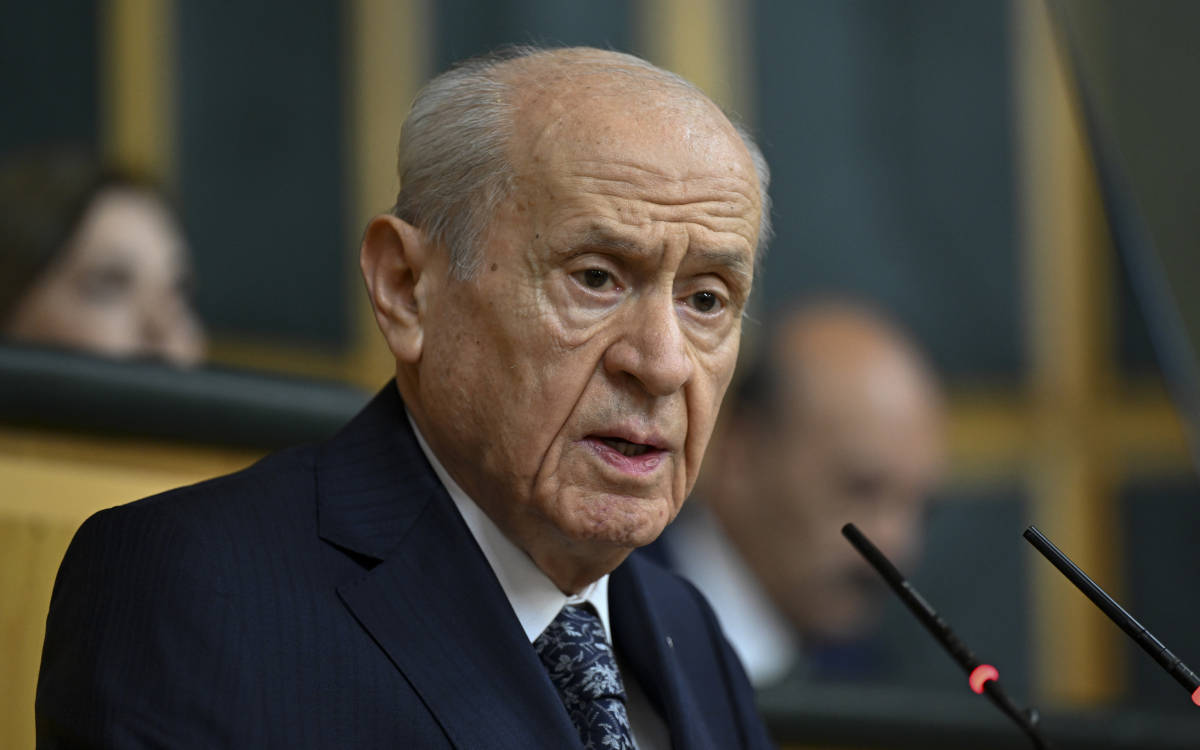



Nationalist Movement Party (MHP) leader Devlet Bahçeli has confirmed reports that he proposed appointing a Kurdish and an Alevi vice president for President Recep Tayyip Erdoğan. However, he strongly criticized the journalist who first published the claim.
İsmail Saymaz, a columnist for the pro-opposition outlet Halk TV's news site, reported last week that Bahçeli had made the proposal during a closed-door party meeting.
In a written statement released late yesterday, Bahçeli acknowledged the proposal but took aim at Saymaz, describing him, without mentioning his name, as someone “who has made a name for himself in gossip."
He added the leak’s timing was “noteworthy," apparently referring to the ongoing Kurdish peace process.
Referring to the alliance between the MHP and Erdoğan’s Justice and Development Party (AKP), Bahçeli said, “The Nationalist Movement Party and the People’s Alliance will not allow Turkey to fall victim to ethnic and sectarian upheaval.”
He also confirmed that the proposal was discussed at a meeting held on Jul 18. “In a period where the ‘Terror-Free Turkey’ initiative is progressing step by step, it was evaluated that one of the two vice presidents could be an Alevi and the other a Kurd,” Bahçeli said, referencing the government bloc’s branding of the Kurdish peace process.
Bahçeli, in an unexpected move, initiated the current peace process in October, suggesting that PKK leader Abdullah Öcalan could be granted a release from prison if he called on the group to dissolve itself.
Öcalan made this call in late February and the PKK on Jul 11 organized a symbolic disarmament ceremony to mark the end of the 40-year armed struggle.
Lebanon comparisons
Meanwhile, the MHP leader sharply rejected comparisons between his proposal and Lebanon’s confessional political system.
“To associate this political proposal with Lebanon is a deliberate distortion and manipulation of a sincere idea,” he said.
“No one has the power, courage, or capacity to turn Turkey into a country with the chaotic and unstable structure of Lebanon or similar nations.
“The attempt to slander and demonize a proposal grounded in history and culture, by bohemian and distressed political failures yearning for Beirut nights, is a pitiful opportunism." (HA/VK)

