









THOUSANDS RALLY AGAINST ANTI-ABORTION LAW IN TURKEY
"My Body, My Decision"

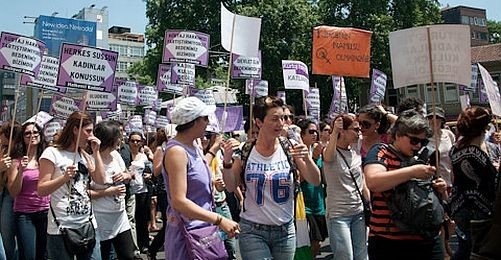



Last week, Turkish Prime Minister Recep Tayyip Erdoğan likened abortion to murder and announced a new initiative by his conservative Islamic-inspired government to change restrictions on abortions in Turkey. Legislators from Erdoğan's party then quickly proposed a law that would end abortions after 4 weeks of pregnancy, except for in an emergency. Since 1983, Turkish women were allowed 10 weeks of pregnancy to get an abortion.
The reaction to the announcements came swiftly. Yesterday in Istanbul, thousands rallied to protect abortion rights for women. As part of its coverage, the British Guardian newspaper posted this video:
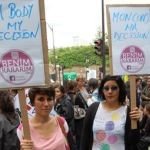
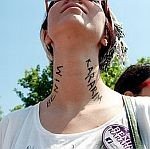
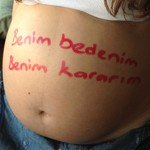
Earlier in the week, the website Bianet jumped into a campaign - called "Benim Kararım," or "my decision." The campaign called for women to assert their rights and for men to show solidarity by getting people to send in pictures of themselves either holding signs or writing on their bodies that women's abortion rights are none of the government's business using one of these slogans:
For women: "My Body, My Decision", "This Is My Issue"
For men: "Woman's Body, Woman's Decision", "My Wife's Body, My Wife's Decision", "My Daughter's Body, My Daughter's Decision", "My Girlfriend's Body, My Girlfriend's Decision", "This is Women's Issue", "My Sister's Decision", "My Mother's Decision"
Responses have been overwhelming. Çiçek Tahaoğlu, the women's news editor at Bianet, said that the total number of entries hadn't been tabulated, but at least one thousand had come in. Scores are now posted online in Bianet pages, at the website benimkararim.org.
Asked about the campaign's prospects of beating back the proposed law, Tahaoğlu told ThinkProgress by e-mail:
That's our hope to preserve our right to abortion and we believe that the campaign will succeed. But I should say that we don't only want to keep the laws as they stand, we want to make them better for us. We also want the government to stop doing politics over our bodies.
Many commentators do see political overtones. They think that, beset with instability and calls to action on Turkey's border with Syria and a broad war being waged against militant Turkish groups, Erdoğan seized upon the abortion issue as a distraction. Turkey-based writer Andrew Finkel, writing in the New York Times, noted the bizarre comparison Erdoğan made in his remarks between Cesarean section births, which also limit birthrates, and the errant military attack on smugglers in Uludere thought by the government to be separatists militants. Finkel noted:
Turkey liberalized abortion in 1983 in response to high rates of illegal terminations and maternal mortality. If more women start dying again because they are forced to seek illegal abortions, then Erdogan's odd analogy to the massacre at Uludere may turn out to be more apt than it should. (AG/H)

#direnhamile (#resistpregnant)

Can Doctors Refuse to Perform Abortion?
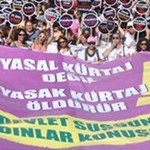
FRENCH WOMEN SUPPORT THEIR TURKISH COUNTERPARTS
“My Body, My Decision,” French Women Say
Turkish Society’s Views on Abortion since 1990

MEN MARCH AGAINST THE ABORTION BAN
“Use Contraceptives! Stop Lecturing Women”
UN POPULATION FUND ON ABORTION
What To Do Instead Of Banning Abortion

"Abortion not the Religious Affairs' Business"
WOMEN OF ISTANBUL HIT THE STREETS
"Abortion Is Our Decision"
Right to Abortion Campaign Launched
#direnhamile (#resistpregnant)
Can Doctors Refuse to Perform Abortion?
FRENCH WOMEN SUPPORT THEIR TURKISH COUNTERPARTS
“My Body, My Decision,” French Women Say
Turkish Society’s Views on Abortion since 1990
MEN MARCH AGAINST THE ABORTION BAN
“Use Contraceptives! Stop Lecturing Women”
UN POPULATION FUND ON ABORTION
What To Do Instead Of Banning Abortion
"Abortion not the Religious Affairs' Business"
WOMEN OF ISTANBUL HIT THE STREETS
"Abortion Is Our Decision"
Right to Abortion Campaign Launched