International Delegation Investigates Alleged Use of Chemical Weapons
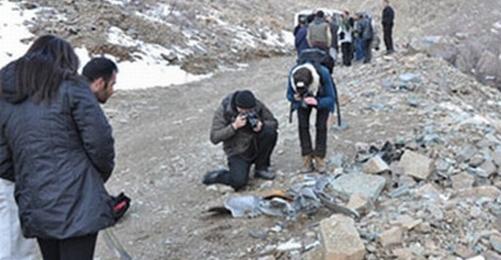



An international delegation from Europe visited the Kazan Valley in Çukurca (Hakkari) to investigate allegations regarding the use of chemical weapons by the Turkish Armed Forces (TSK).
On 19 October, 37 members of the militant Kurdistan Workers' Party (PKK) were killed in an aerial strike by the TSK in the valley in the Kurdish-majority south-east of the country. It was put forward after the clash that chemical weapons had been used.
The delegation was joined by Feleknas Uca, former member of the European Parliament; German parliamentarian Jan Van Aken and German and French lawyers Clementine Frances, Benjamin Hiller, Marie Avpert, Aledeuy Ledrein Aveco and Torre Dominulle. The delegation took samples from the bombed areas in the valley. They said that they were going to announce their result whether chemical weapons were used or not after having consulted a group of experts.
Findings will be published in report
The delegation was accompanied by Mehmet Kanar, Çurkurca Mayor and member of the pro-Kurdish Peace and Democracy Party (BDP). In the course of their investigation the members of the delegation found pieces of bombs and body parts.
Van Aken made a preliminary statement on behalf of the delegation. He said it could be seen that an intense attack happened in an area of 1 to 1.5 km.
Van Aken continued, "Burned and destroyed vehicles in the region show us that it was a large-scale bomb and how strong it was. We investigated pieces of the bombs we found on the ground. We can say for certain that 'MK-82' and MK-84' bombs were used. These bombs weigh between 250 and 950 kg and have a very large radius. Right now I am not able to say anything about the use of a chemical bomb or anything similar".
"We are going to share the samples we took and the observations we made with experts in this field. We will only be able to decide whether chemical were used or not after this investigation. We are going to publish our findings in a report".
The Turkish Medical Chamber (TTB) had applied to the Ministry of Justice and wanted a delegation established by the TTB to carry out a related investigation.
Human Right Association (İHD) Hakkari Branch President İsmail Akbulut said in a statement made to bianet in the beginning of this month: "The statements of both the relatives and eye-witness imply the use of chemical weapons. The bodies were completely burned. This allegation definitely has to be investigated". Akbulut said that samples were taken from the environment and the ground in order to determine whether chemical gas had been used.
The BDP previously called on the government to give a statement on the alleged use of chemical weapons after the bodies of the killed PKK members were reported to have been burned. (AS).