





FREEDOM OF EXPRESSION
Letter "Q" Constitutes Element of Crime




Sociologist İsmail Beşikçi and lawyer Zeycan Balcı Şimşek appeared before the Istanbul 11th High Criminal Court for the second time on Friday (12 November). Both defendants stand accused of "spreading propaganda for the PKK", the outlawed armed Kurdistan Workers Party.
Şimşek is the editorial manager of the "Contemporary Law and Society" magazine as the publication of the Contemporary Lawyers Association (ÇHD) Istanbul Branch.
Beşikçi wrote an article for the magazine entitled "The right of nations to self determination and the Kurds". In Friday's hearing, the prosecutor put forward that Beşikçi wrote the word "Qandil" with a "q" instead of "k". Qandil Mountain is the location of the PKK's base in Northern Iraq. Only the Kurdish alpabet includes the letter "q" whereas it does not exist in the Turkish alphabet. The prosecutor saw an "element of crime" in writing the word with a "q" in Turkish.
In his defence, Bekikçi stated that the government was taking steps towards the Kurdish initiative at the time he wrote the article. "The writing is not propaganda but contains legitimized scientific terms", he said.
Both un-detained defendants are each facing up to 7.5 years in jail. Editorial Manager Şimşek claimed in his defence, "The article we asked for from our teacher [Beşikçi] for our issue that happened to be published during the time of discussion of the Kurdish initiative is a sociological and scientific article".
"You should seize keyboards with the Q letter as well"
Defence lawyer Taylan Tanay commented the prosecutors approach, "Does he write New York with a "v"? ["W" is not part of the Turkish alphabet either.] So you should seize all keyboards with the letter "q". The word "Kurdish" is written with a small "k" in the prosecutor's final plea. I hope this is a revision mistake. You cannot disparage the Kurdish language by writing it with a small "k". Regardless of what the prosecutor wants or whether the honoured court will decide for punishment, this language has been spoken for a thousand years".
Joint attorney Levent Kanat indicated, "Even though a Kurdish television channel is broadcasting in Turkey, the letter "Q" is being assessed as an element of crime".
Both defendants were represented by more than 50 lawyers, among them also Fethiye Çetin, lawyer of the family of slain Turkish-Armenian journalist Hrant Dink and Kemal Aytaç, lawyer of the Armenian Agos newspaper of which Dink had been the founder and editor-in-chief. The hearing was monitored by Peace and Democracy Party Deputy Ufuk Uras, author and interpreter Muhsin Kızılkaya, writer Temel Demirer, director Çağan Demirel, the Freedom for Jouralists Platform, Ahmet Abakay, President of the Contemporary Journalists Association (ÇGD) and Press Institute Association Ferai Tınç. Upon the lawyers' request for additional time the case was postponed to 4 March.
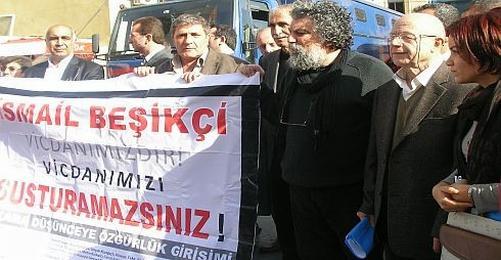
Members of the Ankara Initiative for Freedom of Thought posted a banner in front of the courthouse reading "İsmail Beşikçi is our conscience, we will not allow our conscience to be silenced".
The trial was opened on 11 May this year based on Beşikçi's words ""The Kurds pay the price for a 200-year struggle for freedom and for a free fatherland. [...] Syria, Iran and Turkey govern the Kurds with oppression and cruelty. [...] The resistance against this oppression and cruelty appears to be a legitimate right. [...]" (BT/EÖ/VK)


FREEDOM OF EXPRESSION
Sociologist Beşikçi and Lawyer Şimşek Convicted

FREEDOM OF EXPRESSION
Courtroom Cram-Full of Supporters for Tried Beşikçi and Şimşek
Sociologist Beşikçi and Lawyer Şimşek on Trial

"A Solution for the Kurdish Question must be a Solution for Turkey"
FREEDOM OF EXPRESSION
Sociologist Beşikçi and Lawyer Şimşek Convicted
FREEDOM OF EXPRESSION
Courtroom Cram-Full of Supporters for Tried Beşikçi and Şimşek
Sociologist Beşikçi and Lawyer Şimşek on Trial
"A Solution for the Kurdish Question must be a Solution for Turkey"
KURDISH QUESTION
"Bilingual Life" Project Fuels Interest in Kurdish Language
BİA NEWS CENTRE
Turkey Fails in Human Rights

PKK Should Apologize for Their Losses, Victims' Families Urge
President Gül's Diyarbakir Trip Arouses Vexed Reactions
DTK - KURDISH QUESTION
Parliament President Sceptic on Kurdish Proposal