KCK MAIN TRIAL
Evidence in Kurdish, Court in Turkish

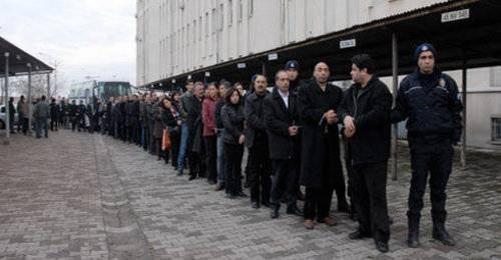



The Diyarbarkır trial on the Union of Kurdish Communities (KCK) was continued before the Diyarbakır 6th High Criminal Court on 6 December. A delegation from Italy observed the 28th hearing of the trial.
The KCK was established by Abdullah Öcalan, imprisoned leader of the armed outlawed Kurdistan Workers' Party (KCK).
The President of the Diyarbakır Bar Association, Mehmet Emin Aktar, spoke at the hearing and suggested a co-operation with the court in order to be able to handle and advance the trial.
In order to realize this, the court had to dismiss the request of transferring the case to a different province and should allow the defendants to appear at court in one group, Aktar explained. The lawyer also indicated that the defendants have been detained for 32 months now which was contrary to the purpose of arrest, he said.
The court board accepted Aktar's demand and decided to have the defendants participate at the hearings collectively. The court also rejected the transfer of the trial to a different province and postponed the trial to 12 December.
No defence in Kurdish
154 defendants, 104 of whom are detained, are being tried in the scope of the Diyarbakır KCK case. Mehmet Emin Aktar evaluated the trial for bianet and reported that the defendants were insisting on presenting their defence in Kurdish. However, the court did not recognize this right, Aktar said and implied that there had not been any change this issue.
Aktar quoted Court President Menderes Yılmaz as saying at the 28th hearing, "I did not call Kurdish an unknown language. I just said that I do not know the language. Just as I do not know Italian I do not know Kurdish either". In Aktar's opinion, the term "unknown language" used since the beginning of the trial was not picked intentionally. The lawyer told bianet that as far as he knew the court president was not against Kurdish or Kurds.
"Yet, the attitude of the court displayed until today was shaped by a countering reflex against the attitude of the defendants. The only way of easing procedures is a decision by court for the release of the defendants. We cannot talk about a goodwill attitude as long as this has not been done", Aktar added.
"Evidence cannot be presented before the interrogations"
Aktar said that procedures were jammed at the phase of presentation of evidence. The evidence could not be presented if the interrogation had not been done, he explained.
Up to now, the defendants have not been interrogated and did not present their defence Aktar said and highlighted a number of problems related to the evidence:
* The major part of the evidence in the case file is based on audio surveillance and findings from communications.
* Interception must be backed by a judge's decision. Moreover, the decision should clearly define the name of the person who is going to be intercepted, his phone number, the alleged offence, in the context of which criminal investigation the listening will be done, the duration of interception and which means are going to be used for the interception.
* The law also specifies that communications with first-degree relatives shall not be recorded.
* Furthermore, evidence related to conversations on the phone and eavesdropped in audio surveillance were almost entirely made in Kurdish. The police included these records in their Turkish translation into the case file without the Kurdish original. We do not know how appropriate these translations are and we think that the Kurdish records should be translated again by experts.
* Besides, the translator used ellipses in places that were incomprehensible. The meaning can be different if you do not provide the conversation as a whole.
* We forwarded our concerns to court. The court board said to re-evaluate the evidence upon these objections and to announce a decision afterwards. However, this again will lengthen the trial period. In our opinion, the court should do these procedures at the beginning and only after that the evidence should be presented in accordance with the law. (EKN/VK)


bianet gece editörü. bianet'te eş yayın yönetmenliği ve editörlük yaptı. 2006-2007'de Nokta dergisinde, 2008-2011'de Aktüel dergisinde muhabirlik yaptı. 2004'te Bilgi Üniversitesi Medya ve İletişim Sistemleri bölümünden, 2008'de Bilgi Üniversitesi Kültürel Çalışmalar yüksek lisans programından mezun oldu.


Journalist Ahmet Nesin to Apply for Renunciation of Citizenship
Conscientious Objector Işık Acquitted of ‘Alienating People from Military Service’
.jpg)
The Ones Massacred in Madımak 26 Years Ago Commemorated in Sivas
2019 LOCAL ELECTIONS
HDP MP Paylan: Not a Single Objection by HDP is Accepted Throughout Turkey
Q&A WITH PROF. AKARCA ON MARCH 31 ELECTIONS
'Contrary to Past Elections, Government Spreads Fear While Opposition Gives Hope'